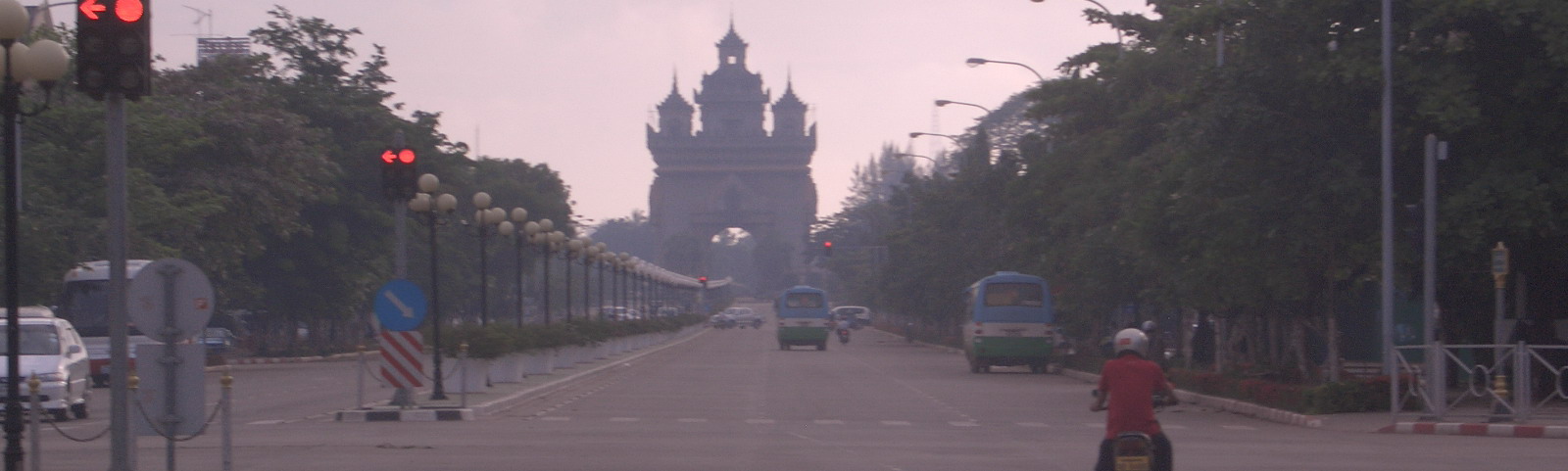
Patuxai is one of those places in Vientiane that feels instantly familiar yet entirely its own. Standing in the heart of the city, its arch rises above the surrounding square, a silhouette that blends the grandeur of Paris with the quiet elegance of Laos. There’s no overwhelming pomp here, no attempt to overshadow the city with monumentality. Instead, it feels like a quiet nod to history, a structure built more for remembrance than for spectacle.
Construction began in 1958, when Laos was still under French colonial rule. The idea was to honor those who had fought for the country’s independence, though the project dragged on for years. By the time it was completed in the mid-1960s, Laos had already broken free from colonial ties. What makes the story even more intriguing is the material used—concrete originally intended for an American airstrip during the Vietnam War. The Lao repurposed it, turning what was meant for war into a symbol of peace and national identity.
The architecture of Patuxai is a conversation between two worlds. From a distance, it resembles a European triumphal arch, with its columns and sculpted details. But look closer, and you’ll find traditional Lao motifs woven into the design—ornamental patterns, stylized lotus flowers, and figures that hint at the country’s cultural roots. At the top, four statues represent different facets of Lao life: Buddhism, agriculture, and the rhythms of rural existence. Inside, a small museum offers fragments of the monument’s history, but the real draw is the view from the top. Climbing the narrow stairs, you emerge onto a platform where Vientiane unfolds beneath you—a city of low-slung buildings, palm trees, and the distant curve of the Mekong.
Locals often call it the "Gate of Victory," though the name feels a little too grand for what Patuxai actually is. It’s not a monument to military triumph or political power. Instead, it’s a place of quiet reflection, where the past and present coexist without fanfare. The square around it is more park than plaza, with fountains that come alive in the evenings and shaded paths where families gather. On holidays, the area is strung with lights, and the arch becomes the backdrop for celebrations. But most days, it’s just a part of the city’s daily rhythm—students stopping for photos, children playing near the water, and elders chatting on benches.
For many in Vientiane, Patuxai isn’t just a tourist stop; it’s woven into the fabric of everyday life. It’s where couples take wedding photos, where friends meet before heading to a café, where the heat of the afternoon is softened by the shade beneath its arches. In the evenings, the lights cast a warm glow over the square, and the air fills with the hum of motorbikes and laughter. There’s no pressure here, no need to perform or pose. It’s simply a place to be, to pause in the middle of the day’s routines.
The climb to the top isn’t the most graceful experience. The stairs are steep and narrow, more functional than grand, and by the time you reach the platform, you might be out of breath. But the view makes it worth the effort. From above, Vientiane reveals itself as a city that moves at its own pace—no skyscrapers, no frantic energy, just a sprawl of rooftops and greenery stretching toward the river. It’s a reminder that Laos doesn’t rush, that even its monuments are built for contemplation rather than spectacle.
What makes Patuxai special is how unassuming it is. Laos has spent decades closed off from the world, and even now, as it opens up, it does so on its own terms. There are no crowds here like in Bangkok or Hanoi, no vendors hawking souvenirs at every turn. The square rarely feels overrun, even on busy days. The Lao haven’t turned Patuxai into a commercial attraction; it remains a place for locals first, a spot where the city’s life unfolds naturally.
There’s something almost endearing about how Patuxai doesn’t quite fit. It’s too grand for Vientiane’s modest scale, yet too simple for its symbolic weight. But maybe that’s the point. Like Laos itself—a country shaped by war, colonialism, and isolation—it’s not perfect. It doesn’t try to be. The arch stands as it is, a testament to resilience without pretension. It doesn’t claim to represent the greatness of Laos; it just exists, a quiet marker of a nation’s past and the small, everyday moments that define its present.