Zadar’s waterfront holds a place where the Adriatic meets the sky. Here, ancient stones and modern life coexist without friction. Among them stands an installation that feels like a bridge between eras—one dedicated to the sun, the sea, and the quiet curiosity humans have always felt toward the natural world.
The Greeting to the Sun is a monument to light. It marks the passage of days and nights, reminding anyone who stops to look how fleeting and vivid existence can be.
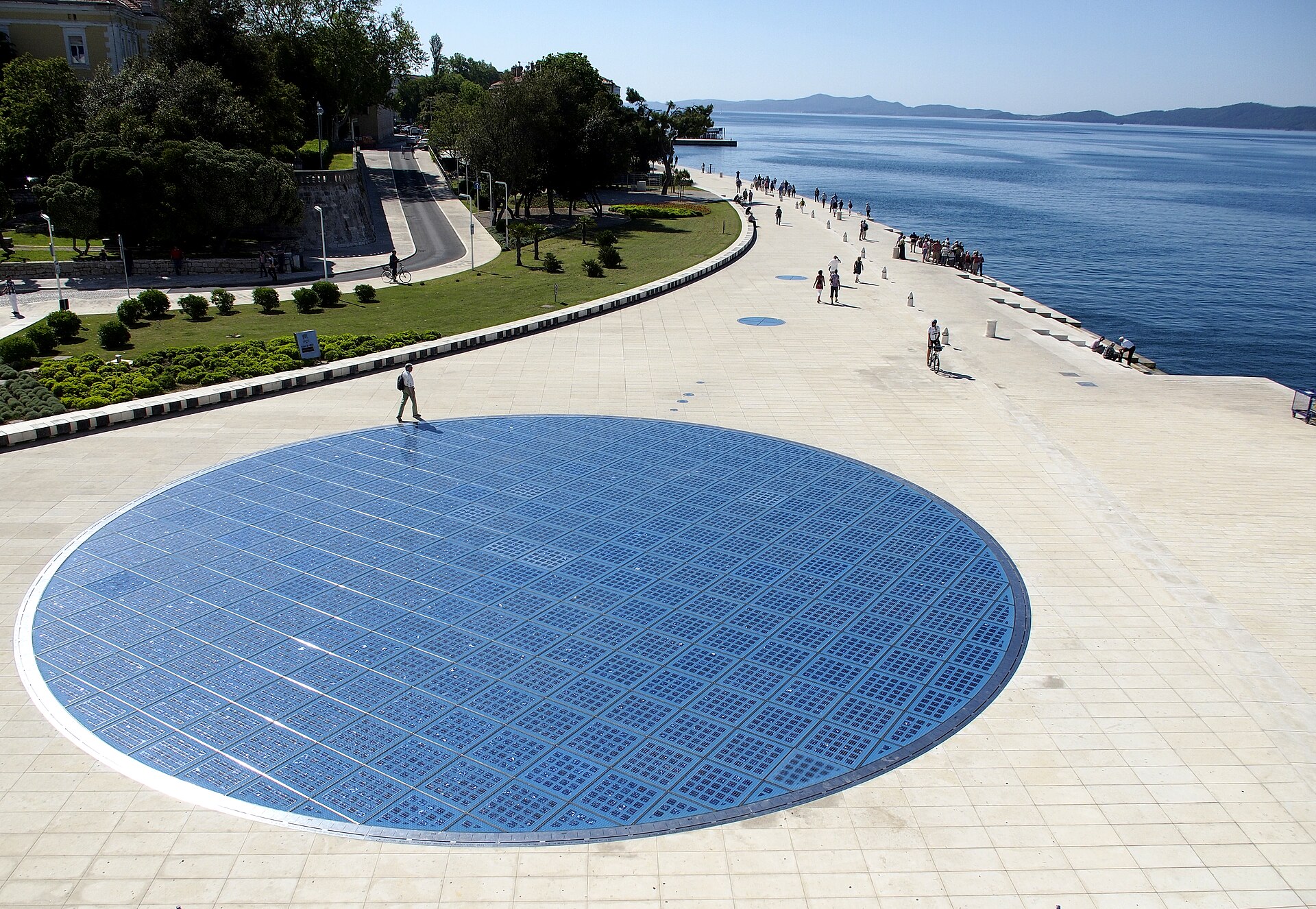
Architect Nikola Bašić designed it as part of a project to revive Zadar’s waterfront after years of neglect. The installation opened in 2008, alongside two other works meant to restore the city’s connection to the sea. Yet the Greeting to the Sun became the most cherished. Maybe because it doesn’t demand attention—it earns it. A flat circle of glass and steel, it reveals its depth only to those who linger.
The installation spans twenty-two meters. Three hundred glass panels cover its surface. Below them, photovoltaic cells soak up sunlight, storing energy that later spills back as gentle, shifting light. The colors aren’t random. They echo the sea and sky—blues deepening into violets, golds fading into ambers. Smaller circles radiate outward, each representing a planet in our solar system. Their sizes and distances follow real proportions. It’s a quiet map of the cosmos, a way of seeing our place in it.
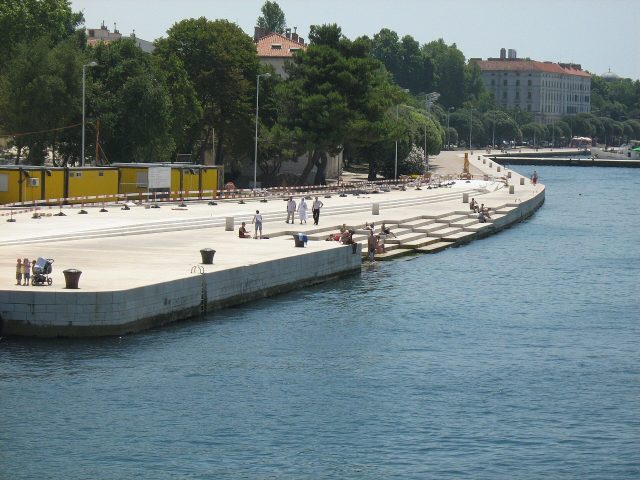
The Greeting to the Sun sits steps away from the Sea Organ. Together, they turn the waterfront into a conversation between art and nature. The Sea Organ translates waves into music. The Greeting to the Sun turns sunlight into light. Both use language most of us ignore in daily life. Here, the city asks you to pay attention—to listen, to watch, to feel part of something beyond yourself.
Evenings draw people. They arrive as the light begins to pulse, watching reflections play on the water. The colors shift from warm amber to cool indigo. No one explains what it means. The experience is enough. Some find hope in it. Others see connections between everything around them. For many, it’s just the beauty of the moment that stays.
The installation does more than glow. The energy it collects powers the waterfront’s lights. Art becomes utility. It’s rare for a public work to serve a purpose beyond decoration. That might be why locals return to it often—it’s not separate from life but part of it.
The waterfront invites exploration. Walk along the sea as the sun sets. The old Venetian walls stand nearby, their stones worn smooth by centuries. Modern cafés and shops line the promenade. The air carries salt and the scent of grilled fish. Waves mix with laughter and conversation. Time slows here, as if the city itself is asking you to stay awhile.
You can’t understand the Greeting to the Sun from a distance. Visit in daylight, when the glass panels catch the sun. Return at dusk to see the light wake up. It’s the kind of place that lingers because it speaks to something basic—our need to create, to wonder, to find beauty in everyday things.
Zadar’s history runs deep. Every stone has a story. But the Greeting to the Sun tells a different one. It’s about the future. About living with nature, not just taking from it. About art that is both beautiful and useful. Most of all, it’s a reminder to stop sometimes and watch the light change.