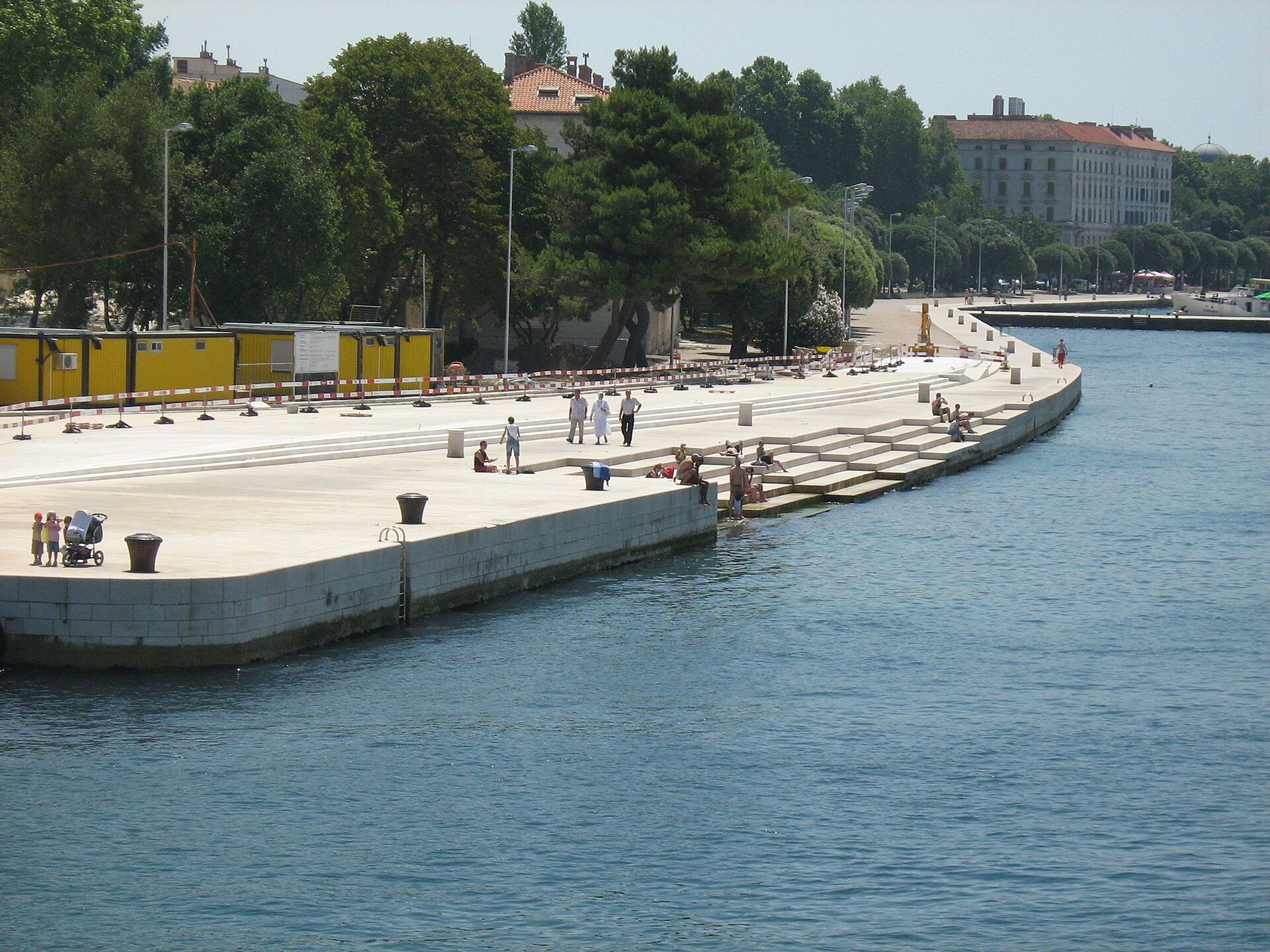
Zadar’s Sea Organ is one of those places that doesn’t reveal itself at first glance but lingers in your memory long after you’ve left. Stretching along the city’s waterfront, it looks like nothing more than a series of wide stone steps descending into the Adriatic. Yet when you sit down on one of those steps, something unexpected happens. The waves rolling in press air through hidden pipes beneath the stone, filling the air with sounds—sometimes deep and resonant, other times high and almost melodic. It isn’t music in the traditional sense, but rather the sea improvising, its voice shifting with the wind, the tide, and the time of day.
The idea for the Sea Organ emerged after Zadar’s waterfront was rebuilt in 2005, part of a larger effort to heal the city’s scars from the war years. Architect Nikola Bašić didn’t just want to restore the promenade; he wanted to create a space where people could pause, listen to the sea, and feel connected to something beyond the everyday. At first, many were skeptical. How could stone and waves produce anything meaningful? But when the first sounds drifted across the water, doubts faded. What was once an empty stretch of coastline became a place where the city and the sea could meet.
The design is deceptively simple. Beneath the granite steps lie thirty-five polyethylene pipes, arranged at different angles and depths. Each pipe connects to a resonator that amplifies the sound as water surges through them, pushed by the waves. The result is something between an organ and the natural rhythm of the sea—sometimes grand, sometimes barely audible. The sound is never the same twice, making each visit unique. Some days, it feels like the sea is breathing; other days, it’s as if it’s singing.
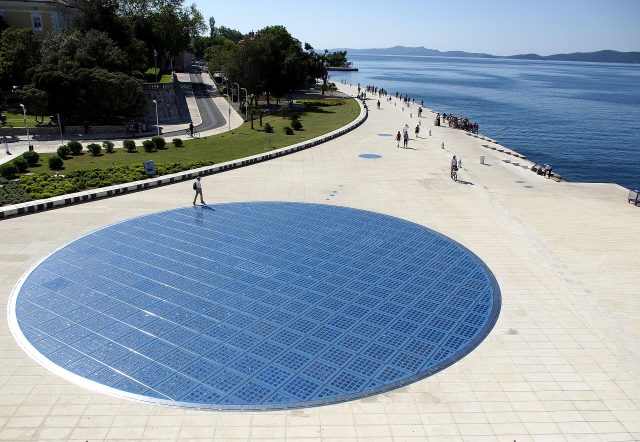
The waterfront where the Sea Organ sits is worth exploring in its own right. Unlike many coastal cities, Zadar’s promenade has no barriers—no docks, no markets, no walls separating the city from the water. You can walk along the shore, watching the islands of Ugljan and Pašman in the distance, or simply sit on a bench as the sun sets. Locals often say that Zadar has one of the most beautiful sunsets on the Adriatic, and the Sea Organ seems to exist just to underscore that beauty. In the evening, as the sky turns gold and pink, the sounds of the organ grow richer, as if the city and the sea are having a conversation without words.
This isn’t just a tourist attraction; it’s a quiet reminder of how art, architecture, and nature can coexist without one overpowering the other. There’s no ticket to buy, no guided tour to follow, no need to understand how it works. You just arrive, sit down, and listen. Maybe that’s why it draws not only visitors but locals as well—students with books, elderly couples in quiet conversation, young lovers holding hands by the water. It doesn’t demand attention; it simply offers a moment of stillness.
When the Sea Organ first opened, many in Zadar were unsure what to make of it. Some saw it as an odd experiment, a whim of modern architecture. But over time, the sounds became part of the city’s rhythm, as familiar as the cry of gulls or the lapping of waves. Now, it’s hard to imagine Zadar without it. The organ doesn’t compete with the sea; it hums alongside it, a subtle presence that enhances rather than distracts.
From an architectural standpoint, the Sea Organ is a masterclass in working with a space without dominating it. Bašić didn’t build a grand monument that would overshadow the surroundings. Instead, he created something almost invisible at first glance, something that reveals itself only when you take the time to notice. The granite steps flow seamlessly into the waterfront, their gray-blue hue blending with the sea and sky. Even the material was chosen to harmonize with the landscape—on sunny days, the stone almost seems to glow.
The Sea Organ is the kind of place that can’t be fully described in words. You have to experience it—to hear the sounds, to feel the weight of the moment. There’s no schedule, no script, no rules. You can come at dawn, when the promenade is empty and the sea is just waking up. You can come in the middle of the day, when the waterfront is crowded, and still find a quiet corner where the organ’s music stands out. Or you can come at night, when the city lights reflect on the water, and it feels like the sea is playing just for you. That’s the real magic of this place—it doesn’t ask for anything. It just gives you the chance to stop and listen.