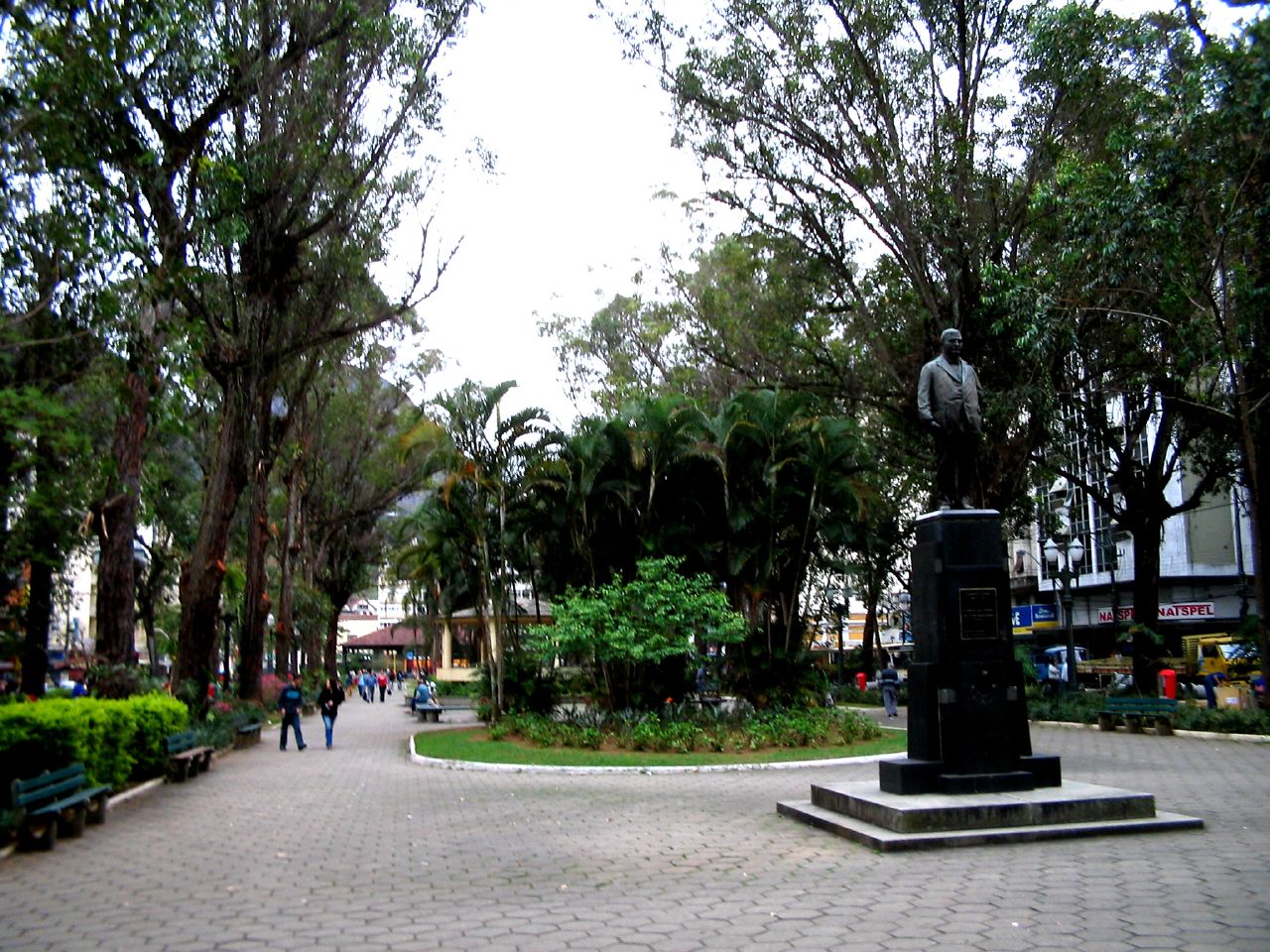
Praça Getúlio Vargas sits at the quiet heart of Conselheiro Lafaiete, a place where the town’s past and present flow together without fuss. Named after one of Brazil’s most consequential leaders, the square carries the weight of history lightly, its worn cobblestones and shaded benches offering a stage for everyday life rather than grand monuments. Here, the rhythm of a small Brazilian city unfolds at its own pace—unhurried, but never still.
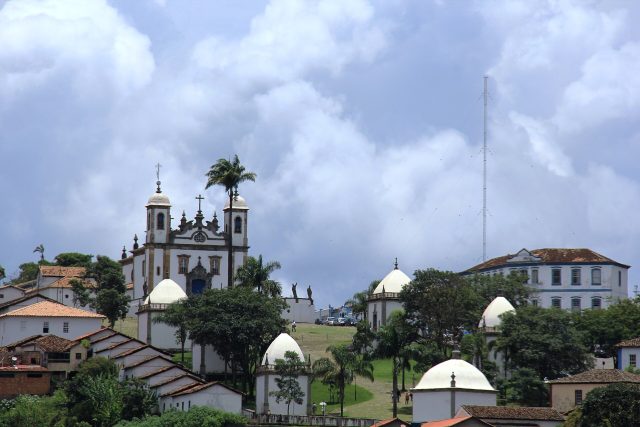
The architecture around the square tells a story of shifting times. Colonial-era buildings with their wooden balconies and carved doorways stand beside structures from the 1930s and 40s, when art deco swept through Brazil, leaving its mark in clean lines and geometric details. The old cinema, once the town’s cultural hub, still wears its faded elegance on the outside, though its interior now houses shops and offices. Nearby, the whitewashed Church of Our Lady of the Rosary, built in the 18th century, rises with quiet dignity, its simple bell tower a familiar sight against the sky. These buildings don’t compete for attention; they simply exist, as much a part of the square as the people who pass by.
Getúlio Vargas, the man after whom the square is named, shaped Brazil in ways that still echo today. As president during two separate terms—first in the 1930s and 40s, then again in the early 50s—he pushed the country toward modernization, introducing labor laws, industrializing the economy, and centralizing power. His legacy is complicated: some see him as a visionary who dragged Brazil into the 20th century, while others remember him as an authoritarian who ruled with an iron grip. The square in Conselheiro Lafaiete doesn’t take sides. It’s just one of many places across Brazil where his name lingers, a quiet reminder of an era that changed the country forever.
By day, the square is a place of small routines. Office workers cut through on their lunch breaks, mothers push strollers past the flower beds, and the occasional street vendor sets up a stand selling coconut water or fresh fruit. In the evenings, the pace slows even more. Families gather on the benches, teenagers kick soccer balls in the open spaces, and older men cluster in groups to talk about politics or football. On weekends, the square transforms into a modest market, with tables piled high with local produce, handmade crafts, and sweets like brigadeiros and pé de moleque. The air smells of roasted nuts and coffee, and the shade of the trees makes it easy to while away an hour or two without noticing the time.
Conselheiro Lafaiete itself is a town that has long since settled into its own skin. Founded in the 18th century as a stopover for gold prospectors, it never became a major city, and today it feels like a place where life moves at the speed of conversation. With around a hundred thousand people, it’s small enough that the square still serves as the town’s living room—a place where everyone eventually passes through. The streets branching off from it lead to churches, museums, and old mansions that hint at the town’s past, but the square itself is where the present unfolds.
What makes Praça Getúlio Vargas special isn’t any single feature, but the way it feels. There’s no rush here, no sense of being in a place designed for tourists. Instead, it’s a square that belongs to the people who use it: the old men playing dominoes under the trees, the children chasing each other around the fountain, the couples strolling arm in arm after dinner. The greenery—palm trees, flowering bushes, and gnarled old fig trees—softens the edges of the buildings, making the space feel almost like a garden. At night, the streetlights cast a warm glow over the cobblestones, turning the square into a different kind of place, one where the past feels closer and the present a little slower.
For visitors, the square is a good starting point to explore the town. From here, it’s easy to wander into the side streets, where colonial houses with peeling paint and wrought-iron balconies stand next to more recent constructions. A short walk away, the town’s museums offer glimpses into its history, while the local cafés serve strong coffee and hearty dishes like feijoada, the black bean stew that’s a staple of Brazilian cuisine. There’s no grand spectacle in Conselheiro Lafaiete, no must-see attractions clamoring for attention. Instead, the town invites you to slow down, to sit on a bench and watch the world go by, just as the locals do.
Like any living place, the square has changed over the years. New buildings have gone up, old ones have been repurposed, and the town has grown outward, swallowing up the surrounding hills. But the square remains the anchor, a place that hasn’t lost its sense of itself. It’s where the town’s different generations overlap: the teenagers scrolling on their phones at the café tables, the retirees reminiscing about the way things used to be, the young families pushing strollers past the same buildings their grandparents once walked by. In that way, Praça Getúlio Vargas is more than just a public space. It’s a thread connecting the town’s past to its present, a place where history isn’t something you visit—it’s something you live.