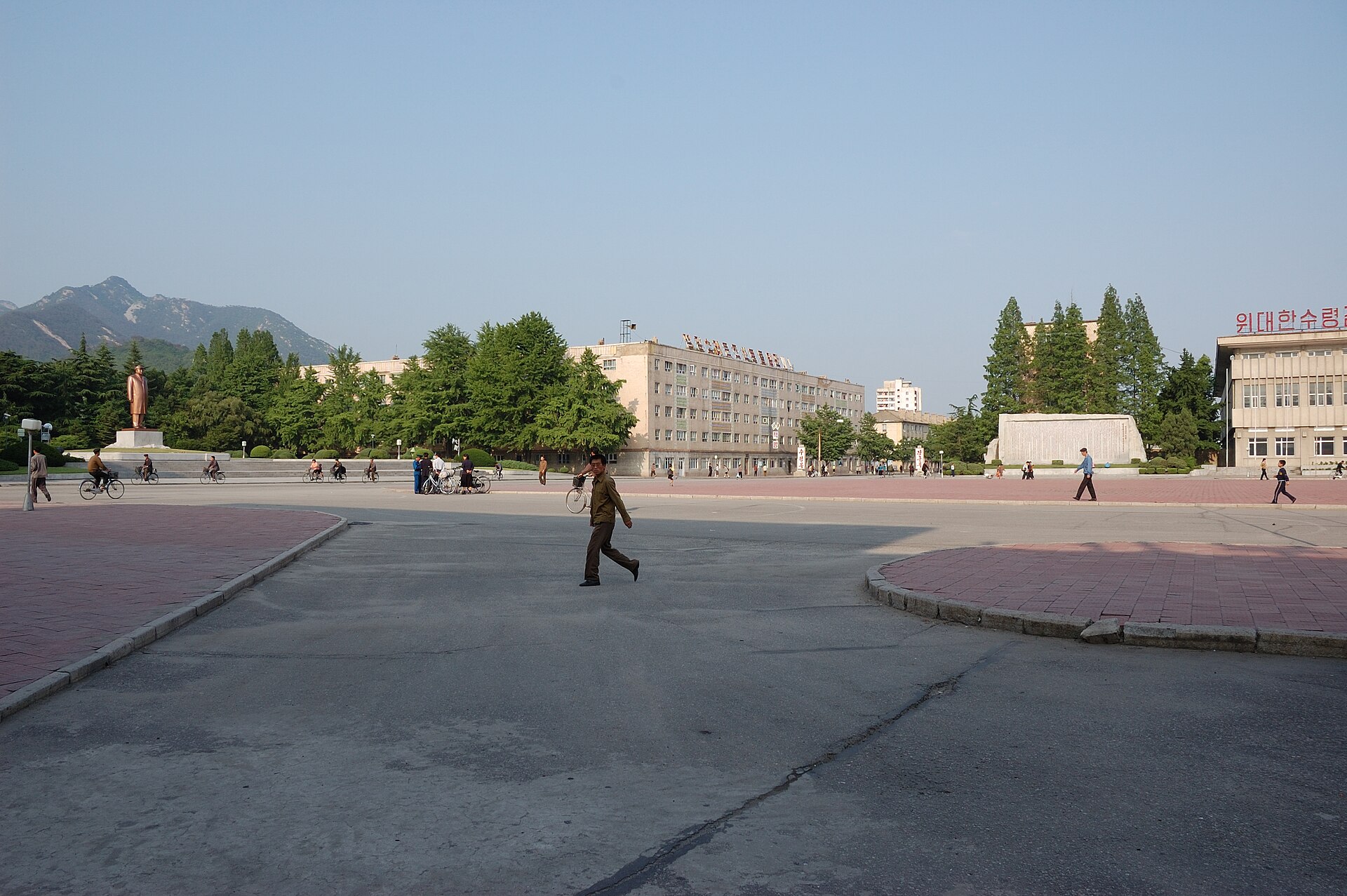
Haeju Square sits quietly at the heart of the city, a place where the past and present coexist without fanfare. Unlike the grand plazas of Pyongyang, it doesn’t demand attention with towering monuments or crowds of visitors. Instead, it offers something subtler—a sense of everyday life unfolding in a city shaped by history, yet not defined by it. The buildings around the square are modest, their facades bearing the marks of mid-20th-century design, blending socialist-era architecture with faint echoes of traditional Korean aesthetics. Murals and slogans appear here and there, not as propaganda, but as part of the scenery, as natural as the weathered stone beneath your feet.
The square itself is unassuming, yet it carries the weight of the city’s layered history. Haeju has been a crossroads for centuries, a trading hub during the Goryeo and Joseon dynasties, and later an administrative center under Japanese rule. After Korea’s division, the city found itself in the North, and the square became a stage for state ceremonies and public gatherings. Today, it remains a focal point for civic life, though its role is more understated than in the capital. There’s no grand narrative here, just the quiet accumulation of moments—parades on national holidays, impromptu meetings, the occasional group of students lingering after school.
What makes Haeju Square interesting is its ordinariness. It’s not a place designed for tourists, and that’s precisely why it feels authentic. In the mornings, the square is nearly empty, save for a few locals hurrying to work or market. By midday, it fills with the hum of daily life—children playing, workers on their lunch breaks, the occasional political rally or cultural performance. Evenings bring a different rhythm, as families and friends gather to unwind, the glow of streetlights softening the edges of the buildings. On holidays, the square transforms, hosting concerts or mass celebrations, but even on ordinary days, it never feels deserted.
The architecture surrounding the square tells its own story. The buildings are functional rather than grand, their designs a mix of Soviet-era pragmatism and Korean influences. Some facades feature bas-reliefs or mosaics, often depicting workers, soldiers, or historical figures, though their meaning isn’t always obvious to outsiders. The square’s center usually holds a monument or sculpture, though these aren’t the towering statues found in Pyongyang. Instead, they’re more subdued, blending into the environment rather than dominating it. The overall effect is one of harmony—nothing clashes, nothing stands out too sharply.
For visitors, the square is a good starting point for exploring Haeju. From here, you can wander into the older neighborhoods, where traditional tile-roofed houses still stand, or head toward nearby landmarks like the Haeju Sokdamgugok, a scenic area of pavilions and ponds. The square is also surrounded by small shops and eateries, where you can try local dishes like naengmyeon (cold noodles) or pick up simple souvenirs. The selection isn’t vast, but that’s part of the charm—there’s no tourist trap here, just the basics of daily life.
What’s striking about Haeju Square is how it reflects the city itself. It’s not a place of spectacle, but of routine. Here, the grand and the mundane coexist—the official parades and the casual strolls, the state ceremonies and the quiet conversations between neighbors. It’s a space where different layers of life intersect, not in opposition, but in quiet balance. For those used to the polished facades of more tourist-friendly destinations, the square might seem uneventful at first glance. But if you linger, you’ll notice the small details: the way people greet each other, the topics they discuss, the way they move through the space. It’s these unscripted moments that give the square its character.
Haeju isn’t a city that draws crowds, and its square isn’t a must-see attraction. But for those curious about life beyond the capital, it offers a rare glimpse into provincial North Korea. There are no luxury hotels or flashy entertainment complexes here, just the rhythm of a city that moves at its own pace. The square isn’t a place to rush through; it’s a place to observe, to sit on a bench and watch the day unfold. In a country often portrayed through extremes, Haeju Square feels refreshingly human—a reminder that even in the most controlled environments, life finds its own quiet way of persisting.