The Tomb of King Kongmin is one of those rare places in North Korea where history feels almost tangible. Tucked away near the city of Haeju, it sits among low hills covered in pine and oak, where the air carries the scent of earth and old stone. This isn’t just an architectural relic—it’s a quiet witness to the final years of the Goryeo Dynasty, a time when Korea stood at a crossroads, caught between fading traditions and the rise of new powers. The stillness here is profound, broken only by the rustle of leaves or the distant call of a bird. It’s easy to imagine the people who once walked these paths, their lives shaped by the same winds and shadows that linger today.
Built in the 14th century, the tomb holds the remains of King Kongmin and his wife, Princess Noguk, a Mongol noblewoman whose marriage to the king was meant to secure an alliance between Goryeo and the Yuan Dynasty. But history had other plans. Kongmin ruled during a turbulent era, as the Ming Dynasty rose to the north and internal strife weakened his kingdom. His reign ended violently—he was assassinated in a coup—and his tomb became a symbol not just of personal tragedy, but of an entire dynasty’s decline. Today, it’s one of the few places where the legacy of Goryeo, often overshadowed by the later Joseon Dynasty, can still be felt.
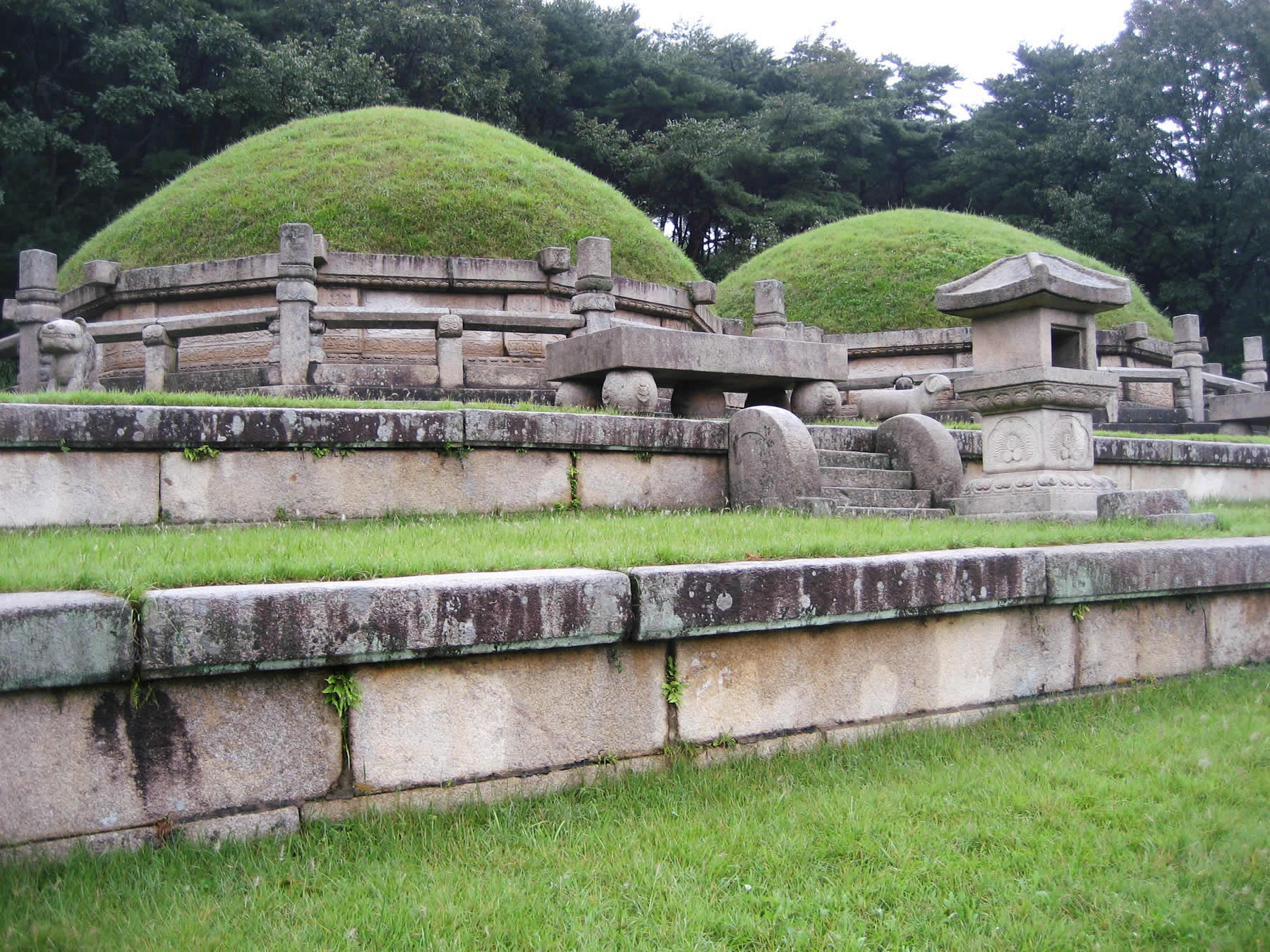
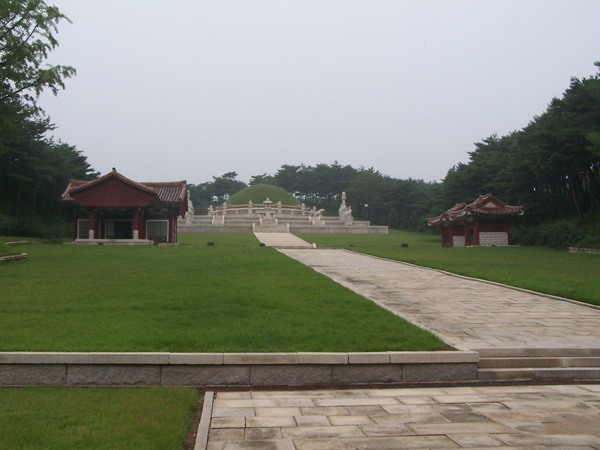
The tomb’s design follows the traditions of Goryeo-era burial complexes, with a few distinctive touches. A large earthen mound, the final resting place of the king and queen, is encircled by stone walls and statues. Carved from gray granite, these figures depict officials, warriors, and animals, their stern expressions suggesting guardianship over the dead. The entrance is marked by a pair of stone gates, leading to a long pathway flanked by lanterns—once used to light the way during rituals, now empty but still striking in their simplicity. The craftsmanship is precise, a reminder of the skill and care that went into creating a place meant to endure.
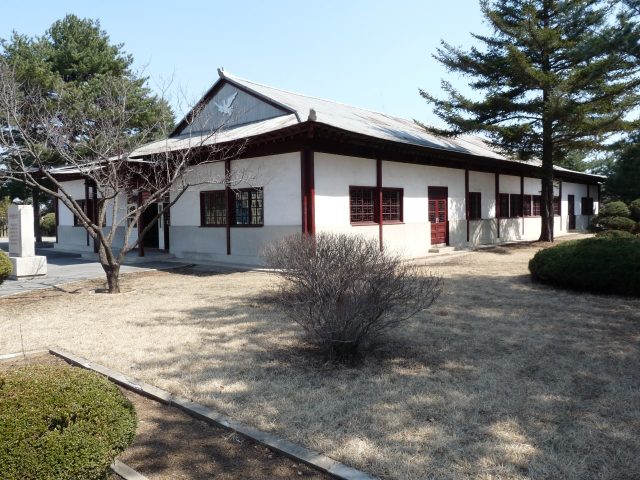
One of the most intriguing features is the stele standing before the tomb. Its surface is etched with Chinese characters, an epitaph recounting Kongmin’s life and reign. Time and weather have worn away parts of the inscription, but what remains offers a glimpse into how his contemporaries viewed him. Nearby, small pavilions once hosted memorial ceremonies, their wooden frames and tiled roofs still intact, though now abandoned. They stand as silent witnesses to the rituals that once honored the dead, their emptiness adding to the site’s haunting atmosphere.
This isn’t a place for casual tourists. There are no souvenir stalls, no guided tours with loudspeakers, no crowds snapping photos. Instead, it’s a destination for those who seek history not as a spectacle, but as something to be felt in the quiet and the details. The surrounding countryside is dotted with fields and villages where life moves at an unhurried pace, much as it has for centuries. Locals rarely visit the tomb, but when they do, their attitude is one of quiet respect, though not reverence. It’s as if they recognize its significance but have long since woven it into the fabric of their everyday world.
Reaching the tomb requires some effort. Haeju itself is not an easy place to access, and the site lies a few kilometers outside the city, down narrow rural roads that wind past rice paddies and orchards. The journey can be muddy in the rainy season or stifling in the summer heat, but these discomforts only deepen the sense of stepping into another time. There are no signs in English, no clear markers—just the landscape and the slow realization that you’re approaching something ancient. It’s the kind of place that rewards patience, where the journey itself becomes part of the experience.
The tomb is more than just a monument to the past; it’s a reminder of how fragile history can be. The Goryeo Dynasty, which ruled Korea for nearly five centuries, faded into obscurity, leaving behind only a handful of sites like this one. Today, the tomb feels slightly neglected, its stones weathered and its pathways overgrown in places. But that neglect is part of its charm. There’s no grandeur here, no attempt to impress—just the quiet weight of memory. It’s a place that doesn’t demand attention but instead invites reflection, a rare quality in a world that often values spectacle over substance.
In recent years, efforts have been made to preserve the tomb. Historians and restorers have worked to protect the stone statues and inscriptions, ensuring that future generations can see them as they were meant to be seen. Progress is slow, though, and some details are already lost to time. The work is painstaking, a reminder that preservation is an ongoing battle against decay. Yet even in its current state, the tomb remains a powerful link to an era when Korea was part of a larger world, one filled with shifting alliances, political intrigue, and the constant struggle for survival.
If you ever find yourself in this part of North Korea, the Tomb of King Kongmin is worth the visit—not for the sake of ticking off a tourist attraction, but for the chance to stand among the silent stone figures and listen to the wind. There are no grand narratives of victory or triumph here, just the quiet sadness of a time long gone. It’s a place that doesn’t offer easy answers but instead leaves you with questions, with the sense that history is not just something to be studied, but something to be felt. And in that feeling, there’s a connection to the past that no textbook could ever capture.