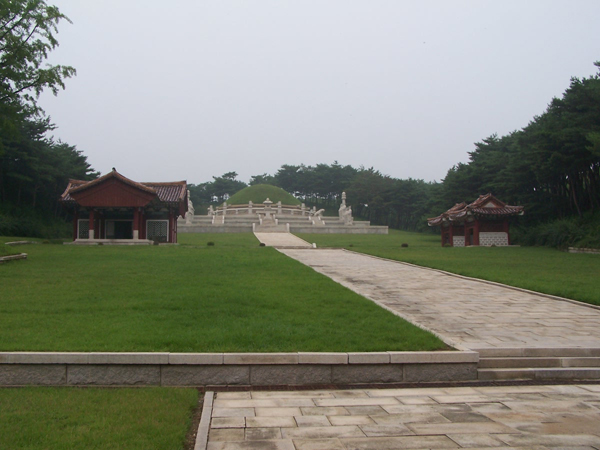
Perched on a gentle rise outside Haeju, the Tomb of King Wanggon feels like a quiet conversation with history. The low hills around it are covered in pine trees and wild grasses, their scent mixing with the earthy dampness of the Korean countryside. This isn’t just another ancient monument—it’s where the story of a unified Korea begins. Wanggon, the founder of the Goryeo Dynasty, ruled in the 10th century, and his legacy still shapes how Koreans see their past. His name appears in textbooks, but standing here, it’s easier to imagine him as a real person rather than a distant figure from the pages of history.
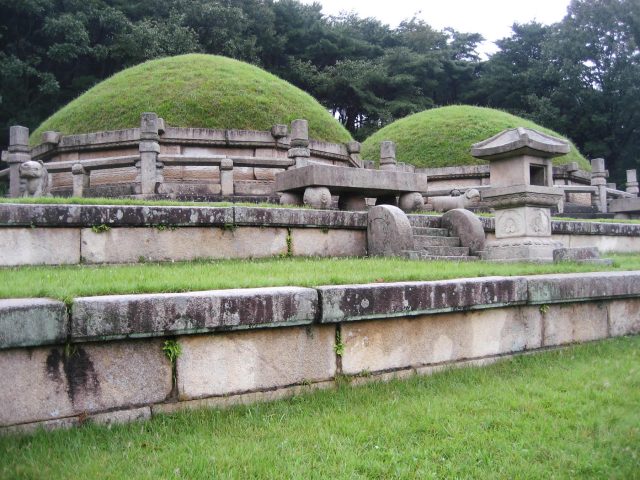
The tomb’s architecture tells its own story of change. Originally, it was a simple burial mound surrounded by a stone fence, built in the early Goryeo style. Over the centuries, later dynasties added their own touches—steles, altars, and inscriptions—to honor Wanggon’s memory. What remains today are fragments, but they’re enough to piece together the original design. The main mound rises above the landscape, encircled by a low stone wall, while granite slabs at its base bear carved words about the king’s life and reign. The craftsmanship is understated, almost humble, yet it carries the weight of centuries.
Visiting the tomb is less about sightseeing and more about stepping into a slower rhythm. There are no crowds, no souvenir stalls, no flashy signs—just the wind rustling through the grass and the occasional murmur of locals paying their respects. The surrounding fields and villages feel untouched by time. Farmers work in rice paddies, cows amble along dirt roads, and the air hums with the quiet routines of rural life. It’s a place where the past doesn’t feel distant; it’s simply there, woven into the landscape.
For Koreans, Wanggon’s tomb is more than a historical site—it’s a symbol of unity. When he founded the Goryeo Dynasty, he brought together fractured kingdoms under a single rule, laying the groundwork for a cohesive Korean identity. Even now, with the peninsula divided, his legacy resonates. The tomb stands as a reminder of what once was and, for some, what could be again. It’s a rare kind of monument, one that doesn’t just commemorate the past but still feels relevant to the present.
Haeju itself is a city where history lingers in unexpected corners. Once a thriving center of trade and culture, it still holds traces of its former importance. Crumbling fortress walls, old temple gates, and hidden shrines peek out from between modern buildings, hinting at a richer past. The tomb is just one piece of this puzzle, but it’s the one that gives the city its soul. Walking through Haeju, you sense that the land remembers—every stone, every path, every bend in the river has a story to tell.
What makes the Tomb of King Wanggon unusual is its lack of grandeur. There are no towering statues or gilded halls, no reconstructed palaces to dazzle visitors. Instead, there’s just the earth, the stones, and the wind. It’s a place that invites reflection rather than awe. Many who come here leave with a quiet sense of connection, as if the past isn’t something to be observed but something to be felt. The simplicity of the site makes it feel alive in a way that more elaborate monuments often don’t.
Of course, visiting North Korea means navigating a different set of expectations. The tomb is protected as a national heritage site, and access isn’t always straightforward. Rules can change, and what’s open to visitors one day might not be the next. For those who do make the journey, though, it’s an opportunity to see the country beyond the headlines. Here, history isn’t locked away in museums or staged for tourists—it’s right in front of you, breathing through the land itself.
Standing at the tomb, it’s easy to forget the noise of the modern world. The silence isn’t empty; it’s full of echoes—of battles fought, of kingdoms rising and falling, of a man who once shaped a nation. Wanggon’s legacy isn’t just in the stones or the inscriptions but in the very idea of Korea as a unified whole. And in a place like this, that idea doesn’t feel like a relic. It feels like something still alive, waiting to be rediscovered.