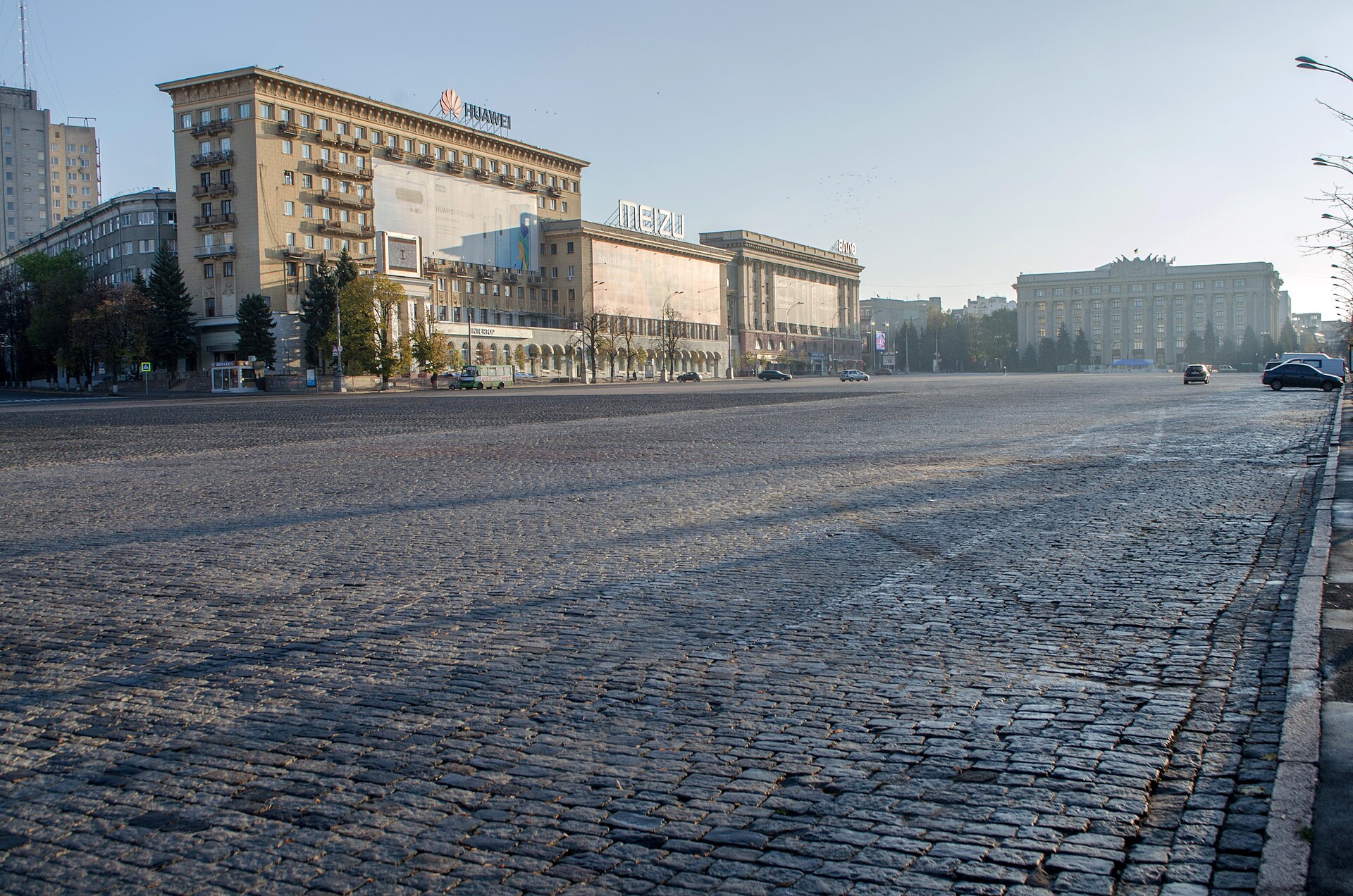
Freedom Square in Kharkiv isn’t just the largest city square in Ukraine—it’s one of the most expansive public spaces in Europe, stretching over twelve hectares. Its sheer scale makes it hard to grasp at first glance. From certain angles, the square feels more like an open field than a central urban hub, with buildings framing its edges rather than crowding in. This vastness wasn’t an accident. Designed in the late 1920s as part of a grand Soviet urban plan, the square was meant to embody the ideals of a new era—spacious, modern, and built for the people. At the time, Kharkiv was the capital of Soviet Ukraine, and the city’s leaders wanted a square that would reflect its status as a forward-looking metropolis.
The square’s layout is a study in symmetry. At its heart stands the Derzhprom building, an imposing constructivist complex that was once the tallest structure in the Soviet Union. Completed in 1928, its three interconnected towers and geometric precision were a bold statement of industrial ambition. The building’s design, with its clean lines and functional aesthetic, was a radical departure from the ornate architecture of the past. It was meant to symbolize progress, efficiency, and the collective spirit of the working class. Even today, Derzhprom dominates the square, its silhouette instantly recognizable against the skyline.
Around the square, other buildings from the same era tell their own stories. The Kharkiv State University’s main building, with its neoclassical columns and grand entrance, contrasts sharply with Derzhprom’s modernist lines. It was built in the 1930s, when Stalinist architecture began to favor more traditional forms, blending imperial grandeur with socialist symbolism. Nearby, the Hotel Kharkiv, another constructivist landmark, offers a glimpse into the city’s mid-century hospitality. These buildings don’t just coexist—they create a dialogue between different architectural philosophies, each layer reflecting a shift in political and cultural priorities.
For decades, Freedom Square was the stage for Kharkiv’s public life. Parades, rallies, and official ceremonies were held here, with thousands gathering to mark state holidays or listen to speeches. The square’s open expanse made it ideal for such events, its scale amplifying the sense of collective purpose. But it wasn’t just a space for state-sanctioned gatherings. In quieter moments, it served as a meeting place for students, a shortcut for pedestrians, or a spot for impromptu picnics. Even during the Soviet era, when public spaces were tightly controlled, the square retained a certain everyday informality.
After Ukraine gained independence in 1991, the square’s role began to change. The grand parades of the past faded, and the space took on a more relaxed, civilian character. Today, it’s a place where people come to walk, skate, or simply sit on the benches scattered along its edges. In winter, a large ice rink often appears near the center, drawing families and groups of friends. In summer, the square hosts open-air concerts, festivals, and even temporary beach setups, complete with sand and palm trees. These events give the square a festive, almost playful atmosphere, a far cry from its original solemn purpose.
The square’s name itself has been a point of contention over the years. Originally called Dzerzhinsky Square, after the founder of the Soviet secret police, it was renamed Freedom Square in 1996, reflecting Ukraine’s post-Soviet identity. The change wasn’t just symbolic—it marked a shift in how the space was perceived and used. No longer a stage for state propaganda, it became a place where people could gather freely, without the weight of ideology hanging over them. That said, the square’s Soviet past is still visible in its architecture and layout, a reminder of the layers of history that shape any city.
One of the square’s most striking features is its underground network. Beneath the surface lies a labyrinth of tunnels and halls, originally built as part of the Derzhprom complex. These spaces were designed to house offices, storage, and even bomb shelters, a nod to the paranoia of the era. Today, parts of the underground are accessible to the public, including a small museum and a few shops. The contrast between the open sky above and the dim, echoing corridors below adds another dimension to the square, hinting at the hidden infrastructure that keeps a city running.
Despite its size, Freedom Square doesn’t feel overwhelming. The lack of high-rise buildings around its perimeter keeps the space airy and approachable. Trees line some of the paths, providing shade in the summer, while the wide pedestrian zones make it easy to navigate. On weekends, the square buzzes with activity—street musicians set up near the university, vendors sell snacks and souvenirs, and groups of students gather to chat or study. It’s a place where different generations and social groups intersect, each bringing their own rhythms to the space.
Kharkiv’s climate plays a role in how the square is experienced. Winters here are harsh, with snow often blanketing the ground for months. The square’s vastness can make it feel even colder, the wind sweeping across the open space with little to block it. Yet there’s a certain beauty to it—the way the snow softens the edges of the buildings, or how the low winter sun casts long shadows across the pavement. In spring, the square comes alive as the ice melts and the first green shoots appear. By summer, it’s a different place entirely, filled with light and movement.
Freedom Square isn’t just a relic of the past. It’s a living part of Kharkiv, adapting to the city’s changing needs while retaining its historical character. Whether it’s serving as a backdrop for a protest, a venue for a music festival, or simply a place to take a leisurely stroll, the square remains central to the city’s identity. Its scale and history make it unique, but it’s the people who use it—day in and day out—that give it life. In that sense, Freedom Square is more than just a public space. It’s a reflection of Kharkiv itself: resilient, evolving, and always finding new ways to belong to those who call it home.