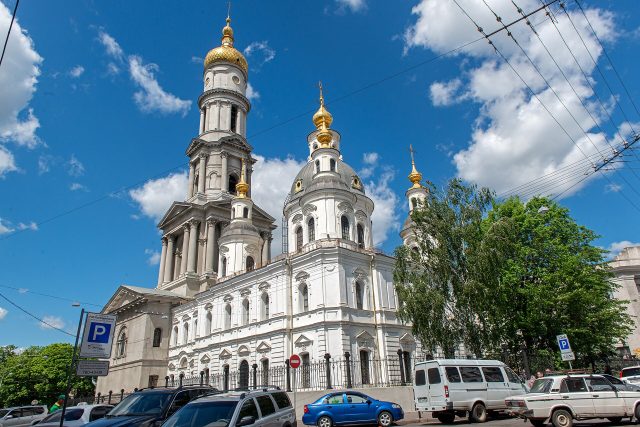
The Annunciation Cathedral stands as one of Kharkiv’s most striking landmarks, a place where the city’s past and present intersect in quiet grandeur. Built in the late 19th century, it was conceived not just as a place of worship but as a monument to the region’s spiritual and architectural ambitions. Its towering red-brick walls and massive central dome dominate the skyline, visible from afar, while the intricate details of its Byzantine-inspired design draw the eye closer. The cathedral’s imposing presence is softened by the play of light on its facades, especially at dawn or dusk, when the brickwork takes on a warm, almost golden hue.
The idea for the cathedral emerged in the mid-1800s, a time when Kharkiv was expanding rapidly as both a cultural and industrial hub. The city’s growing Orthodox community needed a larger, more imposing church to reflect its significance, and the project was entrusted to local architect Mikhail Lovtsov. His vision blended traditional Byzantine elements with the structural innovations of the era, resulting in a building that was both timeless and distinctly of its time. Construction began in 1888 and stretched over nearly two decades, a testament to the scale of the undertaking. The cathedral was finally consecrated in 1901, dedicated to the Annunciation of the Virgin Mary, and quickly became a focal point for the city’s religious life.
Inside, the cathedral’s vast interior unfolds like a carefully composed symphony of space and light. The soaring vaults, adorned with faded but still vibrant frescoes, create an atmosphere of reverence, while the gilded iconostasis commands attention at the heart of the nave. The craftsmanship of the wooden carvings and the delicate mosaics that line the walls speak to the skill of the artisans who worked here. Some of the icons housed within the cathedral are centuries old, their origins lost to time, while others were created specifically for this space by local artists. The interplay of natural light through the stained-glass windows adds a sense of quiet movement to the stillness of the interior.
The cathedral’s history has not been without hardship. During the Soviet era, it was stripped of its religious function, its sacred spaces repurposed as a warehouse and later a planetarium. The frescoes were whitewashed, icons removed or destroyed, and much of the interior decoration lost. It wasn’t until the late 20th century that restoration efforts began in earnest, slowly returning the cathedral to its former glory. Today, it stands as an active place of worship once more, its doors open to those seeking solace, celebration, or simply a moment of reflection. Services, baptisms, and weddings are held regularly, each ceremony adding another layer to the cathedral’s living history.
Beyond its religious significance, the Annunciation Cathedral has become a cultural touchstone for Kharkiv. It hosts concerts of sacred music, exhibitions on Orthodox heritage, and lectures on the city’s architectural evolution. On major holidays like Christmas and Easter, the cathedral draws crowds from across Ukraine, its halls filled with the sound of choirs and the scent of incense. The energy of these gatherings spills out onto the surrounding square, where the cathedral’s presence anchors the rhythm of the city.
The area around the cathedral is as much a part of its story as the building itself. The square where it stands, once named after Rosa Luxemburg, is now a lively hub in the heart of Kharkiv. Pedestrian paths crisscross the space, connecting the cathedral to nearby cafes, shops, and historic buildings. In warmer months, the square buzzes with activity—students meeting between classes, families strolling, and street musicians adding to the ambiance. When winter arrives, the square transforms, its open space filled with a towering Christmas tree and festive markets that draw locals and visitors alike.
What makes the Annunciation Cathedral special is not just its age or its beauty, but the way it has endured. It has witnessed wars, political upheavals, and the slow march of time, yet it remains a constant in a city that has changed around it. The cathedral is more than a relic; it is a living part of Kharkiv’s identity, a place where history is not just remembered but actively experienced. Whether you come to admire its architecture, to attend a service, or simply to sit quietly in its shadow, the cathedral offers a rare sense of continuity in a world that often feels transient.
For those visiting Kharkiv, the Annunciation Cathedral is one of those places that lingers in the memory long after the trip is over. It doesn’t demand attention in the way a flashy modern landmark might, but rather invites you to slow down and take notice. The worn stone steps, the echo of footsteps in the nave, the way the light filters through the windows—these small details create an atmosphere that feels both timeless and deeply personal. It’s a reminder that some places are more than just buildings; they are keepers of stories, silent witnesses to the lives that have unfolded within their walls.