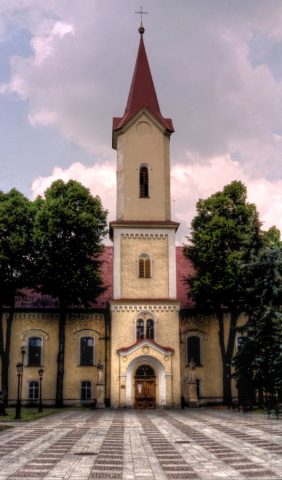
Štúr Square in Revúca is one of those places where time seems to slow down, allowing you to notice the small details that usually slip by unnoticed. It isn’t just the central square of a small Slovak town—it’s a living space where history, daily life, and quiet pride in the past intertwine. There are no crowds of tourists, no loud cafés, no flashy signs, just the unhurried rhythm of provincial life, where every cobblestone, every building, even the shadows of the trees, has its own story to tell.
The architecture here is a testament to the Austro-Hungarian influence that shaped many towns in Slovakia. The buildings, with their steep roofs, narrow facades, and decorative elements of Baroque and Neoclassical styles, stand in neat rows, creating a sense of order and warmth. Some still have their original carved balconies, stucco details, and old-fashioned lanterns, though most have been repainted in soft pastel shades that give the square a gentle, almost fairy-tale appearance. The town hall stands out with its clock tower, visible from a distance, its solid, unpretentious design reflecting the town’s modest but dignified character.
The square is named after Ľudovít Štúr, a key figure in Slovakia’s national revival. In the 19th century, he fought for the recognition of the Slovak language and culture, and his name here is no coincidence. Though Revúca is small, it was always part of this movement. A modest monument to Štúr stands in the center of the square, and while it isn’t grand, locals treat it with respect. It’s more than just a statue—it’s a reminder that even small towns have played their part in history.
Today, Štúr Square is where the threads of the town’s life come together. In the mornings, small shops open, selling local products like smoked meats, cheeses, and fresh bread. By midday, retirees gather on benches to chat, while children play near the fountain, a small but enduring part of the square’s landscape. In summer, small fairs are held here, where you can find handmade ceramics, embroidery, and wooden toys. In winter, the square transforms into an ice rink, becoming a gathering place for families.
Revúca’s industrial past is another layer of its identity. The town was once a center of metallurgy, and though the factories have long since closed, their legacy lingers. Some of the buildings around the square once belonged to merchants tied to the iron trade, and traces of the old industrial infrastructure can still be found in the surrounding area. This gives the town a distinct character—it isn’t polished like tourist hubs, but retains the marks of real, lived-in history.
The atmosphere of Štúr Square is a mix of nostalgia and everyday life. There’s nothing staged here—just the real, unvarnished details: peeling paint on shutters, cracks in the pavement, old shop signs that have been there for decades. Yet the square doesn’t feel neglected. It’s alive, breathing, changing with the town. In the summer evenings, teenagers gather here; in winter, strings of lights are hung; in spring, flowers are planted in pots. It’s a place where everyone feels at home, even if they’ve just arrived.
For visitors, Štúr Square is the natural starting point for exploring Revúca. From here, narrow streets lined with 18th-century houses branch off, and a short walk away lies a park with the remains of an old fortress. But even if you don’t venture further, the square itself is worth lingering in. The café on the ground floor of one of the buildings serves strong coffee and homemade pastries, while the bakery across the street always smells of fresh bread. This isn’t a place for rushing—it’s a place for simply being.
Revúca doesn’t try to be a tourist destination, and that’s its charm. Štúr Square isn’t an open-air museum—it’s part of the town’s living fabric. It isn’t perfect or meticulously restored, and that’s precisely why it’s so appealing. Here, you can sense how people lived a hundred years ago and see how they live today. History hasn’t faded into the past—it’s still here, in every brick, every conversation, every step on the cobblestones.