Revúca is one of those quiet Slovak towns that rarely appear on tourist maps. There are no crowds, no neon signs, no famous landmarks. Yet that’s what makes it special. Time moves slowly here, and history lingers in the worn cobblestones and the quiet rhythm of daily life. At the heart of this unassuming place stands the town hall—a building that has witnessed centuries of local history, serving as both an administrative hub and a symbol of the community.
The town hall occupies a central spot on Revúca’s main square, where merchants once traded goods and where locals still gather. Built in the late 18th century, the structure reflects the town’s prosperity during its industrial heyday. Revúca was a key player in the region’s iron production, and the town hall’s architecture mirrors that significance. Its design blends late Baroque and neoclassical elements—clean lines, symmetrical windows, and restrained elegance. It doesn’t demand attention, but its quiet dignity makes it compelling.
Over the years, the town hall has changed. In the 19th century, a clock tower was added, becoming one of Revúca’s most recognizable features. The clock still marks the hours. Inside, the original grandeur remains: ornate plasterwork, wooden paneling, and heavy chandeliers. The interiors feel like a preserved fragment of another era.
Though the town hall still serves its administrative purpose, parts of it are open to visitors. Exhibits inside trace Revúca’s past, from its craft traditions to its industrial legacy. For those interested in metallurgy, there are documents and artifacts about the town’s connection to ironworking. Even if that isn’t your usual interest, the building itself is worth a visit. The air inside feels thick with history, as if the walls remember the decisions made within them.
The square surrounding the town hall is the true heart of Revúca.
Low-rise buildings with colorful facades line the perimeter. They house small cafés and shops selling local goods. In summer, the square hosts markets. In winter, it’s adorned with festive lights and a Christmas tree. There’s a warmth here that’s hard to find in larger cities—a sense of belonging that comes from shared routines and familiar faces. The town hall is a living part of daily life, a place where people run errands, meet friends, or sit on a bench.
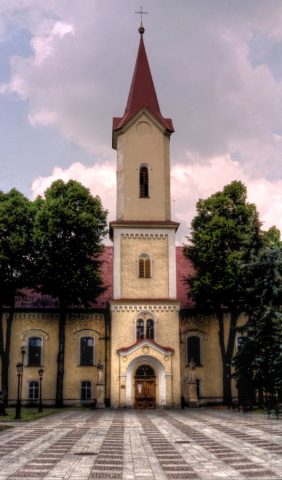
Just steps away stands the Church of St. Ladislaus. Built centuries before the town hall, its Gothic architecture offers a striking contrast. The church’s austere stonework and towering spire stand in quiet dialogue with the town hall’s civic grace. Together, they create a harmonious center for Revúca, where the past feels tangible.
For visitors, the town hall is a natural starting point. From here, you can wander the narrow streets, peek into small museums, or venture to the outskirts where old industrial buildings still stand. The town is compact enough to explore on foot in a few hours. Revúca reveals itself slowly, like a story that unfolds at its own pace. There’s no grand spectacle, just the quiet pleasure of discovering a place that has remained largely unchanged.
Beyond its history, Revúca is also a gateway to nature. The town is surrounded by gentle hills and forests, where trails wind through landscapes untouched by mass tourism. In summer, the air stays cool even on warm days. In autumn, the woods blaze with color. Locals often hike these paths or ski them in winter, returning to the town square as if to a home base. The town hall, with its steady presence, feels like the anchor of it all—a place you leave from and always come back to.
Today, Revúca carries on at its own unhurried pace, and the town hall remains a central part of that rhythm. It doesn’t try to be a tourist attraction. It simply exists, a bridge between past and present. Maybe that’s why it lingers in the memory—not as a place you’ve seen, but as one you’ve felt. There’s something rare about a town that doesn’t perform for visitors, that just is. And in that quiet authenticity, Revúca offers more than a postcard-worthy sight.