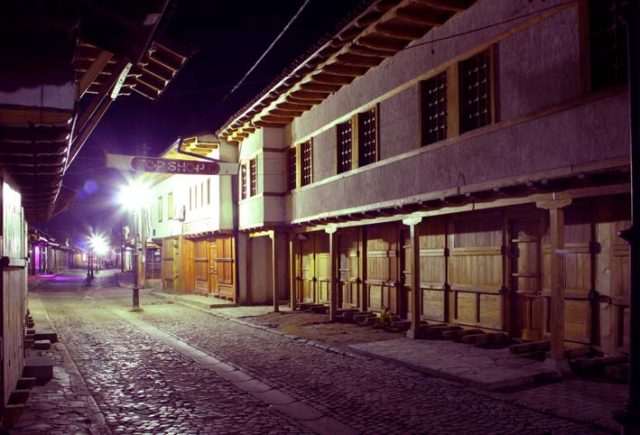
Đakovica’s Shahid Square is one of those places where the past lingers in the air, not as a relic, but as something still alive, shaping the way people move through the space today. It sits at the heart of the city, a broad, open expanse of pavement framed by low buildings with weathered facades, their colors faded by decades of sun and rain. The square doesn’t announce itself with grand monuments or towering structures; instead, it feels like a pause in the rhythm of the city, a place where people naturally gather, whether for quiet conversation, a quick coffee at one of the nearby cafés, or simply to watch the day unfold.
The name itself—Shahid Square—carries weight. *Shahid* means martyr in Arabic, and in Kosovo, the word is tied to the memory of those who lost their lives during the conflict of the late 1990s. The square became a focal point during those years, a place where protests, gatherings, and sometimes violence played out under the watch of the surrounding buildings. Today, the name serves as a reminder, though the square has settled into a different kind of role. It’s no longer a stage for conflict, but the echoes of that time are still present in the way older residents sometimes point out where certain events took place, or in the occasional memorial that appears on anniversaries.
Architecturally, the square is unassuming. The buildings around it are a mix of Ottoman-era structures with overhanging eaves and more modern, utilitarian constructions from the Yugoslav period. Some of the older buildings have been restored, their wooden balconies and arched windows lending a touch of warmth to the otherwise stark surroundings. Others remain untouched, their peeling paint and cracked plaster telling their own stories. The square itself is paved with large stone slabs, worn smooth by years of foot traffic, and in the center, a few benches and a small fountain offer a place to sit. The fountain doesn’t always work, but when it does, the sound of water adds a quiet, almost meditative quality to the space.
What makes Shahid Square interesting isn’t its grandeur, but its ordinariness. It’s the kind of place where life happens in small, unremarkable ways. In the mornings, elderly men gather on the benches to play dominoes or chess, their games stretching out for hours as they sip strong Turkish coffee from tiny cups. Later in the day, teenagers might pass through on their way to school, their laughter cutting through the hum of the city. In the evenings, the square fills with the scent of grilled meat from nearby restaurants, and families stroll along the edges, stopping to chat with neighbors or browse the wares of street vendors selling everything from fresh fruit to cheap plastic toys.
The square’s role in Đakovica’s daily life has shifted over the years, but it has always been a place of convergence. Before the war, it was a bustling market area, with stalls selling everything from vegetables to handmade textiles. During the conflict, it became a symbol of resistance and loss. Now, it’s something in between—a space that has absorbed all these layers of history without being defined by any single one. You won’t find plaques or detailed explanations here; the history is in the details—the way a certain building’s facade still bears the marks of bullets, or how the older generation sometimes falls silent when they pass a particular corner.
For visitors, Shahid Square offers a glimpse into the everyday life of Đakovica, a city that has had to rebuild itself more than once. It’s not a place you’d necessarily seek out for its beauty or its attractions, but for the way it reflects the resilience of the people who call it home. There’s a sense of quiet defiance in how life continues here, how the square remains a gathering place despite everything it has witnessed. It’s the kind of spot where you might sit for an hour, watching the world go by, and leave with a deeper understanding of the city—not through grand narratives, but through the small, human moments that unfold in front of you.
If you wander beyond the square, you’ll find that Đakovica reveals itself slowly. The streets branching off from Shahid Square lead to neighborhoods where time seems to move at a different pace. Some are lined with houses that have been in the same families for generations, their gardens overflowing with roses and grapevines. Others are more modern, with apartment blocks that speak to the city’s growth in recent decades. But no matter where you go, the square remains a reference point, a place people return to, whether physically or in conversation. It’s a reminder that even in a city shaped by upheaval, there are constants—places that endure, not because they are untouched by history, but because they are woven into its fabric.