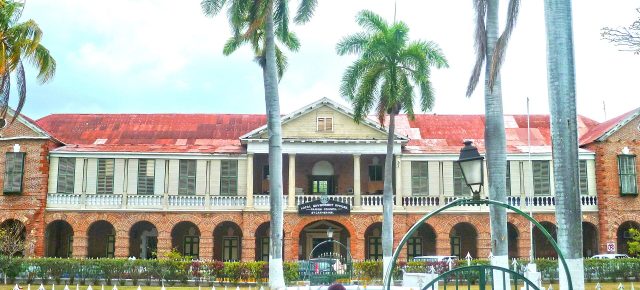
Rodney Square is where Jamaica’s history lingers. The past isn’t buried here—it hums beneath the cobblestones. Spanish Town was Jamaica’s capital until the 1800s, and this square sits at its core, watching as colonial power shifted from Spanish to British hands. The buildings around it still bear the marks of those changes.
The square is named after Admiral George Rodney, the British naval commander who defeated the French at the Battle of the Saintes in 1782. His statue, raised in the 19th century, stands on a tall pedestal—one of the few monuments on the island dedicated to a colonial figure. The bronze has softened over time, its edges blurred by sun and rain, but it still draws those who pause to think about what it represents.
The old courthouse, built in the late 1700s, dominates one side of the square. Its columns and arched windows are textbook British colonial design. Inside, a museum traces Jamaica’s story from the Taíno people to independence. A short walk away, St. Jago de la Vega Cathedral, founded in the 1600s, offers a quieter contrast. Its white walls and wooden pews have held generations of worshippers.
Rodney Square wasn’t always quiet. In colonial times, it hosted markets, auctions, and public punishments. Planters, merchants, enslaved people, and freed citizens all crossed paths here. After emancipation in 1838, it became a meeting place for those discussing freedom and, later, independence. Today, locals sit on benches, children play near the fountain, and tourists take photos—all while daily life carries on around them.
The square has changed with the years. Gas lamps were added in the 1800s, and stone paving gave it a more formal look. But when Kingston became the capital, Spanish Town faded, and many buildings fell into disrepair. Mid-20th century restorations brought Rodney Square back, though not in a way that feels staged. It still feels real—history isn’t just preserved here, it’s part of the present.
For those who look, the square is full of clues. The old courthouse, where slave rebellion trials were held, still stands. So does the former governor’s residence, its worn door handles and faded inscriptions hinting at the lives once lived inside. These buildings don’t demand attention, but they reward those who notice them.
Today, the square mixes eras and cultures. British colonial architecture stands near traces of African heritage. In the mornings, vendors sell fruit and spices. By evening, musicians sometimes play reggae or calypso under the streetlights. It’s not a museum—it’s a place where the past and present overlap.
To visit Rodney Square is to explore Spanish Town. The town is small enough to walk, and other landmarks are close. The 18th-century bridge over the Rio Cobre shows early engineering. The ruins of a Spanish church mark the island’s first European settlers. Unlike Montego Bay or Negril, Spanish Town feels like the real Jamaica—history isn’t just displayed here, it’s still unfolding.
Rodney Square won’t impress like Jamaica’s beaches or mountains. It doesn’t need to. It invites you to listen instead. For some, it’s just a stop on the way to Kingston. For others, it’s a chance to touch the island’s layered past. Either way, it offers a different view of Jamaica—not just sun and sand, but a place with a deep, complicated history. The square is one chapter of that story, and it’s worth your time.