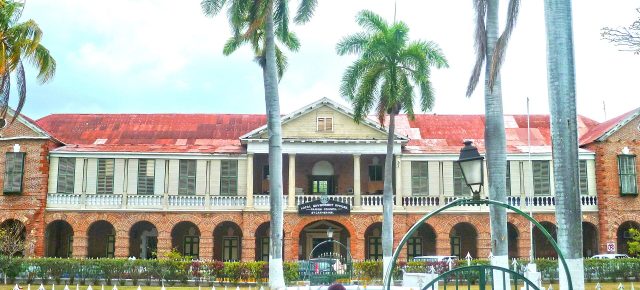
Spanish Town’s Emancipation Park is one of those quiet places where history doesn’t just sit in books or plaques but feels alive in the air. Opened in the early 2000s, it wasn’t built to be another grand monument or a tourist attraction with flashing lights. Instead, it exists as a space to remember what freedom really meant for Jamaica—how it wasn’t handed over in 1838 with the stroke of a pen, but fought for, resisted, and reclaimed over generations. There are no towering statues here, no dramatic arches or polished marble. The park is understated, almost modest, but that’s precisely what makes it feel honest. It doesn’t try to impress; it simply asks you to pause and think.
The park sits in the heart of Spanish Town, a place that has seen more history than most Jamaican cities. Once the island’s capital under both Spanish and British rule, the town still carries the weight of its past in its streets and buildings. This was where decisions were made that shaped the lives of thousands—many of them brought from Africa in chains to work the sugar plantations. Emancipation Park isn’t just another green space in the middle of all that; it’s a bridge between what was and what is. It’s small, easy to walk through in a few minutes, but the way it’s laid out encourages you to slow down. The paths curve gently, the benches invite you to sit, and the information panels aren’t there to lecture but to nudge you into reflection.
At the center of the park stands a sculpture by Jamaican artist Red Wilkins. It’s a simple, powerful piece: two figures, a man and a woman, standing back-to-back, their faces turned upward as if breaking free from something unseen. They’re not meant to represent any one person but everyone who ever had to fight for their dignity. The figures are realistic but not overly dramatic, which makes them feel universal. Nearby, a stone marker notes the date slavery was abolished in Jamaica, but you don’t need to read it to understand what this place is about. The sculpture does the talking in its own quiet way.
The park’s design is uncluttered, almost minimalist. The walkways are paved with tiles that shift subtly in color, guiding you without demanding attention. The plants and trees here aren’t exotic or manicured; they’re native species that thrive in Jamaica’s climate, providing shade in the heat of the day and a soft rustle of leaves when the wind picks up. At night, the lighting is warm but not harsh, just enough to keep the space safe without turning it into a spectacle. It’s the kind of place where you can come at dawn for a quiet run or in the evening to meet friends without feeling like you’re in a performance.
This isn’t the sort of park where people come to take selfies or check off a tourist list. There are no rides, no food stalls, no crowds. Instead, it’s a place for small, meaningful moments—someone reading a book on a bench, a couple talking quietly under a tree, a group of students sketching the sculpture. Occasionally, there are events: poetry readings, acoustic music, local art displays. But they’re never loud or overproduced. They feel organic, like an extension of the park’s purpose rather than a distraction from it.
For anyone curious about Jamaica’s history, Emancipation Park is a good starting point. Spanish Town itself is full of other historical sites—the old courthouse, St. Jago de la Vega Cathedral, the colonial-era buildings that once housed the island’s government. Each of them tells a piece of the story, but the park ties it all together in a way that feels personal. It’s not about dates or decrees; it’s about the people who lived through those moments. The sculpture, the quiet paths, the way the light filters through the trees—it all serves as a reminder that history isn’t just something that happened. It’s something that still shapes the present.
In recent years, Jamaica has been having more conversations about its colonial past and what it means to truly move forward. Places like Emancipation Park play a role in that. They don’t offer easy answers or grand gestures. Instead, they create a space where people can sit with the complexity of history—where they can ask questions without expecting a scripted response. The park doesn’t tell you how to feel. It just gives you room to feel something.
You don’t need to plan a visit here. There’s no ticket to buy, no guided tour to join. Just walk in whenever you like, take a seat on one of the benches, and listen. The sounds of the city—the hum of traffic, the laughter of children, the occasional bark of a stray dog—blend into a rhythm that feels timeless. Emancipation Park isn’t a place you visit once and forget. It’s a place that stays with you, long after you’ve left. Not because it’s grand or flashy, but because it’s real. It’s a reminder that history isn’t just something you learn about. It’s something you carry with you.