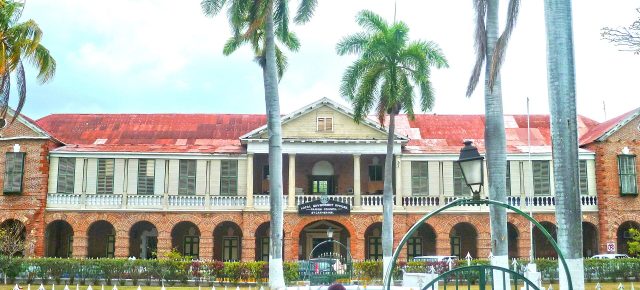
Spanish Town’s museum isn’t just a place where artifacts gather dust behind glass. It’s where Jamaica’s past feels almost tangible, where the weight of history lingers in the air like the scent of old wood and salt from the nearby coast. The building itself is part of the story—one of the few remaining colonial structures in a town that was once the island’s capital. Thick stone walls, wide verandas, and high ceilings speak of a time when Spanish Town was the political and cultural heart of Jamaica, long before Kingston took its place. Walking through its rooms, you can almost hear the echoes of governors’ debates and the distant murmur of a city that once thrived here.
The exhibits span centuries, beginning with the island’s earliest inhabitants, the Taíno. Their world is preserved in fragments—clay pots, stone tools, and shell jewelry—remnants of a culture nearly erased by European arrival. These objects tell a quiet story of people who fished in the island’s rivers and farmed its fertile land long before Jamaica became synonymous with reggae or rum. The museum doesn’t shy away from the darker chapters either. Displays on piracy and the transatlantic slave trade lay bare the brutal struggles for control over the Caribbean, where Jamaica was both a prize and a battleground. Maps, weapons, and personal accounts paint a vivid, if unsettling, picture of an era when the island’s fate was decided by empires far across the sea.
The building’s architecture is a blend of Georgian elegance and practical Caribbean adaptations. Broad verandas shield the interior from the midday sun, while tall windows let in a soft, golden light that dances across the original wooden floors. The grand staircase, worn smooth by centuries of use, leads to rooms where British governors once hosted lavish dinners. Fireplaces, now cold, hint at the rare evenings when the tropical heat gave way to a chill. Outside, the courtyard is a quiet retreat, where the rustle of palm leaves and the occasional call of a bird are the only sounds breaking the stillness.
One of the most compelling sections of the museum focuses on the fight to abolish slavery. Documents, letters, and personal belongings of abolitionists and freed slaves offer a deeply human perspective on this struggle. A yellowed petition signed by enslaved people, a tattered diary kept by a missionary, or a simple wooden spoon carved by someone who had known only chains—these objects don’t just recount history; they make it feel immediate. The exhibit forces you to confront the legacy of slavery, not as a distant chapter in a textbook, but as something that still shapes Jamaica today, in ways both visible and unseen.
The museum also celebrates Jamaica’s cultural contributions, particularly its music. A display of instruments traces the evolution of sound on the island, from the deep rhythms of African drums to the electric guitars that defined reggae. Nearby, costumes from early carnivals and handbills from legendary concerts tell the story of how music became a form of resistance, joy, and identity. There’s something moving about seeing the humble beginnings of artists who would later become global icons, their stories preserved in faded photographs and well-loved instruments.
Spanish Town itself adds to the experience. Once the island’s capital, it now feels like a place where time has slowed. The streets are narrow and quiet, lined with crumbling colonial facades and overgrown gardens. The town’s faded grandeur isn’t sad so much as it is atmospheric—a reminder that history isn’t always about grand monuments, but about the layers of life that accumulate in a place. The museum sits at the heart of this, a quiet guardian of stories that might otherwise be forgotten.
For history enthusiasts, the museum is a must-visit, but even those who usually skip museums might find themselves drawn in. Maybe it’s the tale of a pirate’s last stand off the Jamaican coast, or the account of a slave rebellion that changed the course of the island’s future. Perhaps it’s the personal stories—of a freed woman who built a school, or a musician who played in smoky Kingston clubs before the world knew his name. Or maybe it’s simply the chance to sit in the courtyard, listening to the wind through the trees, and let the past settle over you like the Caribbean dusk.
What makes this museum special is its lack of pretension. There are no flashy displays or dramatic reconstructions, just a straightforward, honest presentation of history. The building doesn’t need to impress—it already has, by surviving wars, hurricanes, and the slow march of time. The exhibits don’t lecture; they invite you to listen, to reflect, and to find your own connection to the stories they tell. Whether you spend an hour or an afternoon here, you leave with more than just facts. You leave with a sense of the people who shaped Jamaica, and the quiet resilience of a place that has seen empires rise and fall, yet still stands.