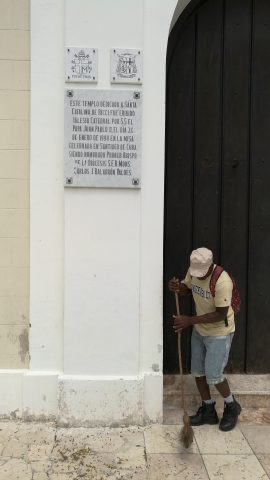
El Cobre is a quiet town in Santiago de Cuba province, one of those places that rarely makes it onto tourist itineraries. Yet here, in the unassuming heart of the town, the past and present of the island intersect in a way that feels both ordinary and profound. The town is best known for its Basilica of Our Lady of Charity, the patron saint of Cuba, but the Revolution Square that sits nearby carries a different kind of significance—one that blends faith, history, and the everyday life of its people.
This small square holds an outsized place in the hearts of Cubans. It’s where official ceremonies unfold, where parades mark national holidays, and where the memory of the country’s struggles is kept alive. At its center stands a statue of José Martí, Cuba’s national hero, depicted not as a soldier but as a poet and thinker, a book in his hand. On any given day, you might find schoolchildren gathered for a lesson in history or locals sitting on benches beneath the shade of trees, watching the world go by. The square isn’t a stage for spectacle; it’s a backdrop for life as it’s lived.
The architecture here is unpretentious, the kind that tells a story without trying too hard. Low colonial-era buildings with arched doorways and wrought-iron balconies frame the square, their faded facades bearing the marks of time. There’s no grandiosity, no polished marble or towering monuments—just the quiet dignity of a place that has seen generations come and go. The cracked pavement and weathered walls aren’t signs of neglect; they’re part of the square’s character, a reminder that this is a space for people, not postcards.
El Cobre’s history is woven into the fabric of Cuba’s fight for independence. In the 19th century, the surrounding hills were a battleground during the Ten Years’ War, the first major uprising against Spanish colonial rule. Later, the nearby Sierra Maestra mountains became a hideout for Fidel Castro’s revolutionaries. The Revolution Square stands as a testament to these struggles, though it doesn’t shout its history. Instead, it whispers it through the faded slogans still visible on some of the buildings, through the way locals speak of the past as something that’s still very much alive.
But the square isn’t just a monument to history—it’s a living part of the town. Mornings bring the scent of fresh fruit and baked goods sold from makeshift stalls, while the air fills with the sound of sizzling *tostones* and the chatter of neighbors catching up. On weekends, music spills into the square—sometimes from a proper band, other times from a lone guitarist strumming a *son cubano* tune. Children kick soccer balls across the pavement, old men play dominoes at rickety wooden tables, and young couples steal glances by Martí’s statue. The square doesn’t just witness life; it absorbs it.
The real pulse of the square becomes impossible to ignore during religious festivals. The Basilica of Our Lady of Charity draws pilgrims from across Cuba, turning El Cobre into a sea of devotion. Thousands gather on the square, bringing flowers to the statue of the Virgin, praying, and then celebrating with music, dance, and food. For many Cubans, this is more than a religious pilgrimage—it’s a journey to the heart of their identity, where faith and national pride intertwine. The square becomes a place of shared stories, where strangers become temporary family over plates of *lechón* and glasses of *prú*.
What makes Revolution Square different from the polished tourist spots is its refusal to perform. There are no souvenir stands, no guides herding visitors through a scripted experience, no crowds posing for photos. Those who come to El Cobre aren’t looking for a postcard version of Cuba; they’re searching for something real, something that exists beyond the resorts and the well-trodden paths. The square offers a glimpse into the Cuba that locals know—the one where history isn’t confined to museums but spills into the streets, where the past isn’t just remembered but lived.
Time moves differently here. There’s no rush, no urgency, just the slow, steady rhythm of a place that has learned to exist outside the demands of the modern world. Maybe that’s why it feels so magnetic. The square doesn’t ask for attention; it simply is. It’s a place where you can sit on a bench, watch the light change over the rooftops, and feel the weight of history pressing gently against your shoulders. El Cobre and its Revolution Square aren’t just dots on a map. They’re a reminder that Cuba’s story isn’t just about revolution or religion—it’s about the quiet, enduring moments in between.