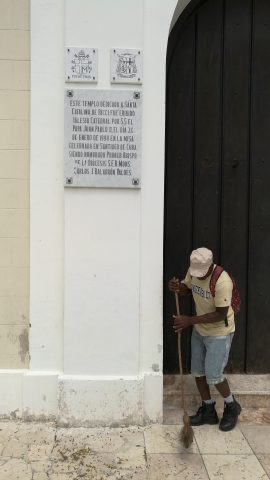
Perched in the hills near Santiago de Cuba, the village of El Cobre holds one of Cuba’s most important spiritual sites. The basilica draws pilgrims from across the island and beyond, its presence shaping the rhythm of life here.
The story begins in the early 1600s, when three enslaved men found a wooden statue of the Virgin Mary washed ashore. The figure, carved from dark wood, held the infant Jesus in one hand and a golden cross in the other. For those living under oppression, it became a symbol of hope. A small chapel was built to house it, and in 1927, the current basilica replaced it—a neoclassical structure with white walls, towering columns, and a domed roof.
Inside, the altar holds the original statue, the same one found centuries ago on the coast. In 1916, Pope Benedict XV declared Our Lady of Charity the patroness of Cuba, making the basilica a national sanctuary.
El Cobre’s significance isn’t only religious. The village feels separate from Cuba’s tourist hubs, where faith and daily life overlap. Pilgrims arrive to pray and leave offerings—candles, flowers, handwritten letters, children’s toys—stacked near the entrance as tokens of gratitude or pleas for help. The atmosphere is quiet, a place where people come to seek answers or celebrate what they believe are miracles.
The most powerful moments happen during major festivals, especially on September 8th, the feast day of Our Lady of Charity. Thousands arrive, some walking for days, to honor the Virgin. The sight of people carrying offerings or singing hymns is striking. Even those who aren’t religious often feel something here.
Life in El Cobre centers on the basilica. The narrow streets, low-slung houses with terracotta roofs, and small shops selling candles and trinkets all serve the pilgrims passing through. Locals share stories of answered prayers and miracles. Many Cubans, regardless of background, feel a personal connection to Our Lady of Charity, believing she offers comfort in hard times.
The basilica has witnessed centuries of Cuban history—the struggles of the enslaved, the ambitions of colonizers, the fervor of revolutionaries, and the resilience of ordinary people. It has become a symbol of unity, where social and racial divides fade in shared faith. The building bridges past and present, a reminder of the values that shaped the island.
Visiting El Cobre reveals a side of Cuba most tourists miss. There are no resorts or crowds, just devotion and the slow pace of a village that feels untouched by time. The basilica sits on a hill, its steps overlooking a valley once filled with sugarcane plantations, now dotted with banana trees and fields. The landscape holds its own history, where the land and people’s faith remain connected.
For those who make the journey, El Cobre is more than a stop. Some leave written prayers in the basilica’s walls, others light candles, and many sit in silence. The place slows time, making the past feel close. It’s where people come to ask questions, seek comfort, or simply be still. In a world that moves quickly, El Cobre offers something rare: a moment where faith and history meet.