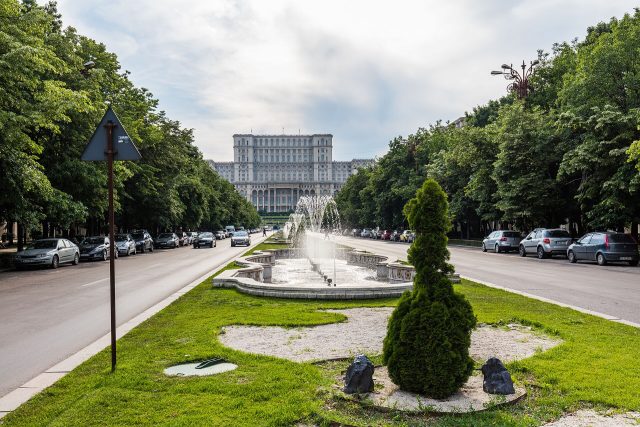
Revolution Square is one of those places where history feels almost tangible, as if the past lingers in the air just a little longer than elsewhere. Located in the heart of Bucharest, it has been a silent witness to some of the most pivotal moments in Romania’s modern story. The square itself is not particularly grand in scale, but its significance far outweighs its size. Surrounded by buildings that tell their own tales of power, change, and resilience, it serves as a kind of open-air museum where the layers of time are visible in the architecture and the very stones underfoot.
The square’s origins trace back to the late 19th century, when Bucharest was expanding rapidly under the influence of European trends. Back then, it was known as Palace Square, named for the Royal Palace that still stands at its northern edge. The palace, now home to the National Museum of Art of Romania, was once the residence of the country’s monarchs. Its neoclassical façade, with its columns and symmetrical design, reflects the ambitions of a young kingdom eager to assert itself on the European stage. Over the decades, the square became a stage for royal ceremonies, military parades, and public gatherings, each event adding another thread to its rich tapestry.
The most dramatic chapter in the square’s history unfolded in December 1989, when it became the epicenter of the Romanian Revolution. For days, thousands of people gathered here to protest against the regime of Nicolae Ceaușescu, the communist leader whose rule had grown increasingly oppressive. The protests turned violent, and the square saw clashes between demonstrators and security forces. It was here, from the balcony of the former Central Committee building, that Ceaușescu delivered his final speech on December 21, only to be met with jeers and defiance. The moment marked the beginning of the end for his regime, and the square’s name was later changed to Revolution Square in honor of those who stood against tyranny.
The buildings around the square offer a fascinating contrast of styles and eras. The former Central Committee building, now the Senate of Romania, is a stark example of socialist architecture—functional, imposing, and devoid of ornamentation. Its plain façade stands in sharp contrast to the more ornate structures nearby, like the Athénée Palace Hotel, a grand belle époque building that has hosted diplomats, spies, and travelers since the early 20th century. The hotel’s elegant interiors and storied past make it a quiet reminder of Bucharest’s cosmopolitan heyday, when the city was known as the "Paris of the East."
At the center of the square stands the Memorial of Rebirth, a towering obelisk-like monument that commemorates the victims of the 1989 Revolution. Its modern design, with a golden crown piercing the sky, is meant to symbolize the rebirth of Romania after decades of communist rule. The monument is often a gathering place for those who come to reflect on the past or to mark anniversaries of the revolution. Nearby, the statue of Iuliu Maniu, a key political figure in Romania’s interwar period, adds another layer of historical context. Maniu, a leader of the National Peasants' Party, was a vocal opponent of both fascism and communism, and his legacy is still debated today.
Beyond its historical weight, Revolution Square is also a place where everyday life unfolds. Locals pass through on their way to work or meet friends at one of the nearby cafés. Tourists pause to take photos or to read the plaques that dot the square, each one a small window into a different moment in time. The square is not just a relic of the past; it’s a living part of the city, where the rhythms of modern Bucharest intersect with the echoes of history. On quiet afternoons, the sound of trams clattering along the nearby streets mixes with the murmur of conversations, creating a soundtrack that feels both timeless and immediate.
One of the most striking things about Revolution Square is how it encapsulates the contradictions of Bucharest itself. The city has always been a place of contrasts—between old and new, East and West, grandeur and decay. The square reflects this duality, with its mix of architectural styles and its role as both a symbol of resistance and a backdrop for daily life. It’s a place where you can stand in the shadow of a monument to revolution and then turn to see a bustling street lined with shops and restaurants, a reminder that history is never just about the past.
For those who take the time to explore, the square offers more than just a lesson in history. It’s a place to sit on a bench and watch the world go by, to imagine the crowds that once filled this space, or to simply soak in the atmosphere of a city that has seen so much change. The buildings around the square tell their own stories, from the grandeur of the Royal Palace to the utilitarian lines of the former communist headquarters. Each one is a piece of the puzzle that is Bucharest, a city that has reinvented itself time and again.
Revolution Square is not the kind of place that demands attention with flashy attractions or tourist traps. Instead, it invites you to slow down and pay attention to the details—the way the light falls on the buildings in the late afternoon, the stories etched into the stone, the quiet dignity of the monuments. It’s a place where history is not just something you read about but something you can feel, if you let it. And in a city as layered as Bucharest, that’s a rare and precious thing.