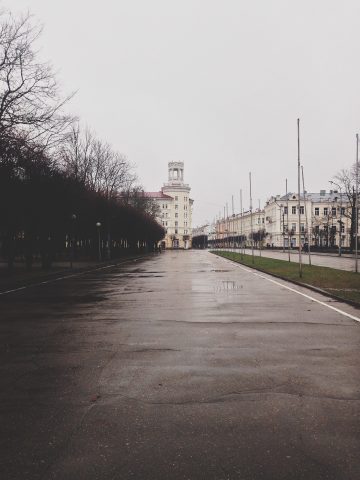
History isn’t just remembered at Victory Square—it’s felt. The square sits where Smolensk’s main streets meet: roads to the train station, the old town, and newer districts all converge here. But it’s more than a crossroads. The memories of war shape the city’s identity, and this is where they settle.
The square took shape after the war. When Soviet forces liberated Smolensk in 1943, much of it lay in ruins. Retreating German troops had left buildings, bridges, and railway tracks in rubble. Reconstruction was slow, but Victory Square was one of the first projects to rise. It wasn’t just a public space—it was a memorial to those who had fought and fallen.
At its center stands a monument to the heroes of the Great Patriotic War. A tall obelisk is crowned with bronze figures of soldiers, mid-stride as if still marching. The names of Smolensk’s Heroes of the Soviet Union—those who defended the city and never returned—are carved into the base. Nearby, the Eternal Flame burns on days of remembrance.
The architecture around the square reflects the era it was built in. The buildings are Soviet neoclassicism: clean lines, grand columns, symmetry. After the war, the Soviet Union often used classical forms to project stability. One of the most prominent structures is the Smolensk State University building. It was among the first restored, a sign of how deeply education was tied to the city’s hopes.
Today, Victory Square is where life goes on. People meet here. Families stroll. Visitors pause to take photos against the monument. On May 9th, the square becomes the heart of the city’s celebrations. Ceremonies, wreath-laying, and wartime songs fill the air. But even on ordinary days, time slows just enough to let you reflect.
The square has changed over the years. In the 1960s, a fountain was added. Children ran through its spray on hot days. Adults sat on benches, watching them play. The fountain is gone now, replaced by flowerbeds, but older residents still remember it.
For visitors, Victory Square is a starting point. From here, it’s a short walk to the Assumption Cathedral, one of the city’s oldest churches. Nearby are the fortress walls built during the reign of Boris Godunov. Museums tell the story of the region’s history, but the square itself offers plenty to see. You can study the monument’s details, read memorial plaques, or sit on a bench, watching the city go by.
Smolensk’s history is difficult. Victory Square is where that history feels most present. It doesn’t demand attention. Its power lies in simplicity. Memory, respect, and silence—nothing more. The past isn’t just remembered here. It’s honored.