Smolensk’s fortress wall is one of those rare places where history isn’t just remembered—it lingers in the air, in the texture of the stone, in the way the light falls across its ancient towers. Built at the turn of the 17th century under Boris Godunov’s decree, it was more than a defensive structure; it became a symbol of the city’s resilience, a silent witness to centuries of sieges, battles, and the quiet, everyday life that persisted despite them. Even today, after so much has been lost to time, the wall’s remaining fragments stretch across the city like a tangible thread connecting past and present.
The decision to build the fortress came at a turning point in military history. By the late 16th century, the old wooden fortifications that had once protected Russian cities were no match for gunpowder and artillery. Godunov turned to Fyodor Kon, the master architect behind Moscow’s White City walls, and tasked him with creating an impregnable stronghold. The construction was nothing short of monumental. In just six years, from 1595 to 1602, thousands of craftsmen and laborers—many of them peasants conscripted for the work—raised a wall nearly six and a half kilometers long, using local white stone and brick. Legends claim that egg whites were mixed into the mortar to strengthen the masonry, though historians still debate whether this was practical or merely a tale born of admiration for the builders’ skill.
What remains of the wall today is only about a third of its original length, but even these fragments reveal the scale of the vision behind it. The walls were massive, reaching up to eighteen meters in height in places, with a thickness of five meters in some sections. Along its perimeter stood thirty-eight towers, each designed for a specific purpose. Some served as watchtowers, others housed cannons, and a few, like the Molokhov Gates, functioned as grand entrances where merchants, diplomats, and travelers once passed through. Each tower had its own character, its own story etched into the weathered stone. The Dnieper Gates, for instance, rise dramatically above the river, offering a view of the landscape beyond—a reminder of how the fortress was not just a military structure but a part of the land itself.
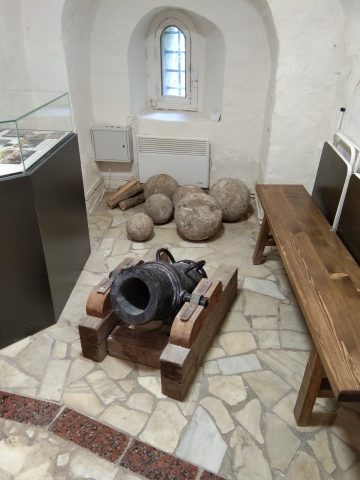
The wall’s most famous trial came in 1609, during the Polish intervention. For twenty months, Smolensk withstood a brutal siege by the forces of King Sigismund III. Though the city eventually fell, the defenders’ stubborn resistance became legendary, a testament to the fortress’s strength and the determination of those who fought for it. Over two centuries later, during Napoleon’s invasion in 1812, the wall again became a battleground. The French army briefly occupied Smolensk, but the fortress held, its stones bearing the scars of cannon fire and the weight of history. A memorial plaque on one of the towers now marks this chapter, a quiet acknowledgment of the lives lost and the city’s unbroken spirit.
Walking along the surviving sections of the wall, it’s easy to imagine the countless people who have passed this way over the centuries. Merchants with carts of goods, soldiers marching to defend the city, townspeople going about their daily routines—all of them would have seen these same stones, felt the same wind coming off the Dnieper. The wall isn’t just a relic; it’s a living part of Smolensk’s identity, woven into the fabric of the city. In some places, the fortifications have been restored, like the Veselukha and Donets towers, while in others, only fragments remain, their crumbling edges softened by time and ivy. Yet even in its incomplete state, the wall has a presence that’s hard to ignore.
For locals, the fortress is an everyday sight, something they pass without a second thought. But for visitors, it often comes as a revelation. Unlike more famous landmarks, Smolensk’s wall doesn’t attract crowds, which only adds to its charm. There’s a sense of discovery in wandering its length, climbing the worn steps of the towers, or pausing on one of the viewing platforms to watch the city below. The absence of tourist hordes means you can take your time, lingering in the quiet corners where the past feels especially close. Afterward, it’s natural to step into one of the nearby cafés, where the murmur of conversation and the clink of cups provide a contrast to the stillness of the ancient stones.
In recent years, the fortress has found new life as a venue for cultural events. Historical reenactments, open-air concerts, and festivals now bring the walls to life in unexpected ways. Some of the most striking moments come during military history events, when actors in period costumes recreate scenes from the past, their voices echoing across the same ground where real battles once raged. These performances aren’t just entertainment; they’re a way of keeping history alive, of making sure the stories of those who built and defended the fortress aren’t forgotten.
What makes Smolensk’s fortress wall so compelling isn’t just its age or its architectural grandeur. It’s the way it embodies the layers of history that have shaped the city—and, by extension, the country. The wall has seen triumph and defeat, peace and war, the rise and fall of empires. It has been a barrier and a gateway, a symbol of strength and a reminder of vulnerability. Time has worn it down, but it still stands, a silent guardian of the past. And in a world where so much history is reduced to dates and names in textbooks, that’s something rare: a place where you can touch the past, feel its weight, and understand, if only for a moment, what it meant to live in its shadow.