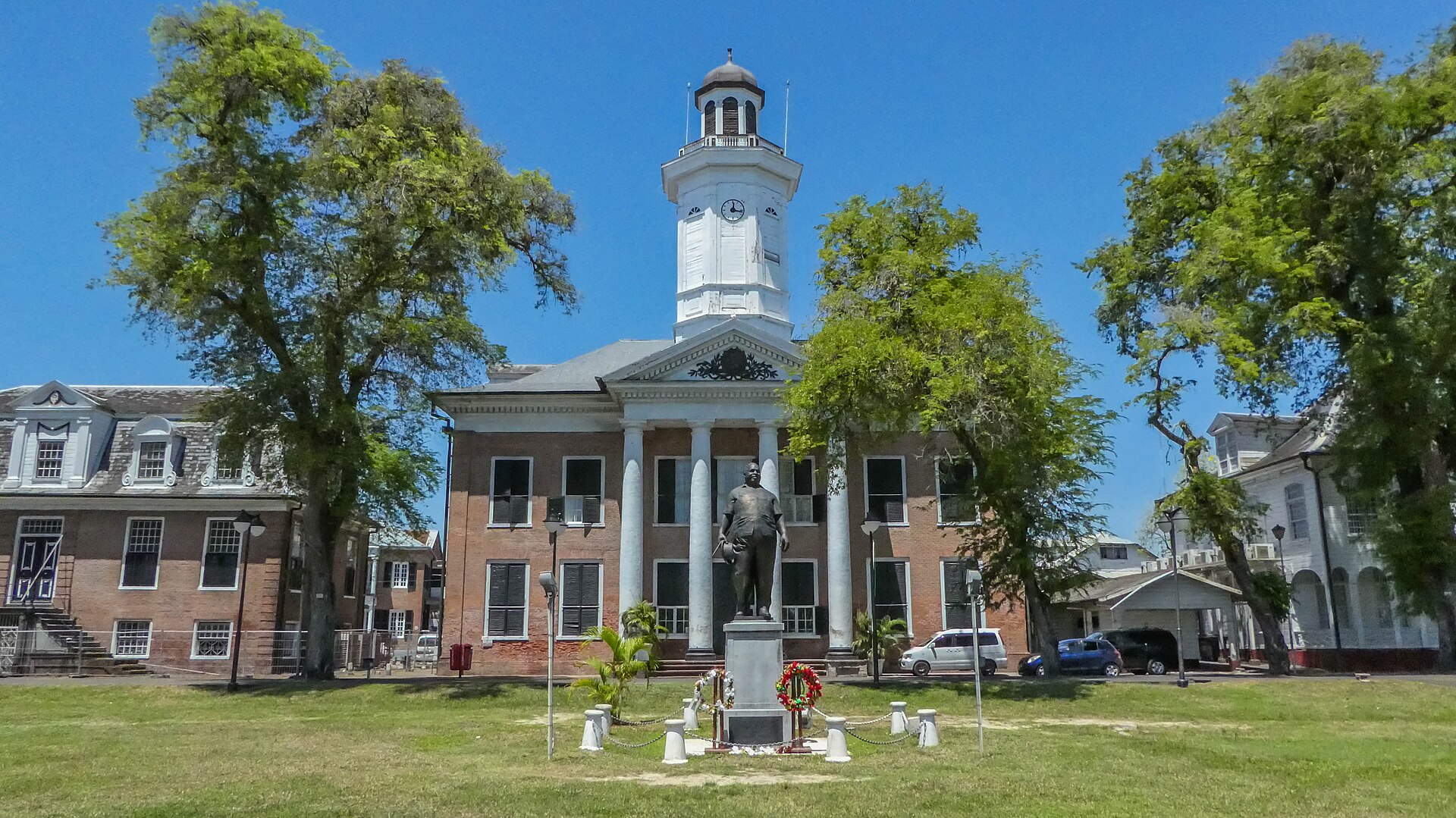
Paramaribo’s Independence Square is one of those places where the city’s past and present seem to settle into an easy rhythm. It sits at the heart of the capital, a broad expanse of paved space framed by some of Suriname’s most important buildings. The square isn’t just a patch of open ground—it’s where the country’s history has played out in public view, from colonial rule to the moment Suriname stepped into its own as an independent nation.
The square’s origins trace back to the Dutch colonial era, when Paramaribo was a key administrative center in the Guianas. The layout and many of the surrounding structures still reflect that period, though the city has long since moved beyond it. The most striking building here is the Presidential Palace, a grand white structure with a neoclassical facade that dominates the northern side of the square. Built in the 18th century, it was originally the residence of the Dutch governor and later became the seat of Suriname’s government after independence in 1975. The palace isn’t open to the public, but its presence is impossible to ignore—it stands as a quiet symbol of both continuity and change.
Across from the palace, the National Assembly building completes the square’s political axis. This is where Suriname’s parliament meets, a more modern structure that contrasts with the older architecture around it. The building’s design is functional rather than ornate, a reflection of its role as a working government institution rather than a historical monument. Between the two, the square itself serves as a kind of open-air stage for national events, from official ceremonies to public gatherings. On ordinary days, though, it’s just a place where people cross on their way to work or pause for a moment in the shade of the trees that line its edges.
The square’s architecture tells a story of layers, where different eras have left their mark without entirely erasing what came before. The wooden buildings that surround it are a hallmark of Paramaribo’s historic center, a UNESCO World Heritage site. These structures, with their wide verandas and intricate fretwork, are a blend of Dutch colonial design and local craftsmanship, adapted to the tropical climate. The materials—mostly timber—were chosen for their ability to withstand the heat and humidity, and the result is a style that feels distinctly Surinamese. Even the newer buildings, like the Ministry of Finance on the eastern side, have been designed to complement rather than overshadow the older ones.
Beyond its political significance, Independence Square is also a social space. In the early mornings, it’s common to see joggers circling the perimeter or groups practicing yoga under the trees. By midday, office workers from nearby buildings fill the benches, eating lunch or scrolling through their phones. In the evenings, the square takes on a different character—quieter, but still alive with the hum of the city. Street vendors sometimes set up near the edges, selling snacks or cold drinks, and on weekends, families might bring their children to play in the open space. It’s not a tourist attraction in the traditional sense, but that’s part of its charm. The square feels like a place where Paramaribo’s residents actually live, not just a backdrop for visitors.
The name itself—Independence Square—marks a turning point in Suriname’s history. Before 1975, it was known as Oranjeplein, named after the Dutch royal family. The renaming was one of the first acts after independence, a deliberate step away from colonial ties. Yet the square doesn’t feel like a place of rupture. Instead, it embodies the way Suriname has navigated its past, neither rejecting its history nor being defined by it. The Dutch influence is still visible in the architecture, the Creole culture is present in the way people use the space, and the indigenous and Maroon heritage, though less immediately obvious, is part of the broader story of the country.
For visitors, the square offers a glimpse into Paramaribo’s daily life, but it’s also a place to reflect on what independence means in a country with such a complex past. Suriname’s path to self-rule wasn’t straightforward—it involved decades of negotiation, political shifts, and, eventually, a peaceful transition. The square doesn’t commemorate any single event so much as it represents the ongoing process of building a nation. There are no grand monuments here, no towering statues. Instead, the significance lies in the ordinary: the way the light falls on the palace’s white walls in the late afternoon, the sound of footsteps on the pavement, the way the city seems to breathe around it.
If you spend enough time here, you’ll notice that the square changes with the seasons. During the dry months, the trees provide just enough shade to make the heat bearable, and the open space feels expansive. When the rains come, the square can flood in places, turning the pavement into temporary pools that reflect the surrounding buildings. The city adapts, as it always has. Locals know which paths to take to avoid the worst of the water, and life goes on. It’s a reminder that Paramaribo, like Suriname itself, is a place of resilience.
Independence Square isn’t the kind of place that demands attention. It doesn’t have the drama of a waterfall or the allure of a bustling market. But that’s what makes it worth lingering in. It’s a space where history isn’t just preserved in stone or bronze—it’s lived, day by day, by the people who walk across it. Whether you’re here for a few minutes or a few hours, the square offers a quiet kind of insight into what makes Paramaribo, and Suriname, unique.