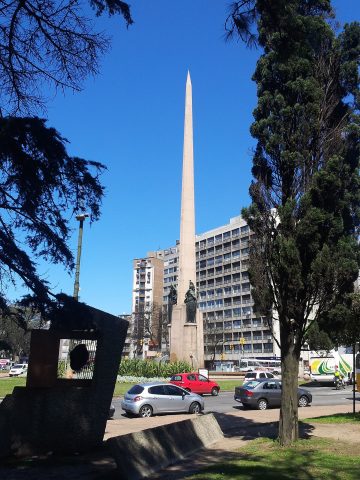
Plaza Independencia isn’t just the geographical center of Montevideo—it’s where Uruguay’s past feels most tangible. This square has witnessed the country’s evolution from a colonial outpost to an independent nation, and every stone here seems to carry a fragment of that story. At its heart stands the imposing monument to José Gervasio Artigas, the man whose name is synonymous with Uruguay’s struggle for sovereignty. His bronze figure dominates the space, not just as a statue, but as a reminder of the ideals he fought for: democracy, equality, and the right to self-determination.
Artigas wasn’t merely a military leader; he was the architect of Uruguay’s early statehood. His resistance against Spanish rule and later Brazilian domination turned him into a national symbol, and the monument erected in his honor in the mid-20th century reflects that legacy. Beneath the towering pedestal lies his mausoleum, a quiet, solemn space that few visitors enter, yet its presence adds weight to the square. It’s as if the very ground here is charged with history, a place where the past isn’t just remembered—it’s felt.
The buildings surrounding the plaza tell their own stories. The Palacio Estévez, with its grand columns and ornate façade, was once the residence of one of Uruguay’s wealthiest families and now serves as a museum. Its opulence contrasts with the more restrained City Hall next door, a building that embodies the practical side of governance. Then there’s the Teatro Solís, Montevideo’s oldest theater, which has stood here since the 19th century. Its neoclassical design and cultural significance make it a natural gathering point, a place where art and history intersect.
But Plaza Independencia isn’t just a stage for monuments and architecture. It’s a living part of the city, where daily life unfolds in all its ordinary and extraordinary moments. Office workers rush past in the mornings, students linger on the benches, and tourists pause to take photos. In the evenings, the square softens under the glow of streetlights, and the shadows of Artigas’s statue stretch across the pavement, blurring the line between past and present. During the summer, the plaza comes alive with open-air concerts and festivals, while in winter, it takes on a quieter, almost contemplative mood—especially rare when a dusting of snow transforms the scene.
One of the most striking features of the plaza is the Puerta de la Ciudadela, the last remaining fragment of the old fortress that once guarded Montevideo. Built in the 18th century, these massive stone gates are a relic of a time when the city was a strategic Spanish stronghold. Today, they stand as a quiet counterpoint to the modern buildings around them, a tangible link to the colonial era. Walking through the arch feels like stepping into another century, a reminder that Montevideo’s history isn’t confined to museums—it’s woven into the fabric of the city itself.
For Uruguayans, Plaza Independencia is more than a tourist attraction. It’s a place of national pride, where Independence Day celebrations, political rallies, and even wedding photos take place. Children play under the shade of the plane trees, while older generations sit on the benches, watching the world go by. There’s a sense of continuity here, a feeling that the square belongs to everyone, regardless of why they’ve come. Even longtime residents still notice its details—the way the light catches the windows of the Palacio Estévez, the rustle of leaves in the breeze, the echo of footsteps on the cobblestones.
The plaza has evolved alongside the city. Once the site of military parades and political protests, it’s now a space for leisure and reflection. Yet its role as a symbol of Uruguayan identity remains unchanged. In a country with a turbulent history, Plaza Independencia serves as a reminder that independence isn’t just a historical event—it’s an ongoing process, shaped by the people who walk its paths. That’s why it continues to matter, whether you’re here to learn about the past, admire the architecture, or simply soak in the atmosphere of Montevideo’s beating heart.