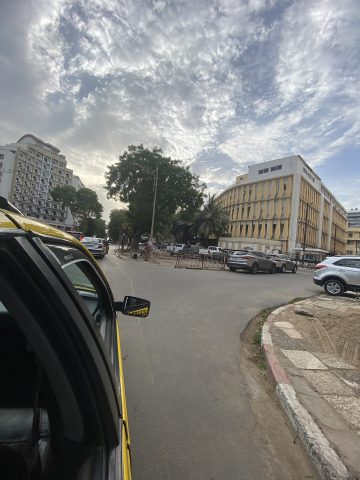
Independence Square is where Dakar breathes. Perched on the plateau that gives the district its name, it overlooks the Atlantic, serving as both a geographical anchor and a living record of Senegal’s past. The square doesn’t just sit at the city’s center—it pulses with its rhythm. Mornings bring a stream of civil servants and students hurrying to work, their footsteps blending with the hum of traffic. By midday, the pace slows as visitors wander past colonial-era buildings, pausing to watch street vendors arrange pyramids of oranges or roasted peanuts. As the sun dips, the air fills with the scent of grilled fish and the sound of kora players tuning their instruments. The square isn’t a static monument; it’s a stage where the city’s daily life unfolds in real time.
Its history mirrors Senegal’s journey from colony to sovereign nation. Originally known as Place du Protectorat, the square was the administrative heart of French West Africa, lined with the offices of colonial rule. After independence in 1960, it was renamed to mark a new chapter, though the buildings that frame it still bear the marks of an earlier era. The Presidential Palace, an imposing structure with its neoclassical columns, stands as a reminder of both continuity and change. Nearby, ministries with their ornate facades and shaded verandas tell a similar story—architecture that was once a symbol of foreign control, now repurposed for a nation finding its own voice.
The square’s design reflects this layered past. The buildings, with their high ceilings and wide balconies, were built to withstand the heat, a practical choice that also lent them a sense of grandeur. French influences are evident in the arches and pilasters, but look closer and you’ll find details that root the space in Senegalese culture. The post office, for instance, is adorned with mosaics depicting traditional patterns, while the stonework on some facades echoes the geometric motifs found in local crafts. It’s a blend that feels organic rather than imposed, as if the square grew into its current form rather than being designed all at once.
More than just a public space, Independence Square is where Senegal’s civic life plays out. National holidays bring parades and speeches, with crowds gathering to watch military displays or listen to politicians outline the country’s future. On April 4th, the anniversary of independence, the square becomes the focal point of celebrations, with music, dance, and fireworks lighting up the night. Even on ordinary days, it’s a place of gathering—vendors selling everything from handwoven baskets to cold bissap, artists sketching portraits for passersby, and children darting between the palm trees. The atmosphere is rarely solemn; there’s always something happening, whether it’s a spontaneous drum circle or a group of friends sharing a meal on the steps of a government building.
At the center of the square stands the Monument to Independence, a bronze figure breaking free from chains. It’s a powerful symbol, but the monument isn’t just a relic of the past. Locals use the space around it as a meeting point, a place to rest in the shade of the palms or snap photos with the city as a backdrop. The area is rarely empty—someone is always sitting on the benches, chatting, or simply watching the world go by. The monument’s message of freedom feels tangible here, not because of any grand ceremony, but because the square itself embodies that spirit in its everyday chaos.
Independence Square also serves as a gateway to the rest of Dakar. From here, it’s a short walk to the Corniche, where the ocean breeze cuts through the heat, or to Sandaga Market, where the scent of spices mingles with the chatter of shoppers haggling over fabric and jewelry. The port is nearby too, with ferries departing for Gorée Island, a place that carries its own weight in history. The square’s location makes it an ideal starting point for exploring the city, but it’s more than just a convenient landmark. It’s a place where Dakar’s different faces—administrative, commercial, cultural—converge, offering a glimpse of how the city functions beyond the tourist brochures.
As evening falls, the square transforms. The streetlights cast a warm glow on the colonial facades, softening their stern lines. Musicians set up near the monument, their melodies weaving through the sounds of laughter and conversation. The air is thick with the smell of grilled yassa chicken and fresh mangoes, sold from carts that line the edges of the square. Locals come here to unwind, dancing to the rhythm of sabar drums or simply enjoying the cooler air. For visitors, it’s a chance to see Dakar at its most relaxed, when the city’s energy shifts from the urgency of the day to the slower, more communal pace of night.
What makes Independence Square special is its lack of pretension. There are no barriers or entry fees, no rules about where you can sit or what you can do. You can buy a glass of ginger juice from a vendor, perch on a low wall, and watch the square’s mood change with the light—from the crisp focus of morning to the golden haze of late afternoon. It’s a place where history isn’t preserved behind glass but lived out in the open, where the past and present coexist without fuss. That informality is why it feels so alive, why it belongs as much to the office workers in suits as it does to the artists selling paintings on the sidewalk. In a city that’s always moving, Independence Square is one of the few places where Dakar slows down just enough to let you catch your breath.