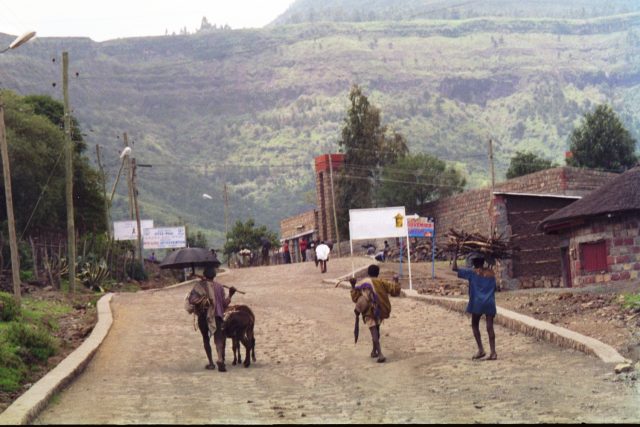
Independence Square in Butajira is the kind of place that doesn’t announce itself with grand monuments or flashy signs. Instead, it quietly anchors the heart of the town, where the main streets converge and daily life unfolds in its most unfiltered form. There are no tourist traps here, no polished facades—just the steady rhythm of a small Ethiopian city going about its business. Vendors spread their goods on makeshift stalls, children dart between the shade of the trees, and elders gather on benches to exchange stories. The square isn’t so much a landmark as it is a stage, where the ordinary moments of life play out in full view.
The history of Independence Square is woven into the broader story of Ethiopia itself. Butajira may not be one of the country’s most famous cities, but its role as a trade and transport hub in the south has always given it a quiet importance. The square emerged naturally in the mid-20th century, as the town expanded and needed a central space for gatherings, commerce, and public life. This was a time of upheaval for Ethiopia—fresh from Italian occupation and on the cusp of decades of internal change. The square became a symbol of resilience, a place where people could come together to discuss the shifting tides of their country or simply find a moment of rest in uncertain times.
The architecture here is unassuming, built for function rather than spectacle. Low-slung buildings of local stone and clay line the square, many dating back to the colonial era. Their sun-bleached facades carry the marks of time, but that only adds to the place’s character. Some structures bear traditional Ethiopian geometric patterns, a subtle nod to the country’s artistic heritage. At the center, a small grove of trees offers shade from the midday heat, while temporary stalls pop up for markets or festivals, transforming the space as needed.
For locals, the square is far more than a physical location—it’s a living part of their daily routine. Mornings bring farmers from nearby villages, their stalls piled with fresh produce, grains, and spices. By midday, the air fills with the rich aroma of coffee, brewed in the traditional *jebena* clay pots right on the pavement. Coffee in Ethiopia isn’t just a drink; it’s a ritual. You might see a woman roasting beans over charcoal, grinding them by hand, and carefully pouring the thick, spiced brew into tiny cups. The ceremony can stretch for hours, drawing in neighbors and passersby, turning a simple act into a communal experience.
As the sun dips lower, the square takes on a different energy. Families stroll in the cooler evening air, young people gather in groups, and elders settle in for games of *gabata*, a traditional board game. Sometimes, impromptu music sessions break out—local musicians plucking the strings of a *krar* or drawing haunting melodies from a single-stringed *masenqo*. The sounds blend with the hum of conversation, the occasional burst of laughter, and the distant rumble of motorbikes, creating the kind of lively, layered noise that defines Ethiopian public spaces.
Independence Square isn’t the kind of place that makes it onto postcards or travel brochures. There are no museums, no high-end restaurants, no guided tours. But that’s precisely what makes it worth lingering over. Here, you won’t find a curated version of Ethiopia—just the country as it is, in all its unvarnished reality. It’s a window into the rhythm of life in a provincial town, a chance to see how people live beyond the capital’s hustle. Even in a place this modest, there’s a sense of history, of culture unfolding in real time.
If you find yourself in Butajira, don’t rush past the square. Take an hour to sit on a bench, watch the world go by, and let the place reveal itself. Buy a cup of coffee from a street vendor, try a piece of *injera* with spicy *wat*, or just listen to the cadence of Amharic or Oromo conversations around you. You might not leave with a checklist of sights seen, but you’ll carry something far more valuable—a deeper understanding of the country and the people who call it home. Independence Square isn’t a monument or a tourist attraction. It’s a living, breathing space, shaped by the people who use it every day, and it continues to exist, quietly and stubbornly, as it always has.