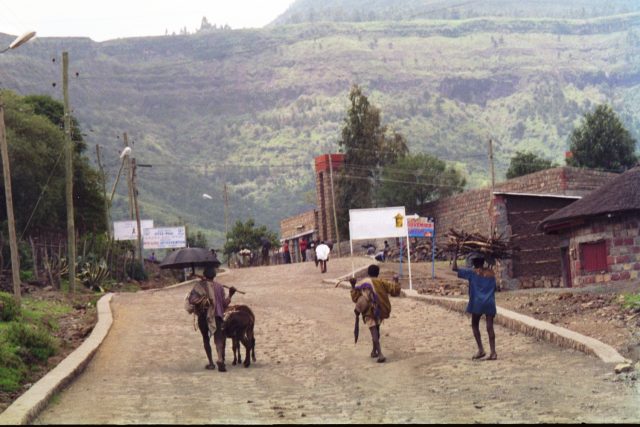
St. George’s Church in Butajira is the kind of place that doesn’t announce itself at first glance. It sits quietly on the edge of town, surrounded by low hills where the air carries the scent of dry earth and woodsmoke. Unlike the famous rock-hewn churches of Lalibela, it doesn’t draw crowds of visitors, and that might be why it feels closer to the Ethiopia that exists beyond guidebooks—unpolished, unhurried, and deeply rooted in the everyday.
The church is dedicated to St. George, one of the most revered figures in the Ethiopian Orthodox tradition. His image appears everywhere here—on icons, frescoes, even the simple woven cloths sold near the entrance. In Ethiopia, St. George isn’t just a saint; he’s a protector, a guardian of the land and its people. Local legends weave his story into the fabric of the region, telling how he aided warriors in battle or once pierced a dragon with his spear to stop a flood that threatened a church’s construction. In Butajira, these stories aren’t just preserved in the church’s walls; they’re alive in the conversations of the people who speak of him with quiet pride.
The architecture is typical of Ethiopian Orthodox churches, yet there’s something distinct about this one. The building is low and sturdy, built from dark stone that has weathered over time, its surface softened by age. The roof is flat, with a small dome over the altar, and the walls are adorned with simple but striking frescoes. Inside, the church follows the traditional three-part layout: an outer courtyard, a middle section for worshippers, and the inner sanctum, accessible only to priests. The floors are packed earth, worn smooth in places, and light filters through narrow windows, casting a dim glow that makes the flickering oil lamps before the icons seem all the brighter.
No one knows the exact year the church was built, but it dates back to the early 20th century. At the time, Butajira was a small settlement along a trade route connecting southern and northern Ethiopia, and the church became more than just a place of worship—it was a gathering point for the community. People came here not only to pray but to settle disputes, share news, and even trade goods. The old trees around the church still stand, their shade once offering rest to travelers, and nearby, a well whose water is said to have healing properties.
Inside, the air is thick with the scent of incense and beeswax, and the walls bear the soot of countless candles. The frescoes, though darkened by time, remain visible, depicting biblical scenes reimagined through an Ethiopian lens. On one, King Solomon meets the Queen of Sheba, but their features and clothing are unmistakably local, a reflection of how sacred stories have always been adapted to fit the culture here. It’s not a matter of artistic license; it’s how faith takes root in a place, bending to its contours rather than the other way around.
Time moves differently at St. George’s. There’s no rush, no urgency—just the steady rhythm of life governed by the church calendar. The biggest festivals, like Timkat (Epiphany) or Meskel (the Finding of the True Cross), transform the church into a sea of color and sound. Flowers decorate the walls, thousands of candles burn, and the air fills with hymns sung in Ge’ez, the ancient liturgical language of the Ethiopian Church. Even those who aren’t religious come for the sense of community, the way the celebrations seem to bind everyone together, if only for a day.
The church isn’t just a religious site; it’s also an educational one. A school operates here, teaching children the basics of faith, Ge’ez, and traditional crafts. In Ethiopia, the church has long been a cornerstone of education, and Butajira is no exception. Some of the older villagers still remember sitting on these same benches as children, memorizing psalms. For many, St. George’s isn’t just a building—it’s a living part of their history, a thread connecting them to their ancestors.
Beyond the church, the landscape stretches out in quiet folds of land—fields, small villages, and in the distance, mountains that blur into the horizon. If you climb one of the nearby hills, the view opens up: red earth, patches of green crops, and the hazy blue of the highlands. It’s easy to see why this spot was chosen for the church. There’s a stillness here, a sense of being part of something larger than the moment.
St. George’s Church isn’t grand or ornate. It’s humble, almost unassuming, and that’s where its strength lies. There’s nothing here that doesn’t belong—just faith, history, and the people who tend to both. For those who visit, it’s not just another stop on a tour; it’s a quiet revelation, a reminder of how many places in the world exist just like this, where time seems to stand still.