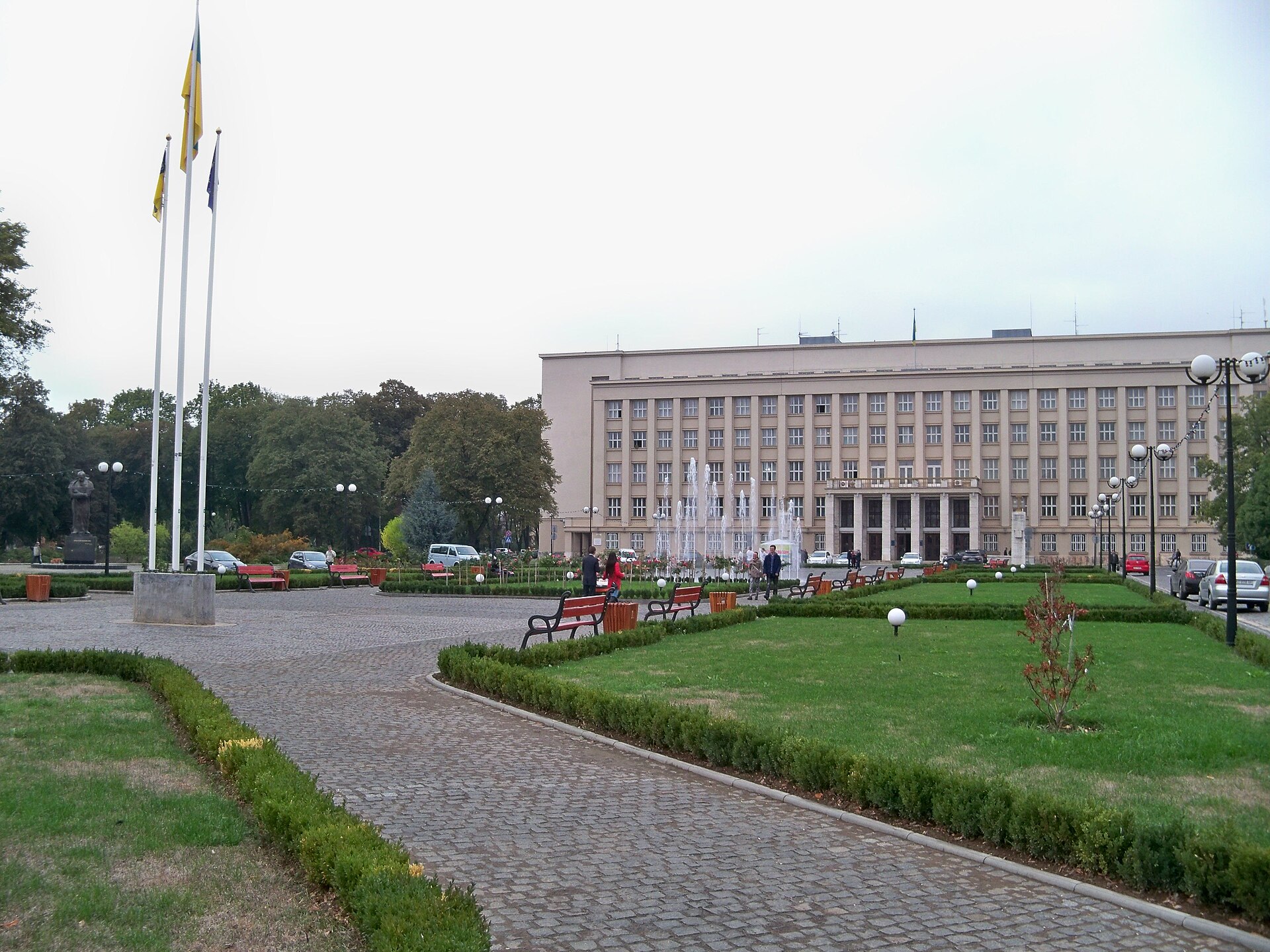
Narodna Square in Uzhhorod is one of those places where the city’s past and present quietly coexist, almost without drawing attention to themselves. Unlike grand central squares in other European cities, this one doesn’t overwhelm with size or pomp. Instead, it feels like a natural extension of the streets around it—lively, unpretentious, and deeply local. The square has been the heart of Uzhhorod for centuries, though its appearance has shifted with time, reflecting the layers of history that have shaped this corner of western Ukraine.
The layout of Narodna Square is simple, almost modest. It’s a rectangular space framed by low-rise buildings, most of which date back to the late 19th and early 20th centuries. Their facades tell a story of architectural influences that have passed through the region: the pastel hues and decorative stucco of Central European towns, the understated elegance of Hungarian Secession, and the practical, slightly austere lines of Soviet-era renovations. Some buildings still bear the marks of their original purpose—former merchant houses, a hotel that once welcomed travelers from across the Austro-Hungarian Empire, or a café where intellectuals and artists gathered in the interwar years. Today, these structures house shops, offices, and small businesses, their ground floors often occupied by cafés or boutiques that spill out onto the pavement in warmer months.
At the center of the square stands a monument that has become its most recognizable feature: a statue of a man holding a book, dedicated to the Ukrainian poet and national figure Taras Shevchenko. Erected in the 1990s, it’s a relatively recent addition, but one that fits seamlessly into the space. Shevchenko’s presence here isn’t accidental—Uzhhorod, like much of Transcarpathia, has long been a crossroads of cultures, and the square has witnessed the ebb and flow of different identities. For decades, this was a place where Hungarian, Ukrainian, Jewish, and Rusyn communities intersected, each leaving their mark on the city’s character. The statue serves as a quiet reminder of that complexity, even as the square itself has become a symbol of modern Ukrainian civic life.
The square’s history is closely tied to the broader story of Uzhhorod. In the Middle Ages, this area was part of the city’s fortified center, though little remains of those early structures. By the 18th century, as Uzhhorod grew under Habsburg rule, the space evolved into a marketplace, a role it retained well into the 20th century. Old photographs show it bustling with vendors selling everything from fresh produce to handmade crafts, their stalls arranged in neat rows. Even today, traces of that market atmosphere linger, especially on weekends when locals gather here to chat, sip coffee, or browse the occasional pop-up stall selling honey, embroidered textiles, or homemade preserves.
What makes Narodna Square special is its lack of pretense. It’s not a place designed for tourists, though visitors do wander through, often pausing to take in the view from one of the benches scattered around the perimeter. Instead, it’s a space for the city’s residents—a place to meet friends, take a shortcut on the way to work, or simply sit and watch the world go by. In the mornings, the square is quiet, with only the sound of footsteps on cobblestones and the occasional clatter of a café opening its doors. By afternoon, it fills with the hum of conversation, the clinking of cups, and the laughter of children playing near the fountain. In the evenings, the streetlights cast a warm glow over the pavement, and the square takes on a more intimate feel, with couples strolling arm in arm or groups of students lingering outside the bars.
The square’s architecture is a testament to the city’s resilience. Many of the buildings here have survived wars, regime changes, and economic upheavals, their facades bearing the scars of time. Some were restored in the decades following World War II, when Uzhhorod found itself under Soviet rule, while others retained their original details, hidden beneath layers of paint or plaster. One of the most striking structures is the former Hotel Ungvár, a grand building with a corner tower that once catered to travelers arriving by train or carriage. Though its interiors have been modernized, the exterior still hints at the elegance of a bygone era. Nearby, a more modest two-story house with a wrought-iron balcony stands as a reminder of the city’s middle-class past, its windows framed by delicate floral motifs.
Narodna Square has also been a stage for the city’s public life. Over the years, it has hosted political rallies, cultural festivals, and even impromptu concerts. During the Orange Revolution in 2004 and the Euromaidan protests a decade later, it became a gathering place for locals expressing their views, their voices blending with the chants of crowds in Kyiv and other cities. In quieter times, it’s a venue for open-air exhibitions, book fairs, or performances by local musicians. The square’s adaptability is part of its charm—it can be a solemn space one moment and a festive one the next, depending on the occasion.
For those who spend time here, Narodna Square is more than just a physical space; it’s a backdrop to everyday life. It’s where an elderly man might feed pigeons in the afternoon, where teenagers gather after school to share headphones and gossip, or where a young couple takes their first photo together. The square doesn’t demand attention, but it rewards those who take the time to notice its details—the way the light hits the cobblestones at dusk, the sound of a street musician playing an old folk tune, or the scent of fresh pastries drifting from a nearby bakery.
In many ways, Narodna Square is a microcosm of Uzhhorod itself: unassuming, layered with history, and deeply human. It doesn’t boast grand monuments or sweeping vistas, but it has a quiet dignity that comes from being lived in, not just looked at. For visitors, it offers a glimpse into the rhythm of the city—a place where the past isn’t preserved in glass cases but woven into the fabric of daily life. And for locals, it remains what it has always been: a familiar, comforting presence at the center of their world.