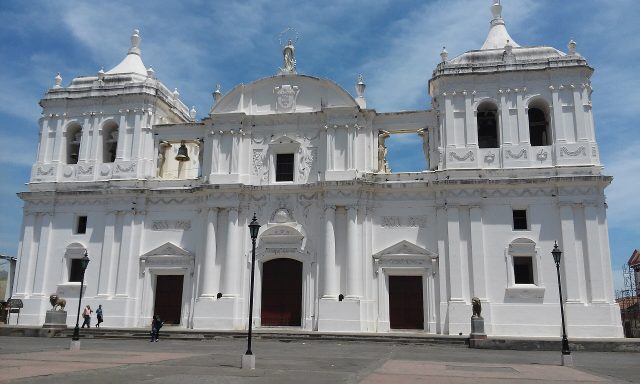
La Merced Square is one of those quiet, unassuming places that feels like the heart of León without ever trying too hard. It sits just a few blocks from the city’s grander plazas, where tourists gather and vendors hawk their wares, but here the pace slows. The square is small, framed by low colonial buildings with pastel facades, their wooden balconies sagging slightly with age. At its center stands the Church of La Merced, a sturdy, whitewashed structure that has watched over the neighborhood for centuries. The church’s bell tower rises above the rooftops, its silhouette familiar to anyone who has wandered León’s streets, though it rarely draws the same crowds as the city’s more famous landmarks.
The square itself is paved with uneven stones, worn smooth by generations of footsteps. Benches line the edges, shaded by trees that offer just enough cover from the Nicaraguan sun. In the mornings, older men gather here to play chess or dominoes, their games unhurried, the pieces clicking softly against the wooden tables. By midday, the square fills with students from the nearby university, their laughter and chatter mixing with the occasional hum of a passing moto-taxi. There’s no grand monument here, no plaque explaining its significance—just the quiet rhythm of daily life, the kind that makes a place feel lived-in rather than staged.
La Merced’s history is woven into the fabric of León in ways that aren’t always obvious. The church was built in the 18th century, though the exact date is lost to time, as is often the case with colonial-era structures in Nicaragua. It was one of many churches constructed by the Spanish to solidify their presence in the region, but unlike León’s cathedral or the Church of San Francisco, La Merced was never meant to be a showpiece. It was a parish church for the neighborhood, a place where locals came to worship, celebrate, and mourn. Over the years, it has survived earthquakes, political upheavals, and the slow decay that comes with time, though its walls still bear the faint scars of repairs and restorations.
The architecture of the church is simple but striking in its own way. The facade is plain, with a single arched doorway and a small rose window above it, the kind of design that prioritizes function over ornamentation. Inside, the space is dimly lit, the air thick with the scent of candle wax and old wood. The altar is modest, adorned with statues of saints that have been repainted countless times, their features softened by layers of pigment. The pews are worn, their wood polished smooth by the hands of generations of worshippers. It’s not a place that inspires awe in the way León’s cathedral does, but there’s a quiet dignity to it, a sense of continuity that makes it feel like a living part of the city.
Beyond the church, the square has always been a gathering place for the people of León. In the 19th century, it was a hub for political discussions, a place where revolutionaries and intellectuals would meet to debate the future of Nicaragua. Rubén Darío, the country’s most famous poet, is said to have walked these streets as a young man, though there’s no plaque to mark the spot. The square has seen its share of protests and celebrations, from the overthrow of dictators to the more mundane festivals that mark the passage of the seasons. Even today, it’s not uncommon to see impromptu gatherings here, whether it’s a group of musicians playing folk songs or a street vendor selling sweet plantain empanadas.
What makes La Merced Square special is its ordinariness. It’s not a place you visit to check something off a list or to take a photo for social media. It’s a place where life happens, unscripted and unfiltered. In the late afternoon, when the sun dips low and the light turns golden, the square takes on a different mood. The shadows lengthen, and the air cools just enough to make sitting outside bearable. Children chase each other around the benches, their shouts echoing off the church walls. A woman sets up a small stand selling refrescos, the ice clinking in plastic cups. The church bells ring, not for a service, but just because it’s time—another day drawing to a close in León.
For those who spend time in the city, La Merced becomes a kind of anchor. It’s where you might stop for a moment of quiet after a long walk through the bustling markets, or where you’ll find yourself drawn when you need to think. The square doesn’t demand attention, but it rewards those who pay it. There’s a sense of timelessness here, a feeling that no matter how much León changes, this small patch of ground will remain, steady and unchanging. It’s the kind of place that doesn’t reveal its secrets all at once, but if you sit long enough, you’ll start to notice the details—the way the light hits the church facade in the morning, the sound of the wind rustling the leaves of the trees, the way the old men nod to each other as they pass.
León is a city of contrasts, where grand colonial architecture stands alongside crumbling adobe walls, and where the energy of a young, vibrant population collides with the weight of history. La Merced Square embodies that duality. It’s neither grand nor forgotten, neither touristy nor completely off the beaten path. It’s just a part of the city, as essential as the streets that lead to it and the people who call it home. And perhaps that’s why it feels so authentic—because it’s not trying to be anything other than what it is. A place where life unfolds, one day at a time, under the watchful gaze of an old church and the endless Nicaraguan sky.