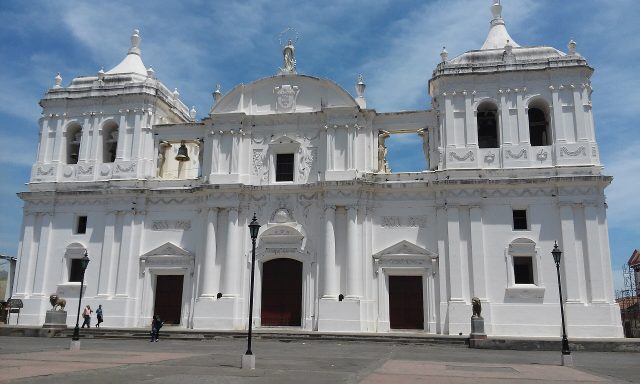
León is a city where history isn’t confined to books or archives but lingers in the worn cobblestones, the faded facades of colonial buildings, and the quiet courtyards where time seems to move at its own pace. The Museum of Traditions and Legends is one of those rare places where the past doesn’t feel distant or preserved behind glass—it feels alive, breathing through stories, crafts, and the everyday rhythms of Nicaraguan life. This isn’t a museum in the conventional sense, with sterile displays and rigid labels. Instead, it’s more like stepping into someone’s home, where the walls whisper tales of folklore, superstition, and the unspoken rules that have shaped communities for generations.
The building itself is a piece of history. Housed in a colonial mansion that once belonged to one of León’s prominent families, it carries the weight of the city’s past in its thick adobe walls and high, wooden-beamed ceilings. The central courtyard, with its trickling fountain, is a quiet nod to the way life was lived here centuries ago, when León was the political and cultural heart of Nicaragua. These were the kinds of houses where deals were struck, revolutions were plotted, and families gathered to share meals and stories. Now, the same spaces invite visitors to explore not the grand narratives of power, but the smaller, more intimate stories that define a people.
The museum’s exhibits are built around the myths and traditions that still echo in the memories of Nicaraguans. Here, you’ll meet La Carina, the ghostly woman in white said to wander riverbanks at night, her presence a warning to those who stray too far after dark. There’s El Cadejo, the mythical dog with glowing eyes, a guardian spirit that walks beside travelers, protecting them from unseen dangers. And then there’s La Segua, the woman with the face of a horse, a cautionary figure who lures men into the shadows. These aren’t just campfire tales—they’re part of Nicaragua’s collective imagination, a way of making sense of a world that can be unpredictable and harsh. The museum doesn’t just present these stories as relics; it shows how they’re still woven into the fabric of daily life, shaping how people think, behave, and even joke with one another.
Beyond the legends, the museum offers a glimpse into the practical side of tradition. One room recreates a potter’s workshop, the clay-streaked wheel and half-finished vessels a testament to a craft that has been passed down for centuries. Nearby, a blacksmith’s forge stands cold, its anvil and tools hinting at the labor that once shaped the tools of everyday life. A merchant’s stall overflows with handwoven baskets, rough-hewn pottery, and textiles dyed in vibrant hues—objects that were once essential to survival but are now often seen as art. These displays aren’t just about the past; they’re a reminder that many of these skills still exist, even if they’ve adapted to modern times. In León, you can still find artisans who keep these traditions alive, whether in backstreet workshops or at the city’s bustling markets.
What makes the Museum of Traditions and Legends different from other museums is its refusal to treat culture as something static. Here, folklore isn’t just preserved—it’s performed, reinterpreted, and kept alive through workshops, music, and storytelling sessions. Visitors might find themselves learning how to weave a hammock, listening to a marimba band play under the stars, or sitting in the courtyard while a local storyteller recounts the latest twist on an old legend. The museum doesn’t just document tradition; it invites people to participate in it, blurring the line between observer and participant. This is a place where culture isn’t something you look at—it’s something you feel, whether through the rhythm of a drum or the rough texture of hand-spun thread.
León has long been a city of artists and students, a place where creativity thrives in the spaces between history and modernity. The museum reflects that energy, often hosting exhibitions by local craftspeople who reimagine traditional motifs in contemporary ways. Sometimes the displays shift to highlight forgotten customs or explore how old stories take on new meanings in today’s world. It’s a reminder that culture isn’t a fixed thing—it evolves, just as the people who carry it do. The museum doesn’t just tell stories; it gives them room to grow, ensuring that the next generation of Nicaraguans will have their own versions to pass down.
Walking through the museum, you won’t find the usual museum etiquette—no ropes keeping you at a distance, no signs demanding silence. Some exhibits invite touch, and the guides, often locals with deep ties to the traditions on display, are more than happy to answer questions or share personal anecdotes. There’s a sense of warmth here, as if the museum itself is extending an invitation to linger, to ask, to connect. It’s the kind of place where you might find yourself losing track of time, drawn into a conversation about the meaning behind a particular ritual or the origins of a folk song.
The Museum of Traditions and Legends isn’t a place you can rush through in an hour. To really understand it, you need to slow down, to let the stories sink in and consider why these traditions still matter. Afterward, you might find yourself seeing León differently—not just as a city of colonial churches and revolutionary murals, but as a living archive of the beliefs, skills, and quirks that make Nicaragua what it is. The streets become an extension of the museum, where every corner shop, every street musician, every hand-painted sign might hold another piece of the story. In León, history isn’t just something you learn about; it’s something you step into, one legend at a time.