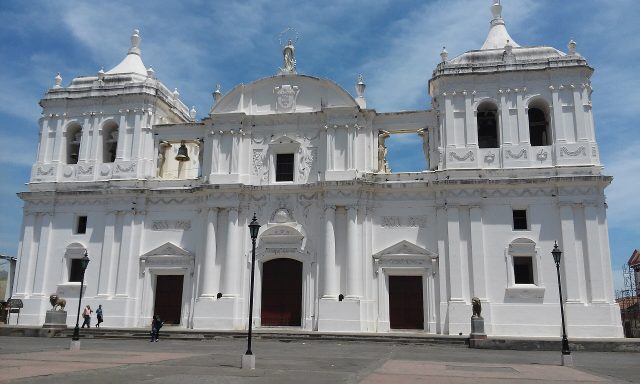
León Cathedral stands as one of those rare places where history isn’t just remembered—it lingers in the air, in the weight of the stones, in the quiet echoes of footsteps across its worn floors. Built in the early 1700s, it has witnessed the rise and fall of empires, the tremors of earthquakes, and the shifting tides of a nation’s identity. Yet it remains, steadfast and unshaken, a silent guardian of León’s past. From the outside, its architecture might seem deceptively simple—a blend of Baroque and Neoclassical styles that favors solidity over ornamentation. Thick walls and sturdy columns speak of an era when buildings had to endure not just time, but the unpredictable forces of nature. There’s a certain humility to its facade, a reminder that grandeur wasn’t always about excess, but about resilience.
Step inside, and the atmosphere shifts. The high ceilings and spacious nave are bathed in soft, filtered light, creating a sense of quiet reverence. The contrast between the whitewashed walls and the gilded altars is striking, yet never overwhelming. Each detail feels deliberate, from the intricate carvings to the way the light falls just so, illuminating the space without fanfare. The main altar, dedicated to the Virgin Mary, anchors the cathedral with its understated majesty. There’s no need for ostentation here; the simplicity of the design invites contemplation, a moment of stillness in a world that rarely slows down.
Beyond its architectural beauty, the cathedral holds a deeper significance for Nicaragua. Beneath its vaulted ceilings lies the tomb of Rubén Darío, the country’s most celebrated poet and a pioneer of Spanish-language modernism. His resting place, tucked away in a side chapel, draws visitors from across the world—writers, scholars, and admirers who come to pay homage to a man whose words shaped a nation’s literary soul. Darío spent part of his life in León, and the city still carries his legacy in its streets, its cafés, and its quiet corners. Standing before his tomb, it’s impossible not to feel the weight of his influence, the way his poetry gave voice to a people and a culture.
The cathedral has also been a witness to Nicaragua’s turbulent history. In the 19th century, it stood as a silent observer of the struggle for independence, its walls absorbing the echoes of revolutionary fervor. Later, it bore witness to the upheavals of the 20th century, its steps trodden by protesters, soldiers, and ordinary citizens caught in the currents of change. Yet through it all, the cathedral remained a symbol of hope, a place where people could gather not just in prayer, but in solidarity. Today, it continues to serve as a bridge between past and present, hosting everything from solemn religious services to concerts of sacred music and cultural events that draw both locals and travelers.
One of the cathedral’s most unique features is its roof. Unlike many colonial churches, León Cathedral allows visitors to climb to the top, where the city unfolds beneath you like a living map. The view is breathtaking: the red-tiled rooftops of León stretch out in every direction, interspersed with patches of green from the city’s parks. In the distance, the silhouettes of volcanoes rise against the horizon, a reminder of the land’s raw, untamed beauty. The climb is narrow and steep, but the reward is worth the effort. From this vantage point, León reveals itself in all its complexity—vibrant, historic, and endlessly fascinating.
The cathedral is deeply woven into the fabric of daily life in León. On Sundays, its pews fill with worshippers, their voices rising in hymns that have echoed through the centuries. On weekdays, the square outside buzzes with activity—vendors selling handmade crafts, children chasing each other across the cobblestones, tourists snapping photos of the grand facade. There’s a warmth here, an ease that makes the cathedral feel less like a monument and more like a living part of the city. Even those who don’t consider themselves religious or historically inclined can’t help but be drawn to its quiet dignity.
More than just a historical landmark, León Cathedral is a space that evolves alongside the city it calls home. Its walls have absorbed countless stories—some whispered in prayer, others shouted in protest—and today, new narratives continue to unfold within them. For some, it’s a place of worship; for others, a source of inspiration or a refuge from the noise of modern life. Whatever brings people here, the experience is always the same: a sense of connection to something larger than oneself. The cathedral doesn’t just preserve history; it makes it tangible, a living thread that ties the past to the present. In a world that often feels fragmented, places like this remind us of the power of continuity, of the way a single building can hold the soul of a city.