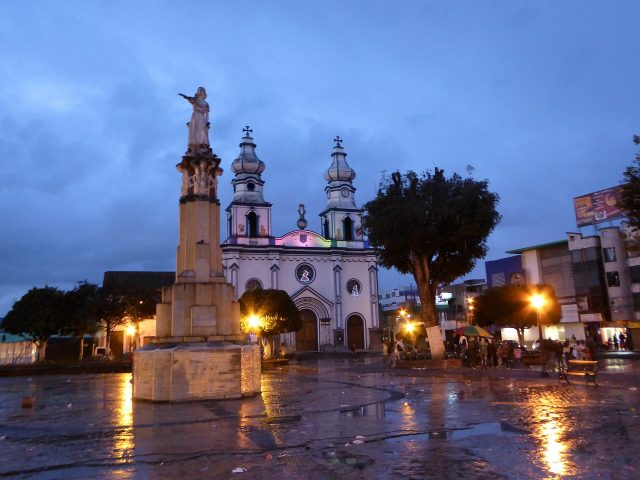
Ipiales sits high in the Andes, where the air is thin and the days move slowly. Plaza 20 de Julio is its center—a square where locals meet, travelers rest, and life happens without fuss. Under the shade of old trees, the past lingers in the architecture, the conversations, and the way sunlight falls on cobblestones.
The buildings around the plaza are simple, their whitewashed walls and wooden balconies worn by time. They follow the practical style of the region, shaped more by mountains than by design. The Church of La Merced, one of Ipiales’ oldest structures, stands among them. Built in the 18th century, its twin towers and sturdy doors mark the town’s colonial roots. People gather on its steps, and its bells ring through the day.
Ipiales was founded by Spanish conquistadors in 1539 but remained a remote outpost for centuries. In the 19th century, a trade route between Colombia and Ecuador brought change. The plaza became the heart of this shift—a place where merchants rested, deals were made, and the town’s identity formed. Its name honors July 20, 1810, when Bogotá’s uprising against Spanish rule began Colombia’s fight for independence.
The plaza isn’t frozen in time. It’s alive with the small moments that define the town. Mornings start with vendors selling fresh produce, cheese, and herbs. By noon, schoolchildren laugh around the fountain while older men play chess on benches. Evenings bring cooler air and music from nearby cafés—sometimes cumbia, sometimes a guitar’s slow strum.
Ipiales sits at 2,800 meters above sea level. The altitude gives the town a sharp, clear quality. On clear days, the snow-capped peak of Cumbal, an active volcano, rises in the distance. The air stays cool, and nights turn cold. It feels like the town exists in its own rhythm, far from the valleys below.
For visitors, the plaza offers a quiet way to experience Ipiales. There are no luxury hotels or tourist traps—just a place to sit and watch. Locals often chat, sharing stories or pointing out hidden corners. If you’re lucky, you’ll catch a festival. The plaza fills with color, music, and dance during these celebrations.
From the plaza, the rest of Ipiales is easy to explore. Narrow streets lead past shops selling handmade textiles and pottery. A short walk takes you to a viewpoint overlooking layered green and brown valleys. Nearby, Las Lajas Sanctuary—a church built into a canyon—attracts visitors with its dramatic architecture.
But you don’t need to leave the plaza to feel its pull. Sit on a bench, watch the light shift over the mountains, and let the day pass at its own pace. This isn’t a place for rushing. There are no crowds, no must-see lists—just the quiet hum of daily life.
In Ipiales, time feels different. The altitude, the stillness, the way past and present mix—it all adds up to something hard to name but easy to feel. The plaza, with its unassuming charm, holds that feeling. It doesn’t ask for attention, but if you give it time, it might leave you with a quiet peace that stays with you long after you’ve gone.