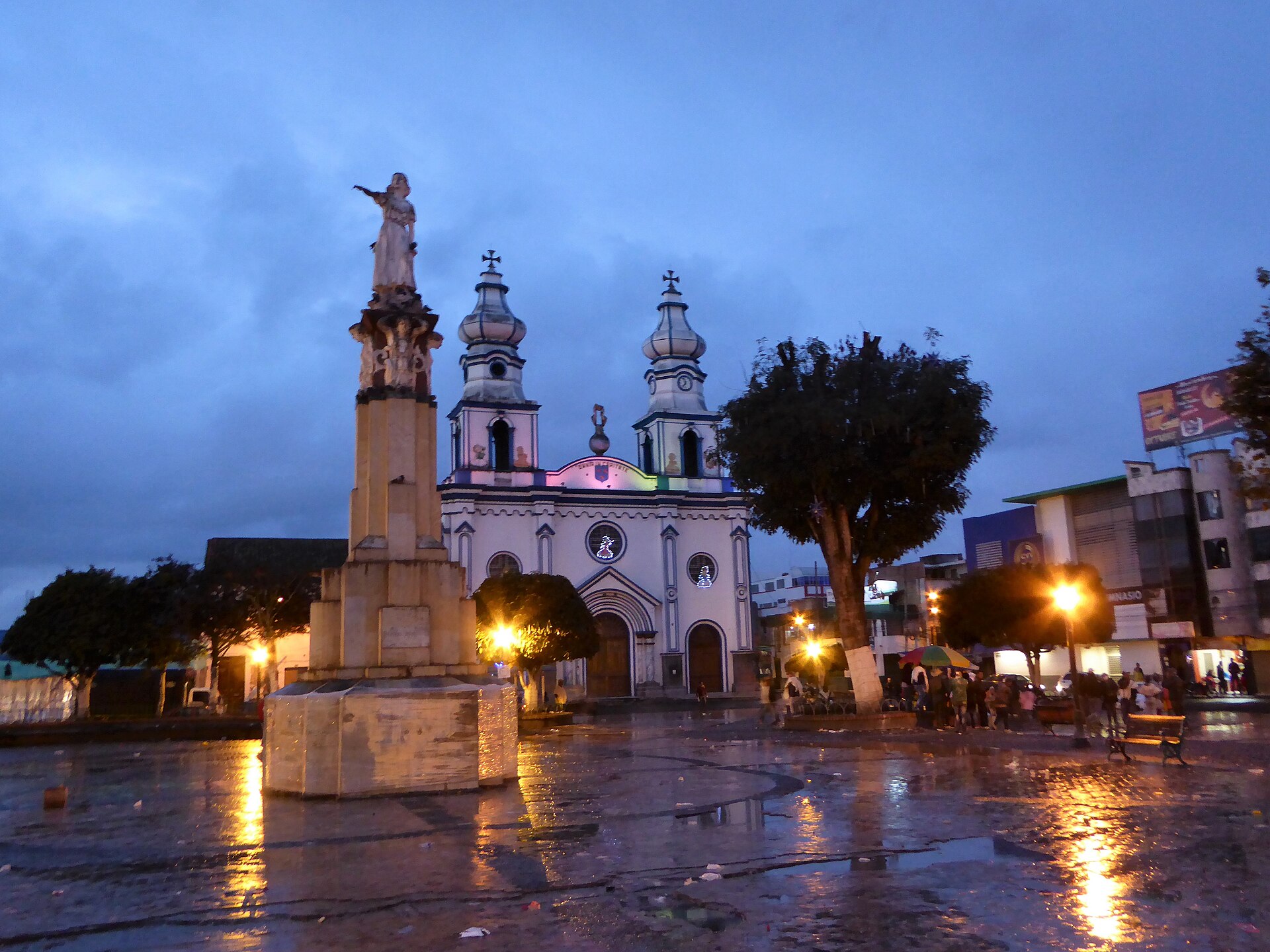
Time moves differently inside San Felipe Neri. The past lingers in the quiet corners, and the air carries the weight of centuries. Built during the colonial era, it stands on one of Ipiales’ central squares, a witness to the changes in this corner of southern Colombia. Its whitewashed facade, crowned with a modest dome, doesn’t demand attention—until you step inside. Then the space unfolds with a quiet grandeur.
The architecture follows colonial religious traditions: clean lines, restrained ornamentation, and a spacious nave. The wooden beams overhead, darkened by age, have held up the ceiling since the church was first constructed. Faded frescoes on the walls still tell their stories in muted colors. There’s no gilded opulence here, just simplicity that invites reflection.
Ipiales has long been a spiritual anchor near the Ecuadorian border, and San Felipe Neri has been at its heart. For generations, it has drawn pilgrims from the city and surrounding villages. In colonial times, churches like this were the center of community life—where people gathered for mass, town meetings, festivals, and even legal proceedings. The cathedral was where the sacred and the ordinary intertwined.
The cathedral is deeply connected to the devotion of Our Lady of the Rosary. Every October, the city celebrates her with processions, prayers, and traditional dances. The streets fill with music, color, and the scent of food. Even those who aren’t religious often join in the shared joy.
The cathedral doesn’t feel like a relic. Locals still come to pray, mark milestones, or sit in silence. On Sundays, families fill the pews, and the organ and choir fill the air. On weekdays, light filters through stained glass, casting shifting patterns on the stone floors. It adapts to the moment—whether a service or a solitary thought.
The square in front is one of Ipiales’ liveliest spots. Vendors sell fresh fruit and empanadas. Artisans display handwoven textiles and carved wooden figures. Street musicians play under the trees, their melodies blending with conversation. Here, the past and present coexist.
For anyone curious about Ipiales, the cathedral is a starting point. Founded in the 16th century, the city is dotted with colonial-era buildings, but San Felipe Neri sets the tone. Its style echoes in nearby houses and streets, tying the city together. A walk through Ipiales shows how deeply its identity is rooted in this history.
Restorations have been careful, preserving the cathedral’s original character. Some elements show their age—the cracks in the plaster, the worn steps—but these only add to its authenticity. This isn’t a polished tourist attraction. It’s a place that has grown with the people of Ipiales.
Visiting San Felipe Neri isn’t about ticking off a landmark. It’s about stepping into a different rhythm. There’s no rush, no crowds. Instead, there’s the quiet hum of a city moving at its own pace, where faith, history, and daily life intersect. Slow down, and the cathedral offers a glimpse into the soul of Ipiales—a place where the past is still alive.