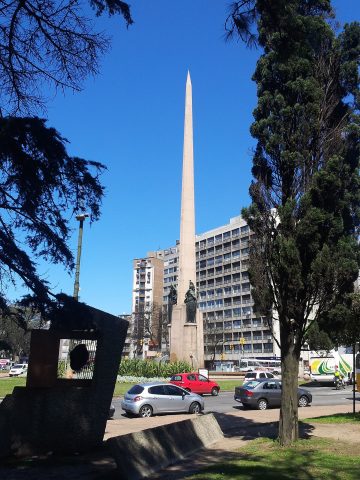
Plaza Zabala sits quietly in the heart of Montevideo’s Old City, a place where the weight of history lingers in the air. Unlike the busier squares that draw crowds of tourists and locals alike, this one feels suspended in time, offering a rare moment of stillness in the middle of the capital. There are no hurried footsteps or selfie sticks here, just the gentle rustle of leaves and the occasional murmur of conversation from those who pause on the benches. It’s the kind of spot where you might sit for a while, watching the light shift across the cobblestones, or simply let the city’s rhythm slow to match your own.
The square takes its name from Bruno Mauricio de Zabala, the Spanish military leader who founded Montevideo in the early 18th century. His arrival in 1724 marked a turning point for the region, then a contested stretch of land between Spanish and Portuguese forces. Zabala chose the site for its strategic position along the bay, establishing a fort that would eventually grow into the city we know today. A bronze statue of him stands at the center of the plaza, gazing out as if still assessing the potential of the place he helped shape. His legacy is woven into the fabric of Uruguay, much like Juan de Garay’s in neighboring Argentina, where he founded Buenos Aires around the same time.
The buildings that surround Plaza Zabala tell their own stories, each one a chapter in Montevideo’s architectural history. The most striking is the Palacio Taranco, built in the early 20th century for a wealthy merchant family. Its facade blends neoclassical and art nouveau elements, a grand contrast to the more modest structures nearby. Today, the palace houses the Museum of Decorative Arts, where visitors can wander through rooms filled with antique furniture, porcelain, and paintings collected by the original owners. Other buildings in the area, once the homes of colonial-era families, have been repurposed into offices or apartments, though many still retain their original charm—wrought-iron balconies, arched doorways, and courtyards hidden from the street.
The plaza hasn’t always been the open space it is today. In the 19th century, this was the site of a fort that defended the city from maritime attacks. When Montevideo outgrew its role as a fortified settlement, the fort was demolished, and the area was transformed into a public square. For generations, it served as a gathering place where people met for conversation, music, and the simple pleasure of being outdoors. Over the years, the square has seen changes—new monuments, redesigned gardens, different paving—but its essence has remained the same: a quiet corner where the past feels close enough to touch.
Nowadays, Plaza Zabala is both a historical landmark and a living part of the city. On weekday mornings, you might see office workers cutting through on their way to work, while weekends bring families strolling under the trees. In the summer, small concerts and open-air exhibitions occasionally take over the space, and in winter, strings of lights add a festive glow. The cafes and restaurants nearby offer a place to sit with a coffee or a bite to eat, watching the square’s unhurried pace. The best time to visit is in the late afternoon, when the setting sun casts a golden light over the old buildings and the scent of blooming trees fills the air.
For anyone exploring Montevideo’s history, Plaza Zabala is an ideal starting point. From here, it’s a short walk to other landmarks—the Metropolitan Cathedral, the Solís Theatre, Plaza Constitución—each with its own stories to tell. But there’s something about this particular square that makes the past feel especially vivid. Maybe it’s the absence of crowds, or the way the buildings seem to lean in as if sharing secrets. Whatever the reason, it’s a place where time moves differently, where the layers of history are visible in the worn stones and the quiet conversations of those who pass through.
In recent years, the plaza has become a hub for cultural events. Street art festivals, book fairs, and even small theatrical performances have found a home here, drawing locals and visitors alike. Artists often display their work outdoors, and musicians sometimes set up for impromptu concerts. These gatherings add a new dimension to the square, making it feel even more connected to the city’s creative spirit. Yet despite its growing popularity, Plaza Zabala hasn’t lost its understated charm. It doesn’t try to be a tourist attraction in the traditional sense, and that’s precisely what makes it special.
Walking through Plaza Zabala, it’s hard not to wonder about all the people who have crossed its paths over the centuries. Merchants and sailors, politicians and poets, ordinary citizens and famous figures—each left their mark in some small way. The square has witnessed revolutions, celebrations, and quiet everyday moments, standing as a silent observer to the city’s evolution. It doesn’t demand attention, but those who take the time to notice will find a place where the past and present coexist effortlessly, where history isn’t just remembered but felt.