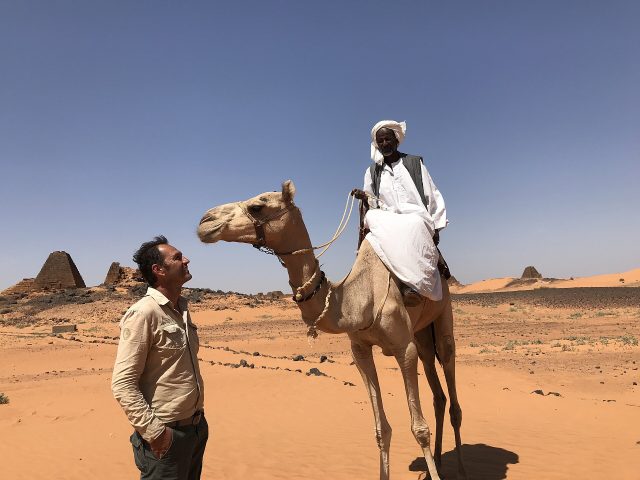
Standing in the vast silence of Sudan’s northern desert, the pyramids of Meroë feel like a secret the world forgot. Unlike their more famous counterparts in Egypt, these structures rise from the sand with a quiet dignity, their steep, narrow profiles cutting sharp angles against the horizon. They were built not by pharaohs, but by the rulers of the Kingdom of Kush, a civilization that once rivaled Egypt in power and influence yet remains largely unknown outside academic circles. For centuries, these pyramids served as tombs for kings and queens who governed a land stretching from the Nile to the Red Sea, their stories etched into the stone in fading hieroglyphs and murals.
The architecture here is distinct, almost defiant in its difference. Where Egyptian pyramids slope gently, the pyramids of Meroë are steeper, their sides rising at a sharper incline, as if reaching for something just beyond grasp. Many have lost their peaks—some to time, others to the hands of looters—but their bases remain intact, their entrances facing east, toward the rising sun. Inside, the walls of a few surviving tombs still bear traces of the past: scenes of rulers in ceremonial dress, offerings to the gods, and inscriptions in the Meroitic script, one of the few written languages of sub-Saharan Africa that remains undeciphered. The tombs were plundered long ago, but the fragments that remain hint at a society rich in artistry and ambition.
The Kingdom of Kush emerged around the 8th century BCE, its capital eventually shifting to Meroë, a city that flourished as a hub of trade and culture. Here, Egyptian, Greek, and indigenous traditions blended, creating a civilization that was both unique and deeply connected to the wider ancient world. The pyramids were built over nearly eight centuries, from the 4th century BCE to the 4th century CE, each one a testament to the reign of a different ruler. What makes Meroë particularly fascinating is the prominence of women in its history. Queens like Amanirenas and Amanishakheto ruled in their own right, leading armies and negotiating with Rome as equals. Their tombs stand alongside those of kings, a rare acknowledgment of female power in the ancient world.
Today, the pyramids exist in a kind of suspended animation. The desert around them is empty save for the occasional camel herder guiding his flock to a rare well. The air shimmers with heat during the day, and at night, the sky explodes with stars so bright they seem almost within reach. There are no crowds here, no vendors hawking trinkets, no tour buses lining the horizon. The silence is profound, broken only by the whisper of wind over sand. It’s easy to imagine that the past is still present, that the spirits of the Kushite rulers linger in the shadows of their tombs, watching as the modern world passes by without notice.
Visiting Meroë is as much about the journey as it is about the destination. The road from Khartoum winds north through an endless expanse of desert, punctuated by the occasional oasis or the ruins of long-abandoned temples. The nearest city, Atbara, is a quiet place where life moves at a slower pace, and strangers are greeted with curiosity rather than suspicion. There are no luxury hotels here, just simple guesthouses where the hospitality is warm and the tea is strong. The lack of infrastructure can make the trip feel like an adventure, but it also means that those who make the effort are rewarded with an experience few others will ever have.
The pyramids themselves are a reminder of how fragile history can be. In the 19th century, an Italian explorer named Giuseppe Ferlini dynamited the tops of several pyramids in a misguided search for treasure, leaving many of them permanently scarred. Today, the site is protected by UNESCO, but the forces of nature—wind, sand, and time—continue their slow work of erosion. Despite this, the pyramids retain a haunting beauty. They stand as proof that even the mightiest civilizations eventually fade, leaving behind only echoes of their former glory.
For those who come here, Meroë is more than just a historical site. It’s a place where the past feels tangible, where the weight of centuries presses down on you in the most unexpected way. There are no guided tours dictating where to look or what to think, no signs explaining every detail. Instead, there’s only the vastness of the desert, the silence of the pyramids, and the sense that you’ve stumbled upon something rare—a piece of history that has been left largely untouched by the modern world.
Perhaps that’s why Meroë lingers in the memory long after the visit is over. It’s not just the pyramids themselves, but the way the light catches the sand at dusk, or the way the stars seem to hang lower here than anywhere else. It’s the realization that this place, so far removed from the familiar narratives of ancient history, has its own stories to tell—if only you’re willing to listen. And in a world where so much has been mapped, photographed, and explained, that kind of quiet discovery is increasingly rare.