On Jeju Island, Manjanggul Cave stands apart. A lava tube formed by ancient volcanic eruptions, it stretches over seven kilometers—one of the longest in the world. Only a kilometer of it is open to the public, but that’s enough to reveal a subterranean landscape unlike any other in South Korea. Jagged walls, smooth curves, and towering columns tell the story of molten rock that once flowed here, now hardened into eerie, sculptural forms. In 2007, UNESCO recognized the cave as part of Jeju’s World Heritage site, not just for its geology, but for the fragile ecosystem it shelters.
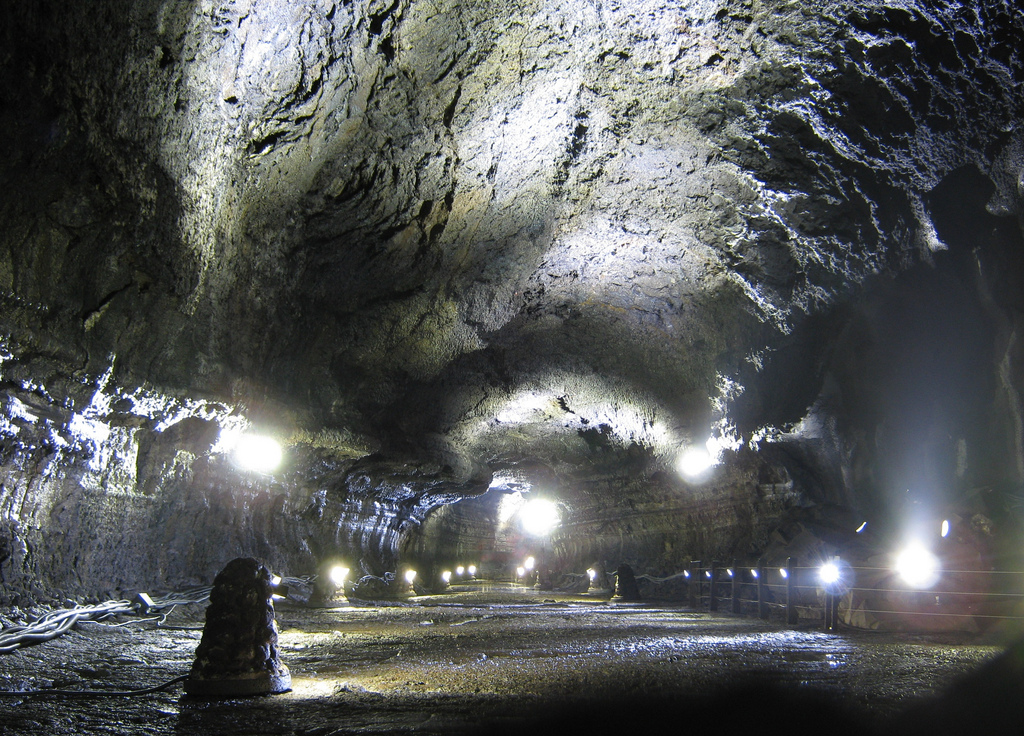
The moment you step inside, the air changes. It’s cooler, damper, thick with the weight of the earth above. The only sounds are your footsteps and the occasional drip of water echoing through the chambers. Soft lights cast shadows over the cave’s most striking features: a seven-meter lava column, one of the tallest of its kind, formed when magma slowly solidified in place. Nearby, the walls ripple with delicate formations, like frozen waves, while rounded bulges in the rock resemble giant pillows—proof of how the lava once yielded under its own weight.
Manjanggul has always been more than a cave. Long before tourists, locals knew of its existence, though few ventured inside. Some took shelter here during storms or conflicts. Others may have used its chambers for rituals—archaeologists have found traces of prehistoric visits, though their exact purpose remains unknown. Today, walkways and lighting make the cave accessible, but parts of it are still off-limits, protected to preserve the life that thrives in the dark.
Time feels different underground. Without the sky or horizon, minutes stretch and blur. The main chamber is vast, its ceiling lost in darkness, its floor a maze of jagged lava. In places, shallow pools of water collect, fed by slow seepage through the rock. The water is clear, almost glass-like, but don’t drink it—minerals dissolved in the cave’s depths can make it unsafe. These pools act like mirrors, reflecting the dim light and adding to the sense of being somewhere outside ordinary time.
For scientists, Manjanggul is a living laboratory. The cave is home to species that have adapted to complete darkness: blind spiders that navigate by touch, insects that sense vibrations, and bats that roost in the deeper chambers. Most visitors won’t see them—they’re elusive, hiding in crevices or active only when the cave is quiet. But their presence is a reminder of how delicate this ecosystem is. Even a camera flash can disturb them, which is why photography is allowed only without artificial light.
If you’re planning to visit, come prepared. The temperature inside stays around 15°C year-round, so a light jacket helps even in summer. The air is humid, and some paths can be slippery—sturdy shoes are a must. The lighting is dim but enough to see the cave’s features without overpowering them. There are no guided tours, but the route is well-marked, winding past the most impressive formations before looping back to the entrance. You can take your time, lingering where you like or moving quickly through sections that don’t hold your interest.
What makes Manjanggul special? It’s not just the size or the formations—it’s the questions it raises. How did this shape form? What’s beyond the next bend? The cave doesn’t give answers. It lets you wonder. Over the years, it has drawn scientists, artists, and writers, all searching for inspiration in a place that defies expectations. Standing inside, you realize how little we know about the earth’s hidden layers—and how much there is left to discover.
When you step back into daylight, the world above feels different. The wind, the birds, the open sky—it all contrasts with the cave’s quiet, enclosed space. Manjanggul doesn’t need to impress. It has existed for millennia, unchanged, and will remain long after we’re gone. In a world that demands constant attention, there’s something comforting about a place that simply endures, patient and mysterious.