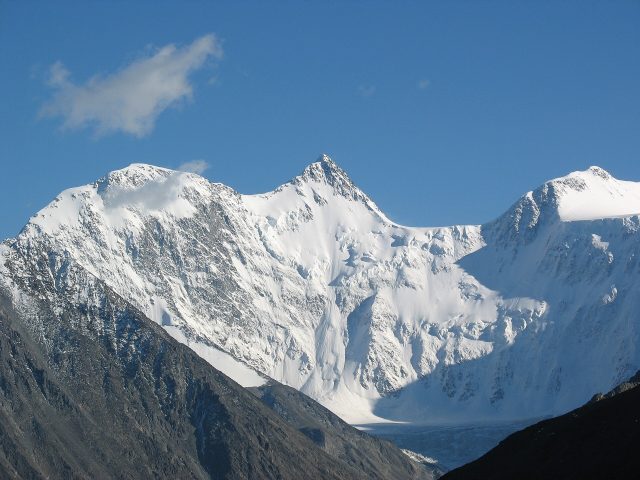
Katu-Yaryk Pass is one of those rare places in the Altai Mountains where nature seems to have gathered all its most dramatic landscapes into one breathtaking stretch. Here, the world splits into two distinct halves: on one side, gentle valleys roll into the distance, softened by the meandering Katun River, while on the other, sheer cliffs rise abruptly, their jagged edges cutting into the sky. The road itself is less a route between two points than an experience—one that tests the skill of drivers and leaves passengers gripping their seats. Winding tightly along the mountainside, the pass is often called one of Russia’s most scenic and challenging drives, its serpentine turns clinging to the slope like a lifeline.
The history of Katu-Yaryk is tied to the gradual opening of the Altai region to the modern world. Until the mid-20th century, no proper road existed here—only narrow footpaths used by nomadic herders and locals transporting goods on horseback. Construction of the current route began in the 1980s, part of an effort to connect Gorno-Altaysk with the remote Ust-Koksinsky district. Engineers faced formidable obstacles: the rock was so dense that blasting often failed to break it, and the steep terrain demanded precision to avoid destabilizing the slope. The final road was carved with care, following the natural contours of the land rather than forcing a path through it.
Today, Katu-Yaryk serves as both a vital transport link and a draw for travelers. In summer, photographers, hikers, and those simply seeking the raw beauty of the Altai make the journey, while winter transforms the pass into a proving ground for experienced drivers. Snow and ice turn the road treacherous, but even in the cold, the landscape retains its allure—frosted cliffs and crisp mountain air create a stark, almost otherworldly atmosphere.
The road itself is a narrow ribbon of asphalt clinging to the mountainside, its steepest sections giving the unsettling impression that the car might slide backward at any moment. Yet this very precariousness is what makes Katu-Yaryk unforgettable. Each hairpin turn reveals a new perspective: the wide Katun Valley unfolding below, the sharp peaks of distant ridges piercing the sky, or dense forests blanketing the slopes. From above, the road resembles a serpent coiled around the mountain, its path dictated by the land’s unyielding contours.
Those who pause at one of the roadside viewpoints are rewarded with panoramas that justify the journey. On clear days, the view stretches to the farthest ranges, their outlines fading into blue. As evening approaches, the cliffs take on golden and rose hues, shadows lengthening until the landscape seems to hold its breath. Many visitors time their trip for these sunsets, when the light softens the rugged terrain into something almost dreamlike.
Despite its growing popularity, Katu-Yaryk remains a place where solitude is easy to find. There are no crowds, no souvenir stalls, no cafes—just the road, the rock, and the vast sky. That said, the pass isn’t entirely without amenities. Small pull-offs along the route offer a chance to rest, brew tea from a thermos, or simply sit on a boulder and listen to the wind. Occasionally, locals set up impromptu stands selling honey, herbal teas, or homemade cheese—a modest but welcome touch for travelers passing through.
More than just a road, Katu-Yaryk embodies the spirit of the Altai. It’s a place where nature’s dominance is undeniable, where humans are temporary visitors in a landscape that has existed for millennia. The pace here is different—slower, measured by the movement of clouds or the distant rush of the Katun River below. It’s easy to lose track of time, to fall into the rhythm of the mountains, where silence is a rare and precious thing.
For many, Katu-Yaryk isn’t just a stop along the way but a place that lingers in memory long after the journey ends. Perhaps it’s the authenticity of the experience—the road that demands respect, the mountains that tolerate no carelessness, the air thick with the scent of wild herbs and open space. This isn’t a destination for those seeking comfort or entertainment, but for those willing to meet the Altai on its own terms: untamed, majestic, and just a little mysterious. That’s why, year after year, travelers find themselves drawn back to its winding path.