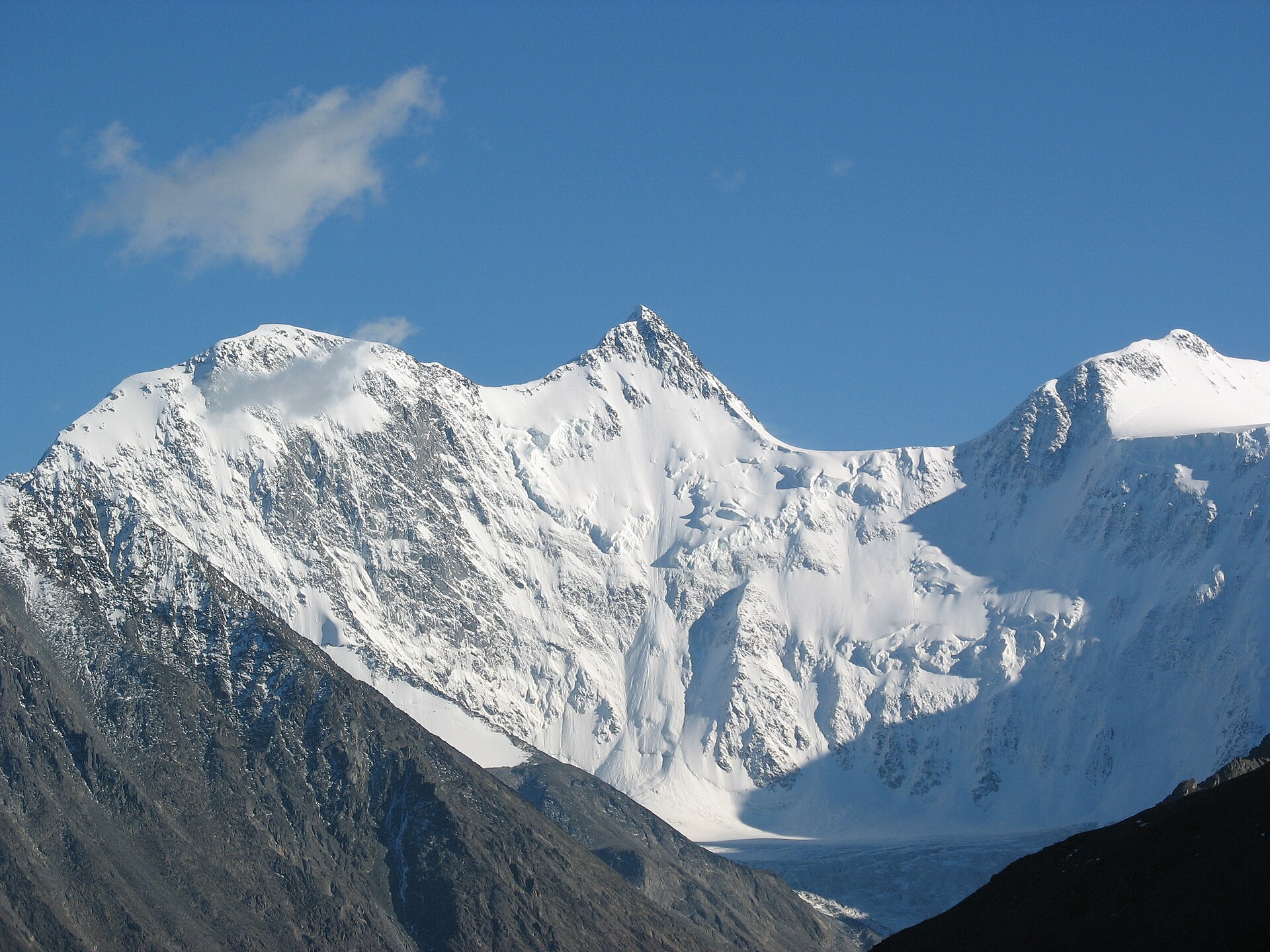
Mount Belukha stands as one of Siberia’s most enigmatic and awe-inspiring landmarks, rising along the border between Russia and Kazakhstan in the heart of the Altai Mountains. Its name, meaning "white," is no accident—the peak is perpetually crowned with snow, which glows under the sunlight as if lit from within. Even in summer, the slopes retain their icy mantle, creating a stark contrast against the surrounding landscapes. For centuries, the mountain has held deep spiritual significance for the indigenous peoples of the Altai, who view its summit as a sacred, almost otherworldly place, untouched by human hands.
The mountain is defined by its twin peaks—East and West Belukha—separated by a saddle. The Eastern summit, reaching 4,509 meters, is the highest point in the Altai range. Climbing it is no small feat; the routes are demanding, the weather unpredictable, and the altitude a challenge even for seasoned mountaineers. Those who make the ascent are rewarded not just with sweeping views of endless ridges and valleys, but with a sense of standing at the edge of something primal, as if the mountain itself guards secrets older than time.
The history of Belukha’s conquest began in the late 19th century, when explorers first ventured into these remote highlands. The Western summit was first successfully climbed in 1914 by Russian mountaineers, while the Eastern peak fell to climbers decades later. Since then, the mountain has drawn adventurers from around the world, though reaching its base remains an adventure in itself. The journey winds through dense taiga forests, across rushing rivers, and over high plateaus where rare wildlife—snow leopards, argali sheep, and brown bears—still roam freely.
For the indigenous Altai people, Belukha is far more than a geographical feature. It is the sacred center of their world, a place where life is said to have begun. Legends speak of hidden caves and lakes within the mountain, holding ancient wisdom, while its slopes are believed to be inhabited by spirits. Even today, many locals treat the mountain with reverence, avoiding loud or disrespectful behavior in its presence. To them, Belukha is not just a destination but a living entity, woven into the fabric of their culture and identity.
The landscapes surrounding Belukha are as diverse as they are breathtaking. Alpine meadows burst with wildflowers in summer, while crystal-clear lakes, fed by glaciers, shimmer with an almost unnatural blue. One of the most striking is Lake Akkem, nestled at the mountain’s foot. Its waters are so transparent that they seem to glow, reflecting the vast, empty expanses around it. Here, it’s easy to lose track of time, wandering for hours without encountering another soul, enveloped in the silence of untouched wilderness.
The climate around Belukha is as harsh as it is unpredictable. Even in summer, frost can descend without warning, and snow lingers on the peaks year-round. Weather shifts in an instant—clear skies can darken into storm clouds within minutes, and warm breezes can turn into icy gusts. This volatility makes treks to the mountain both challenging and exhilarating. Those who venture here must be prepared for anything, from scorching sun to sudden blizzards, but the ever-changing conditions only add to the sense of adventure.
Despite its remoteness, Belukha draws not only climbers but also travelers seeking to witness one of Russia’s most stunning natural wonders. Several routes lead to its base, each offering its own rewards. One of the most popular follows the Katun River valley, where glaciers and jagged ridges stretch as far as the eye can see. Another crosses the Karatyurek Pass, where, on clear days, both summits of Belukha rise above the clouds, their snow-capped forms dominating the horizon.
For those unwilling or unable to undertake a long trek, Belukha can still be glimpsed from a distance—from the shores of Lake Teletskoye or the villages near Ust-Koksa. Even from afar, the mountain commands attention. Its peaks appear to float above the earth, framed by forests and valleys that exude a quiet, timeless beauty. On clear days, Belukha is visible for dozens of kilometers, its silhouette becoming an iconic symbol of the Altai.
Today, Belukha remains one of Russia’s most significant natural landmarks, protected within the Katun Nature Reserve. The area safeguards rare flora and fauna, some of which exist nowhere else on Earth. Yet beyond its ecological importance, the mountain embodies something deeper—a sense of ancient mystery, a reminder of nature’s fragility and power. For many, it becomes a place of pilgrimage, where the sheer scale of the landscape invites reflection on the enduring forces that shape our world.