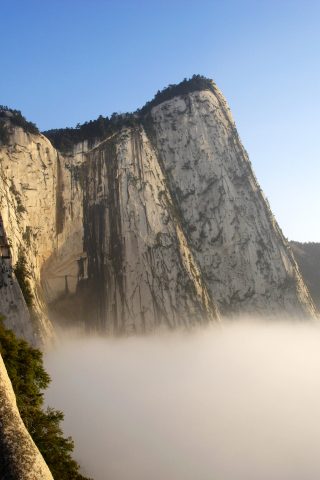
Mount Hua, or Huashan, rises from the earth like a blade forged by the gods. Unlike the gentle slopes of China’s other sacred peaks, its sheer cliffs and jagged ridges defy gravity, carving a silhouette so dramatic it seems almost unreal. Located in Shaanxi Province, just a few hours from the ancient city of Xi’an, the mountain feels worlds apart from the familiar rhythms of modern life. The air is thinner here, the paths narrower, and every turn reveals a view that steals your breath—not just from the altitude, but from the sheer scale of the landscape. Locals call it the Western Peak, though it’s actually a cluster of five summits, each with its own name, character, and legends woven into the rock.
The history of Huashan stretches back over three millennia, to a time when it was believed to be the dwelling place of immortals. Daoist monks first settled here in the early centuries of the Common Era, transforming its perilous cliffs into a pilgrimage site. They carved stairways into the stone, built temples on ledges where no structure should logically stand, and created paths that still feel like a challenge to the laws of physics. The most infamous of these is the "Plank Walk in the Sky," a narrow trail clinging to a vertical cliff face, where travelers edge forward with their backs pressed against the rock and nothing but empty air beneath their feet. In ancient times, the path was even more treacherous—wooden planks were lashed directly to the cliff, and many who attempted the journey never returned.
The architecture of Huashan is inseparable from the mountain itself. Temples and pavilions seem to grow from the stone, their wooden beams and tiled roofs echoing the colors and contours of the rock. The most famous is Canglong Temple, dedicated to the mountain’s deity, perched on a razor-thin ridge between two peaks. To reach it, visitors must cross a chain bridge suspended over a chasm, the wind tugging at their sleeves as they step forward. Inside, the air is thick with the scent of incense, and the only sounds are the murmur of prayers and the distant rush of the wind through the valleys. Another landmark is the East Peak, where a platform at over 2,000 meters offers one of the most sought-after views in China—the sunrise over a sea of clouds, painting the sky in hues of gold and rose.
Climbing Huashan is less a hike than a test of endurance. The most popular route begins at the base, where a steep staircase carved into the rock ascends without mercy. The steps are uneven, slick when wet, and often lack handrails. Halfway up, the infamous "Thousand-Foot Precipice" awaits—a near-vertical climb where chains bolted into the stone are the only thing keeping climbers from slipping into the abyss. Those who prefer to skip the hardest sections can take a cable car, but it only reaches the North Peak, leaving the final ascent to be conquered on foot. Even from the cable car, the height is inescapable; the cabins glide over ravines, and the tiny figures of hikers below look like ants crawling across the face of the mountain.
The mountain shifts with the seasons, each offering a different kind of beauty. Spring brings delicate green shoots to the slopes, though the weather is unpredictable—fog can roll in without warning, swallowing the peaks in an instant. Summer is hot at the base, but the higher altitudes offer cool relief, and nights can be surprisingly cold. Autumn is perhaps the most stunning time to visit, when the foliage blazes in shades of amber and crimson, turning the mountain into a living painting. Winter transforms Huashan into a frozen fortress, its paths glazed with ice and its steps treacherous. Fewer visitors brave the cold, leaving the trails quiet except for the crunch of snow underfoot.
For all its danger, people don’t come to Huashan just for the thrill. Many seek something deeper—a sense of connection to something ancient and enduring. Daoist priests still perform rituals here, and pilgrims leave coins and wishes tucked into the crevices of the rocks. On the summits, you might encounter elderly locals meditating in the thin mountain air or young couples stealing a quiet moment together. At night, when most visitors have descended, the mountain takes on a different character. The only lights come from the flickering lanterns of temple keepers and the rare travelers who choose to spend the night in one of the mountaintop guesthouses. Under a sky dense with stars, the darkness feels alive, the silence broken only by the whisper of the wind.
Descending from Huashan is just as memorable as the climb. With the worst of the fear behind you, details that went unnoticed on the way up suddenly come into focus—the ancient inscriptions carved into the stone by pilgrims centuries ago, the tiny temples clinging to the cliffs like swallows’ nests, the endless stairways winding down into the valley below. At the base, life resumes its ordinary pace. Vendors sell steaming bowls of noodles and cups of tea, and locals share stories of those who never made it back from the summit. But for most, Huashan is more than just a mountain. It’s a place where the raw power of nature confronts you, where you’re reminded of your own smallness, and where the weight of history presses down from the heights above.