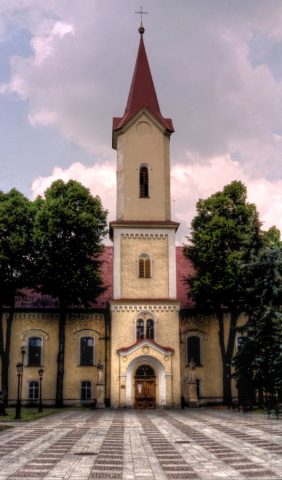
Revúca’s Park Mladeže is the kind of place that doesn’t announce itself with fanfare. Tucked into a gentle rise near the town center, it offers quiet views of the old quarters and the rolling hills beyond. There are no grand monuments or flashy attractions here—just wide paths, mature trees, and the sense that time moves a little slower than it does elsewhere.
The park’s history is woven into Revúca’s industrial past. In the 19th century, when the town thrived on metallurgy and mining, public spaces like this were created as respites from the noise and smoke of factories. Park Mladeže became one of those places where workers and their families could step away from the grind of daily life. By the mid-20th century, it had been updated with modern landscaping, though its original character remained intact. The changes were subtle—enough to keep it functional, but not so drastic that it lost its connection to the past.
The design is simple and unpretentious. A central avenue leads to a small square with a fountain, shaded by old linden and chestnut trees. Their branches form a canopy that cools the air on hot days, and in autumn, the ground turns golden with fallen leaves. Benches line the paths, many of them dating back decades—wooden slats worn smooth by years of use, their metal frames still sturdy. There are no elaborate sculptures or grand installations, just a few modest memorials honoring local figures and events that shaped the town.
At the heart of the park is an open-air amphitheater. In summer, it hosts concerts, plays, and festivals, drawing crowds from Revúca and nearby towns. The stage is small, but the setting is intimate—wooden benches under the trees, the rustling leaves almost like a soundtrack to the performances. When winter comes, the amphitheater stands empty, its steps dusted with snow, the bare branches swaying in the wind. Even then, it doesn’t feel abandoned, just quietly waiting for warmer days.
The park also holds traces of Revúca’s industrial legacy. In the southern part, the remnants of old factory buildings peek through the greenery, their brick walls now draped in ivy and wildflowers. These ruins are a reminder of the town’s past, when furnaces roared and workers gathered here after long shifts. Locals sometimes bring their children to these spots, pointing out the crumbling structures and telling stories of what once was. It’s a way of keeping history alive, not in a museum, but in the open air.
For visitors, Park Mladeže might not be the first place that comes to mind. There’s nothing here that demands attention from afar, no must-see landmarks that draw crowds. But that’s part of its charm. It’s a place for those who want to experience the unhurried rhythm of a Slovak provincial town, where the past lingers in the stones and the trees. You can sit on a bench with a coffee, watch children play, or stroll along the paths, listening to the birds. There’s no agenda, no rush—just the quiet pleasure of being somewhere that feels lived-in and real.
Spring is especially lovely here. Cherry and apple trees bloom, filling the air with the scent of fresh growth, while tulips and daffodils brighten the flowerbeds. Summer brings shade and a welcome coolness, a refuge from the heat of the streets. In autumn, the park transforms into a riot of gold and crimson, the crunch of leaves underfoot adding to the atmosphere. Winter is quieter, the paths nearly empty, the snow muffling the sounds of the town. It’s a different kind of beauty—one that feels almost timeless.
Park Mladeže isn’t the kind of place that claims to be the heart of Revúca, but for those who know it, it’s something more meaningful than just a patch of green. It’s where people meet, where memories are made, where life unfolds in small, everyday moments. Couples come here for walks, families bring their children, and neighbors gather to celebrate or simply enjoy the peace. Maybe that’s why it feels so alive—because it’s not just a park, but a part of the town’s rhythm, a place that changes with the seasons but never loses its sense of belonging.