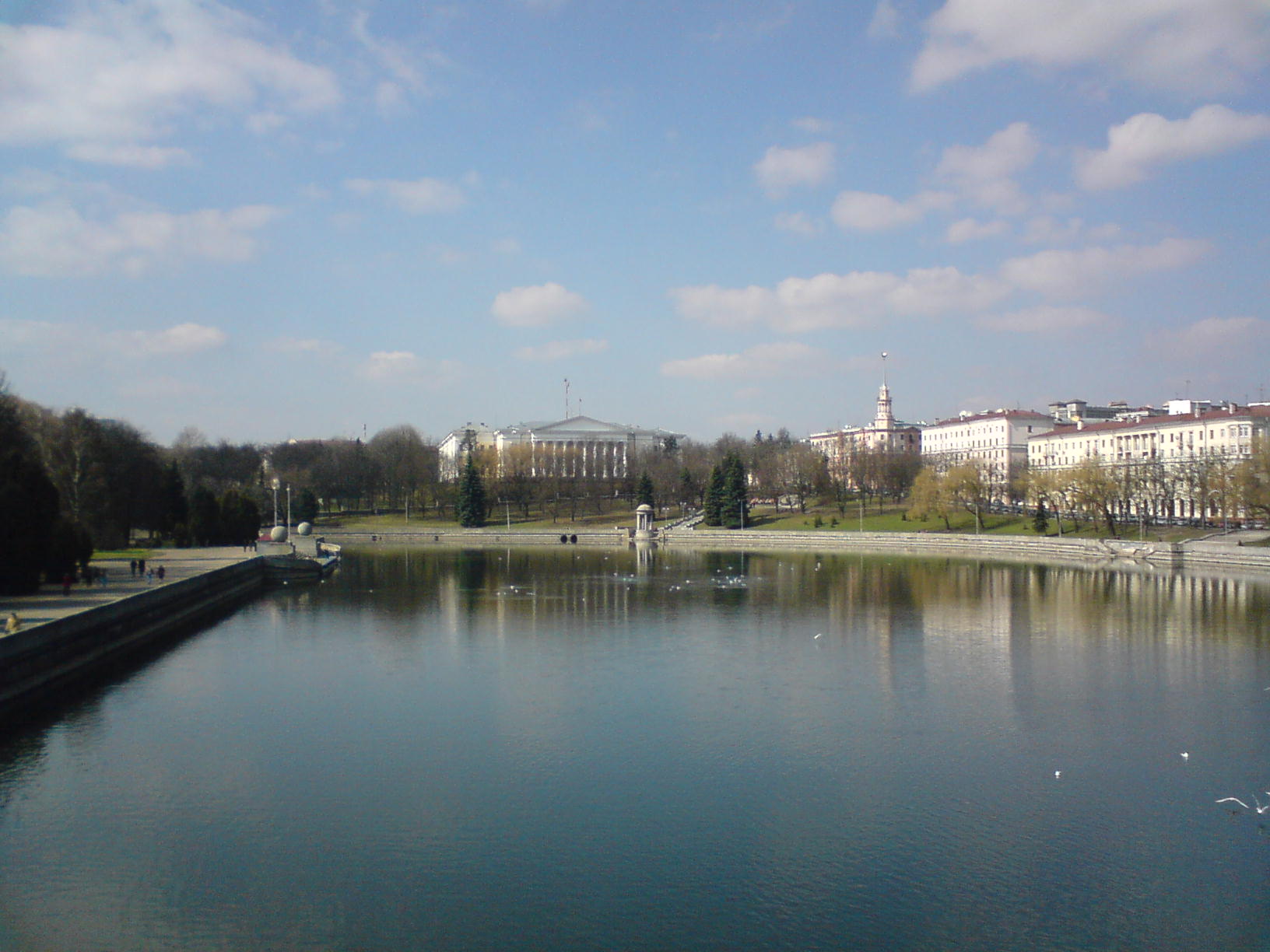
Yanka Kupala Park doesn’t compete with history or nature—it lets them breathe. The Volma River drifts past without hurry, and the paths curve around trees that have stood here for decades. There are no spotlights, no crowds, just the kind of quiet that makes you slow down without realizing it.
Smilavichy was where Kupala was born, where he played as a child, and where he later returned in his mind when he was far away. The park appeared in the mid-20th century, not as a grand statement, but as a place to remember that bond. No marble arches, no grand plazas—just wide, worn paths where people walk the way they always have, past the same oaks that might have shaded a young Yanka Lutsevich.
The monument to Kupala, installed in 1972, is unassuming. He stands with a book in his hands, caught mid-thought, as if he’s just looked up from the page. The sculpture doesn’t tower over the park; it fits into it, like the boulders along the riverbank. Nearby, a granite slab carries lines from his poems—words that feel at home here, where the light shifts through the branches and the water reflects the sky. You don’t have to search for meaning; it’s in the way the wind moves through the leaves while you read.
The park wears each season differently. Spring brings the scent of apple blossoms and wet grass. Summer cools the air near the river, where dragonflies skim the surface. In autumn, the trees turn gold and copper, and the ground smells of mushrooms and damp earth. Winter quiets everything, leaving only the sound of snow underfoot and the occasional cry of a crow. Locals come here to gather mushrooms, walk their dogs, or sit by the water. Tourists visit too, but there’s no schedule, no rush—just the chance to stand still for a while.
Some of the oldest trees here might have been young when Kupala was a boy running along the riverbank. Now, their roots twist into the earth, holding stories no one remembers. A few wooden bridges cross small streams leading to the Volma—simple, practical, as if they’ve always been part of the landscape. There’s no need for ornamentation; the place exists as it is, without apology.
Small events take place here now—poetry readings, concerts, gatherings with writers. They’re not festivals with stages and banners, but quiet moments where people sit on the grass and listen. For locals, it’s tradition. For visitors, it’s a chance to hear Kupala’s words spoken aloud under the open sky, not locked behind glass in a museum.
What makes this park different is that it’s not just a memorial. Families picnic here. Couples take wedding photos under the old lindens. Children chase each other near the river. For some, it’s just a park in a small town. For others, it’s proof that the past isn’t gone—it’s in the way the light falls through the trees, in the sound of the river, in the footsteps of people who come here looking for nothing more than a moment of peace.
If you come to Smilavichy, don’t hurry past. Walk the paths. Sit by the water. Listen to the leaves moving in the wind. Maybe you’ll feel what Kupala did—a quiet connection to the land, the kind that doesn’t need words. Because some poetry isn’t written down. It’s in the way the light hits the water, in the sound of footsteps on dirt, in the stillness of a place that has watched generations pass by.