Navahrudak is a town where the past lingers in quiet streets and gentle hills. History isn’t confined to museums here—it’s woven into everyday life. At the heart of this charm lies Adam Mickiewicz Park, a small space dedicated to one of the most celebrated figures in Polish and Belarusian literature. The park’s significance goes beyond its size. It reminds visitors how art, nature, and memory intertwine in this part of the world.
Adam Mickiewicz was born near Navahrudak, in the estate of Zaosie. Though he spent much of his life abroad, the town remained a presence in his work. His poetry often evoked Navahrudak as a symbol of lost homeland. The park named in his honor was established in the mid-20th century to preserve the connection between the poet and his birthplace. Today, it functions as a living memorial, where the landscape itself becomes part of the tribute.
The park sits on a hillside, offering a view of Navahrudak’s old town, its narrow streets, and the ruins of a medieval castle. Tall lindens and maples line the walkways. At the center stands a bronze statue of Mickiewicz, seated in contemplation. Nearby, a granite stele bears a quote from his works in multiple languages.
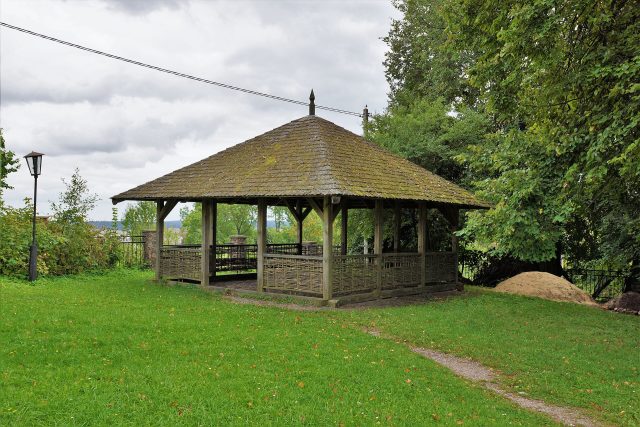
The park’s design is simple. There are no ornate fountains—just stone benches, small bridges over shallow streams, and winding paths. The beauty lies in the details: sunlight filtering through leaves in spring, the scent of blooming apple and cherry trees, the crisp air of autumn when foliage turns gold. Even in winter, the park feels serene, with snow dusting the branches.
Navahrudak is a town steeped in history. Once a major center of the Grand Duchy of Lithuania, it was here that Mindaugas, the first King of Lithuania, was crowned. Later, as part of the Polish-Lithuanian Commonwealth, the town flourished as a hub of trade. Its castle, now in ruins, was once considered impregnable. The Mickiewicz Park sits near the castle hill, and visitors often combine their time here with a walk through the town’s historical sites.
For locals, the park is part of daily life. Families bring children here. Couples stroll along the paths. Friends gather on benches to talk. In summer, small concerts and literary readings are held, often featuring Mickiewicz’s poetry. On quiet evenings, you might hear someone reciting his words aloud.
The park has no pretension. There’s no grand museum—just an open space where history feels present. It’s a place to sit on a bench, look at the statue, and reflect on belonging. Navahrudak doesn’t try to be a tourist hotspot. It welcomes those who come for quiet conversation with the past.
Time moves differently here. You might visit in the early morning, when the grass is damp with dew, or linger until dusk, when the setting sun paints the sky. In those moments, it’s easy to understand why Mickiewicz loved this land. There’s nothing extraneous—just the trees, the hills, the sky, and the sense that others have walked these paths before.
Adam Mickiewicz Park holds the story of one man and the collective memory of a region where cultures and histories intersect. Here, literature and nature, past and present, exist side by side. The park doesn’t demand attention, but its significance is there in every leaf and stone.