Piriápolis is a coastal town where the Atlantic breeze carries the scent of eucalyptus through streets that still feel like they belong to the early 1900s. The hills rise gently above sandy beaches, and tucked among them is Parque de los Ingleses, a place locals simply call the English Park. The name hints at its origins—at the turn of the 20th century, British investors saw potential here, envisioning a resort that could rival those across the ocean.
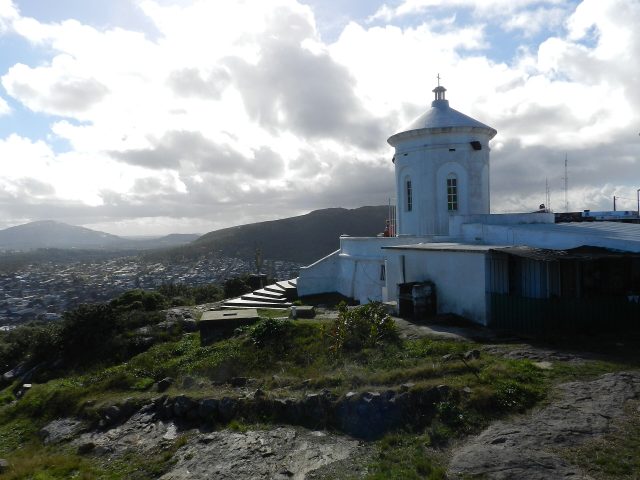
By the 1930s, Francisco Piria, the town’s founder, had acquired the land and transformed it into a public space. His ambition was to create a retreat that could stand alongside Europe’s finest, and though that dream never fully materialized, traces of it remain. Stone staircases wind up the hillsides, leading to viewpoints where the bay stretches out below. Among the overgrowth, you can still find the foundations of old villas and hotels, their colonial-style ruins now woven into the landscape. They don’t feel abandoned, just softened by time, as if nature has claimed them gently.
The park’s paths twist between trees, climbing slopes and dipping into clearings. Old-fashioned lampposts line the way, their warm glow flickering on as dusk settles. Evenings here are quiet, the sky turning shades of pink and gold as the sun sinks behind the horizon. Locals often bring thermoses of mate, sitting on simple wooden benches to watch the light play across the water. There’s no grand design, no unnecessary ornamentation—just the trees, the ocean, and the stillness.
One of the park’s most intriguing features is the remnants of the old railway that once connected Piriápolis to Montevideo. The tracks are barely visible now, half-buried in grass and shrubs, but they’re still there, a quiet reminder of how the town once linked itself to the wider world. Nearby stands the old station, now a cultural center where local artists exhibit their work and small concerts fill the air with music. It’s a place where history isn’t just preserved but kept alive, evolving with each new visitor.
This isn’t a park for those seeking crowds or entertainment. There are no cafes, no rides, no tourist traps—just open space and the occasional laughter of children playing. In summer, the air is thick with the scent of blooming trees; in winter, the paths feel emptier, the views more expansive. It’s a place to slow down, to let the rhythm of the waves and the rustle of leaves set the pace. For families, it’s a safe spot for picnics; for others, a quiet corner to read or think.
Uruguay has always been a blend of European influence and Latin American spirit, and Parque de los Ingleses feels like a piece of that European past. There are no neon signs or loud colors, just the natural beauty of the landscape. Maybe that’s why locals love it so much—it’s a reminder that sometimes the most beautiful things are the simplest: a view of the ocean, the shade of a tree, the quiet of an afternoon.
Walking these paths, it’s easy to wonder how many people have come here over the decades—to escape the heat, to clear their minds, or just to watch the sunset. The park isn’t as famous as the beaches, but its value isn’t in spectacle. It’s in the way time seems to slow, in the way each step along the stone paths feels like a step back in time. The sound of the waves and the whisper of the wind create a backdrop for reflection, a place where the past and present meet without fanfare.
For those who visit Piriápolis for more than just sun and sand, Parque de los Ingleses is a quiet discovery. It doesn’t demand attention, but it rewards those who take the time to explore it—with its understated charm, its sense of history, and the simple pleasure of a place where nature and memory intertwine.