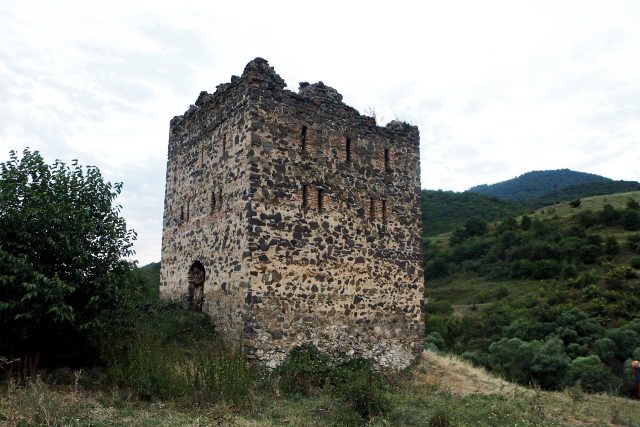
Voskepar is a quiet village tucked into the northern hills of Armenia, just a stone’s throw from the Georgian border. The landscape here is gentle—rolling vineyards, low hills, and the kind of stillness that makes even the wind seem hesitant. It’s not a place that draws crowds, nor is it marked by grand monuments. Yet, on the edge of the village, almost blending into the everyday rhythm of life, stands a modest memorial to the victims of the Armenian Genocide. There are no towering statues or sweeping plazas, no solemn inscriptions demanding attention. Instead, there’s just a simple stone marker, a few trees, and the quiet weight of memory that lingers like the scent of wild herbs after rain.
The memorial wasn’t placed here by chance. Voskepar, like so many Armenian villages, carries the scars of 1915. Some of its people were forced to flee, others perished, and those who remained held onto the stories of what was lost. The monument itself dates back to the Soviet era, a time when such memorials were often understated, almost reluctant. But for the villagers, it became more than just a marker of history. It’s a place where people come not only on official remembrance days, but in the ordinary moments—when a farmer pauses on his way to the fields, when a grandmother brings her grandchildren to lay flowers, or when someone simply needs a quiet corner to sit and reflect. Its location, set apart from the main roads, gives it an intimacy that larger memorials lack. There are no tour groups here, no guided narratives—just the occasional traveler who stumbles upon it, or a local who stops by as if visiting an old friend.
The design of the memorial is as unassuming as the village itself. A rough-hewn stone stele, its surface etched with crosses and Armenian script, stands surrounded by a low fence. A few trees, likely planted long after the monument was erected, cast dappled shade over the ground. There’s no attempt at grandeur, no dramatic flourishes—just the bare, honest acknowledgment of what happened. That simplicity is what makes it feel so personal. It doesn’t try to impose meaning or evoke forced emotion; it simply exists, a silent witness to a past that refuses to fade.
For the people of Voskepar, this memorial is woven into their family histories. Many still remember the stories passed down through generations—of those who were taken, those who survived, and those who returned to rebuild. The monument isn’t just a historical marker; it’s a living connection to those who came before. You’ll often see elderly villagers sitting on the nearby bench, murmuring prayers or lost in thought, as if the past is still present in the rustle of leaves. For them, it’s not a relic but a place where the dead are still part of the conversation.
Every so often, descendants of those who once lived in Voskepar but were displaced during the genocide make the journey back. For them, this small memorial is one of the few tangible links to their roots. They arrive with photographs, letters, and stories—fragments of a life that was interrupted. The village, usually so quiet, briefly comes alive with voices in different languages, children playing in the grass, and the kind of shared reminiscing that feels more like a family reunion than a formal commemoration. There are no speeches, no ceremonies—just the quiet understanding that some things don’t need to be said aloud.
Voskepar itself moves at its own unhurried pace. There are no souvenir shops, no cafes catering to tourists, no signs pointing the way to attractions. Life here revolves around the land—tending vineyards, herding livestock, gathering in the evenings on the central square or in someone’s courtyard. The memorial is part of that rhythm, but it doesn’t dominate it. It’s just there, as much a part of the landscape as the old walnut trees or the distant mountains. The villagers don’t treat it as something separate from their daily lives; it’s simply where they go to remember, to grieve, or to feel connected to something larger than themselves.
If you find yourself in Voskepar, don’t expect anything dramatic. There are no guided tours, no informational plaques, no carefully curated narratives. That’s part of what makes it meaningful. You might visit early in the morning, when the village is still asleep and the only sound is the distant crow of a rooster. Or you might come in the afternoon, when children play nearby and locals pass by, nodding at the memorial as if it’s an old acquaintance. In those moments, it becomes clear that memory here isn’t something preserved behind glass—it’s alive, breathing, as much a part of the present as the dust on your shoes.
Voskepar and its memorial are a reminder that history isn’t always found in grand cities or on famous landmarks. Sometimes, it’s tucked away in places where time moves slowly, where the past isn’t just remembered but lived. There are no grand speeches here, no sweeping declarations—just the quiet persistence of stone, the whisper of wind through the trees, and the unspoken understanding that some things don’t need words. It’s a place where the weight of history feels personal, not because of what’s been built, but because of what’s been left unsaid.