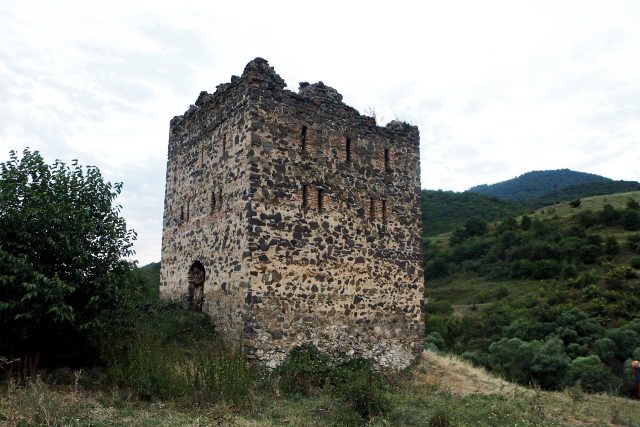
The Church of the Holy Mother of God in Voskepar feels like a place where time has quietly settled, leaving behind the quiet dignity of Armenia’s early Christian past. It stands on the edge of the village, surrounded by low hills where the air carries the scent of dry grass and woodsmoke from distant homes. The church is small, its silhouette unassuming yet striking in its simplicity—no ornate carvings or grand facades, just stone that seems to have grown from the earth itself, as if it has always belonged here.
Its history stretches back to the early Middle Ages, a period when Armenia was shaping its Christian identity. No one knows the exact year it was built, but the architecture tells its own story. The thick walls of dark tuff, the semicircular apses, and the sturdy, no-nonsense design are all hallmarks of Armenian churches from the 7th to 10th centuries. In those turbulent times, churches often doubled as fortresses, offering shelter during raids. That might explain why this one feels so solid, even in its modest size—built not just for prayer, but for survival.
Inside, the space is intimate, with low vaults that create a sense of shelter. The altar is lit by narrow windows, and when the sun is right, light slants across the walls, picking out the rough texture of the stone. The floor is laid with uneven slabs, and in places, faint traces of frescoes remain—ghostly outlines of saints that once adorned the walls. It’s a place where every detail feels purposeful, stripped of excess, as if the builders knew that beauty didn’t need embellishment.
Voskepar itself is one of those quiet Armenian villages that rarely makes it onto tourist maps, but that’s where its charm lies. Tucked in the northern Tavush region near the Georgian border, it’s a landscape of rolling hills and winding roads, where the mountains give way to valleys and the pace of life slows to match the rhythm of the land. The people here are reserved but welcoming. If you wander through the village, you might see women baking lavash in tonirs or elders sitting by their gates, talking in low voices. For them, the Church of the Holy Mother of God isn’t just an old building—it’s a living part of their world, where baptisms, weddings, and memorial services still take place.
The land around the church is open and quiet, with fields stretching toward the hills where sheep and cows graze. Summers are hot and dry, while winters can blanket the village in snow for weeks, cutting it off from the outside world. In those moments, the church becomes even more important—a symbol of endurance, a reminder that life here moves at its own unhurried pace. During the Soviet era, like many religious sites, it was closed, but the villagers kept it safe. After Armenia regained independence, the doors reopened, and it once again became a place of worship.
Today, the church draws a different kind of visitor—not crowds of tourists, but those who come seeking something quieter. There are no souvenir stalls or guided tours here, just the chance to sit on the steps, studying the old khachkars embedded in the walls, or listening to the silence broken only by birdsong and the distant chime of bells. Around the church, the remnants of an ancient cemetery lie half-hidden in the grass, its moss-covered gravestones carved with crosses that have stood for centuries.
Visiting the Church of the Holy Mother of God isn’t about ticking off a landmark. It’s more like stepping into a slower, older way of life. There’s no rush, no pressure to take the perfect photo or follow a set path. Just stone, sky, and the wind moving through the empty corridors, carrying whispers of the past. That’s what makes this place special—it doesn’t try to impress. It simply exists, as it has for hundreds of years, holding the memories of those who built it, prayed here, and eventually became part of its story.