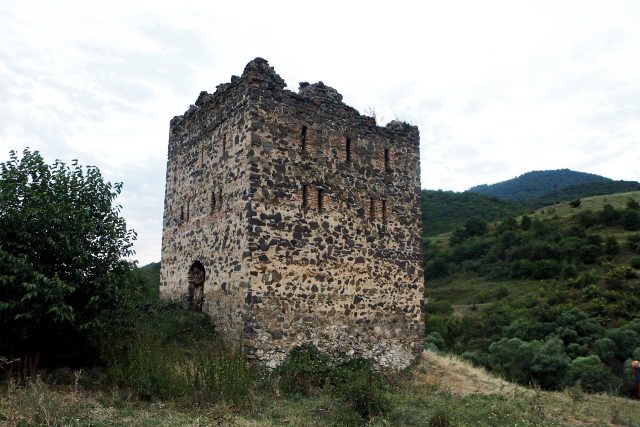
Perched on a gentle hill in the quiet village of Voskepar, the Church of Saint Stepanos feels like a place where time has paused, leaving behind the quiet rhythms of Armenia’s highland valleys. The surrounding landscape is unassuming—rolling green slopes give way to rocky gorges, and the air carries the scent of wild herbs and distant woodsmoke. The church itself is small, its silhouette unadorned yet striking in its simplicity. Built from local tuff stone, it seems to rise naturally from the earth, as if it has always been part of this land.
The origins of Saint Stepanos are rooted in Armenia’s early medieval period, a time when the country had already embraced Christianity as its state religion but still faced challenges in preserving its faith and identity. While the exact date of construction remains uncertain, the church’s architectural features—its cross-domed structure, thick walls, and modest carvings—place it somewhere between the 7th and 10th centuries. This was an era when Armenian architects were experimenting with new techniques, often building churches in remote locations to serve as spiritual anchors for scattered communities. Voskepar, situated at the crossroads of historical regions, likely played such a role, offering a place of worship and refuge in a landscape marked by both beauty and isolation.
The design of Saint Stepanos is characteristic of early medieval Armenian churches, though it has its own distinct qualities. The building is a small single-nave basilica with a semicircular apse facing east, where the altar once stood. The exterior is almost austere, with little decoration beyond narrow windows and a simple cornice beneath the roof. Inside, however, the space feels more expansive than it appears from the outside. Light filters through the slender windows, casting a soft glow over the stone vaults and creating an atmosphere of quiet reverence. The floor, once paved with slabs, now bears only the faint traces of its former state, worn smooth by centuries of use.
One of the few decorative elements is the entrance portal, modest compared to later Armenian churches but still meaningful. Above the doorway, a relief of a cross remains, carved in the rough yet expressive style of the early medieval period. For those who once worshipped here, the cross was more than a symbol—it was part of a visual language understood by all. Nearby, fragments of khachkars—carved stone slabs bearing crosses—lie scattered across the hillside. These remnants, like the church itself, speak of the people who once gathered here, their lives and beliefs etched into the stone.
Today, Voskepar is a small village where life moves at the pace of the seasons. The Church of Saint Stepanos is not a major tourist attraction, and that may be its greatest charm. There are no crowds, no souvenir stalls, no guided tours—just the quiet presence of the building and the landscape around it. The church is open to visitors, though the key is usually kept by locals. If you ask, an elderly villager might lead you inside, sharing stories of how the church once served as a gathering place, how it survived attempts to repurpose it during the Soviet era, and how it has endured the passage of time.
The area around Voskepar is dotted with fields and orchards, while the nearby hills are covered in forests where one can wander for hours without encountering another soul. Locals say that ancient paths once crisscrossed these lands, used by pilgrims traveling to more famous monasteries like Haghartsin or Goshavank. It’s possible that Saint Stepanos was one of the stops along the way—a place to rest, pray, and gather strength before continuing the journey. Though the paths have faded, traces of them remain: old stone slabs that once bridged streams or marked steep ascents, now half-hidden in the grass.
Visiting Saint Stepanos is less about ticking off a landmark and more about stepping into a place where past and present coexist almost imperceptibly. There are no explanatory signs, no marked trails, not even clear directions leading to the church. Yet this lack of formality is what makes the experience feel authentic. You might arrive in the early morning, when mist still lingers over the valley and the sun begins to gild the hilltops. Or you could stay until evening, when shadows stretch long and the air fills with the sounds of crickets, distant dogs, and the rustle of leaves. In these moments, the church feels alive, not as a relic but as a witness to centuries of quiet devotion.
For those interested in Armenia’s history, Saint Stepanos offers a chance to reflect on the country’s enduring resilience. Far from the bustle of cities and tourist routes, the connection between past and present feels especially strong here. The church has survived Arab invasions, Mongol raids, shifting empires, and ideological upheavals, yet it stands today much as it did centuries ago. Perhaps this is where Armenia’s true spirit lies—not in its grand cathedrals or famous monasteries, but in humble churches like this one, scattered across the countryside, where every stone holds the memory of those who built, prayed, and believed.