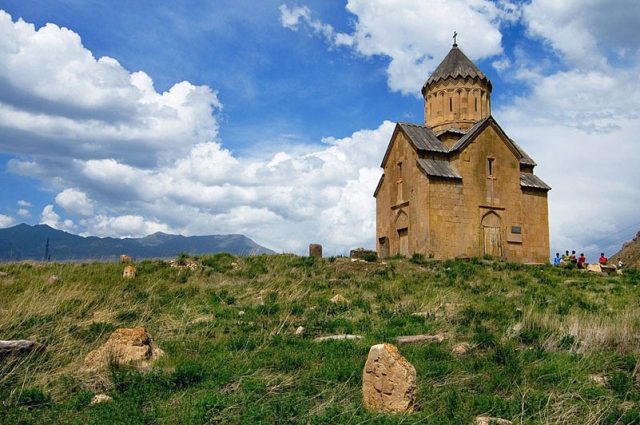
Byurakan is a quiet village nestled on the slopes of Mount Aragats, far from the usual tourist trails. At over fifteen hundred meters above sea level, the air here is crisp and clear, the sky closer than anywhere else in Armenia. But what truly draws visitors to this remote corner of the country isn’t just the breathtaking scenery—it’s the legacy of a man who put Byurakan on the map long before travelers began seeking it out. That man was Viktor Ambartsumian, the brilliant astrophysicist who founded the Byurakan Observatory and helped shape our understanding of the universe.
The monument to Viktor Ambartsumian stands near the observatory, in a place already steeped in history. It’s no accident that this spot was chosen. Here, amid the rugged mountain landscapes, Ambartsumian spent much of his life developing theories that would revolutionize astronomy. The monument itself is a bronze bust, simple yet striking. His face, captured in metal, appears both focused and serene—a reflection of how colleagues and students remember him: a man of deep thought, yet at peace with the mysteries he spent his life unraveling.
Born in 1908 in Tiflis (now Tbilisi) to an Armenian family, Ambartsumian showed an early aptitude for mathematics and physics. After graduating from Leningrad University, he dedicated himself to astrophysics, eventually establishing the Byurakan Observatory in 1946. This was a time when the secrets of stellar systems were just beginning to unfold, and Ambartsumian became a pioneer in the study of galaxy evolution. His groundbreaking work on stellar associations and active galactic nuclei earned him international acclaim, cementing his place as one of the most influential astronomers of the 20th century.
The observatory he founded isn’t just a scientific institution—it’s a symbol of Armenian science. Over the decades, astrophysicists from around the world have worked here, turning Byurakan into a kind of sanctuary for those devoted to the cosmos. The monument to Ambartsumian isn’t merely a tribute to one man’s achievements; it’s a reminder that even in a small village perched high in the mountains, ideas can take root and change the world.
The design of the monument is understated but deliberate. The bust rests on a modest pedestal of local stone, blending seamlessly with the surrounding landscape. Flowerbeds encircle the base, and pathways lead to a viewpoint overlooking the valley and the distant peaks. There’s no grandeur here, no pomp—just quiet reverence, a sense of connection to something vast and enduring.
Visiting the monument isn’t just a detour on the way to the observatory; it’s a chance to step into the history of science. In Byurakan, astronomy isn’t confined to textbooks or laboratories—it’s woven into the fabric of the place. The streets bear the names of celestial phenomena, and conversations among locals often turn to the observatory, where many have family or friends who’ve worked. Even if you’re not an expert in astrophysics, the atmosphere of intellectual curiosity is palpable. Time seems to slow here, inviting reflection on the stars, the universe, and the people who’ve dedicated their lives to understanding it.
The Byurakan Observatory and Ambartsumian’s monument are more than just landmarks—they’re part of Armenia’s cultural heritage. A country with a long tradition of scholarship, Armenia has produced poets, philosophers, and scientists who’ve left their mark on the world. Ambartsumian was one of them, proving that science could be as inspiring as art. His name is recognized globally, but in Armenia, he’s remembered not just as a brilliant mind but as a man who turned his homeland into a hub for astronomical research.
If you find yourself in Byurakan, don’t rush away. Take a moment at the monument, look out at the mountains, the sky, the observatory in the distance. It’s easy to imagine Ambartsumian standing here, pondering the mysteries of the cosmos. Perhaps this is where great discoveries begin—not in laboratories, but in moments of quiet contemplation. And for those who want to learn more, the observatory’s doors are always open, offering a glimpse into the work of modern astrophysicists. Byurakan isn’t just a village in the mountains; it’s a place where science becomes a way of life.