Perched on the slopes of Mount Aragats, Amberd Fortress feels like a natural extension of the rugged cliffs that cradle it. The name translates loosely to "fortress in the clouds," and on most days, that’s exactly where it seems to be—hovering above the mist that drifts through the Arkashen River gorge below. The location wasn’t chosen by chance. This was a crossroads, a place where ancient paths converged, leading toward the snow-capped peaks of Aragats or winding down into the heart of Armenia. For centuries, Amberd stood as both a guardian and a gateway, watching over the comings and goings of armies, merchants, and pilgrims who passed through these highlands.
The earliest records of Amberd date back to the seventh century, though it’s likely that some form of fortification existed here even earlier. The fortress flourished between the tenth and eleventh centuries under the rule of the Pahlavuni princes, one of Armenia’s most powerful noble families. They transformed Amberd into a nearly impregnable stronghold, designed to withstand prolonged sieges. Later, in the twelfth century, the Zakarid dynasty took control, reinforcing the walls and adding new towers. But like many Armenian fortresses, Amberd met a violent end—sacked by the Mongols in the thirteenth century and left to crumble in the centuries that followed.
What remains today is a hauntingly beautiful ruin. The fortress was built from massive basalt blocks, fitted together with such precision that no mortar was needed. The walls, some still standing several stories high, are nearly two meters thick in places. The surviving towers offer a glimpse of the structure’s former grandeur, while inside, you can make out the outlines of living quarters, water cisterns, and even a bathhouse heated by a hypocaust system—an early form of underfloor heating. The craftsmanship is striking, especially considering the harsh climate and remote location.
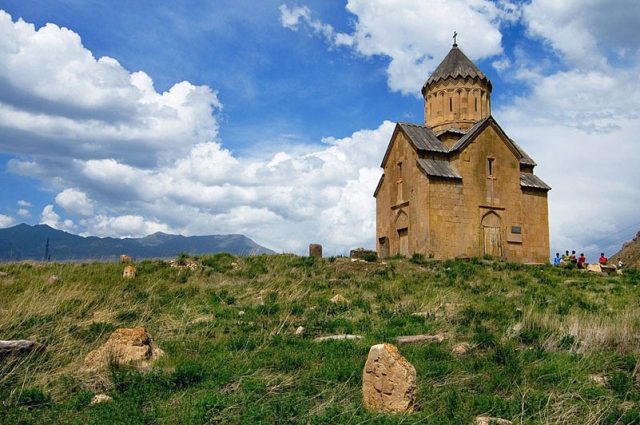
A short walk from the main fortress stands the Church of Vahramashen, built in the eleventh century. Unlike the dark basalt of the fortress, the church is constructed from lighter stone, its dome rising gracefully against the sky. The exterior is adorned with intricate carvings and Armenian inscriptions, while inside, faint traces of frescoes still cling to the walls. Outside, weathered khachkars—traditional Armenian cross-stones—dot the landscape, remnants of an old cemetery that once surrounded the church. Even after the fortress fell into disrepair, the church remained in use, and today it’s one of the best-preserved parts of the complex.
Visiting Amberd is a quiet, almost meditative experience. The path leading up to the fortress is steep, the air thin and sharp with the scent of wild herbs. There are no crowds here, just the sound of the wind and the distant rush of the river far below. On clear days, the view stretches across the valley, where the snow-capped peaks of Aragats loom in the distance. It’s easy to imagine the fortress as it once was—a bustling stronghold, alive with the voices of soldiers, the clatter of hooves, and the murmur of prayers drifting from the church.
Local legends add another layer to Amberd’s mystique. Some say the fortress hides the lost treasures of the Pahlavuni princes, buried somewhere beneath its ruins. Others claim that a mountain spirit once aided its defenders, turning back invaders with unseen forces. Even now, the site is treated with reverence by those who live nearby, as if the stones themselves hold some lingering power. Perhaps that’s why Amberd has survived at all—why it wasn’t dismantled for building materials or swallowed entirely by the earth.
There’s no museum here, no reconstructed halls or informational plaques—just the raw, unfiltered past. The stones don’t explain themselves; they simply endure. A day trip from Yerevan is possible, but the place rewards those who stay longer. The nearby village of Byurakan is home to a famous observatory, where astronomers once scanned the skies, and the surrounding mountains offer trails leading to waterfalls and ancient petroglyphs. In the valley below, small cafés serve hearty Armenian dishes, the kind meant to be eaten slowly, with time to spare.
Amberd is a reminder of how fleeting human achievements can be. Built to last, it now stands as a ruin, its walls slowly surrendering to time. Yet there’s something defiant in its survival. The fortress was meant to protect, but now it’s the other way around—it needs protection from neglect, from the slow creep of oblivion. Still, as long as people come here, as long as they walk its paths and touch its stones, Amberd isn’t truly abandoned. It remains a silent witness to the past, a place where history isn’t just remembered but felt.