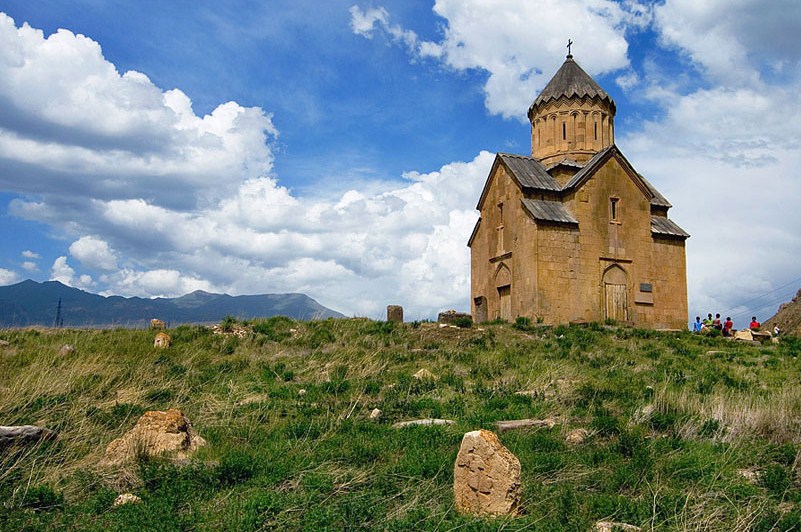
Perched on a gentle rise above the village of Byurakan, the Church of the Holy Mother of God feels like a quiet guardian of time. Its modest silhouette blends into the landscape, yet the building carries the weight of centuries with an understated dignity. Built in the seventh century, when Armenian ecclesiastical architecture was reaching its creative peak, the church is a testament to an era when places of worship were not just spiritual centers but also masterpieces of craftsmanship. The stonemasons who shaped its walls worked with a precision that still impresses today, balancing tradition with innovation in every cut of the pale tuff stone.
The church’s design follows the classic early medieval Armenian style, though it has its own subtle distinctions. The central dome rests on four sturdy columns, creating a cross-shaped interior that draws the eye upward. Outside, the structure is unadorned—clean lines and balanced proportions give it a timeless simplicity. The entrance is framed by a plain portal, once likely marked by an inscription or carving, though time has worn away most of these details. The stone itself, a soft golden hue in the late afternoon light, seems to glow against the rugged backdrop of the surrounding mountains.
Stepping inside, the atmosphere shifts. The air is cool and still, the silence broken only by the faint rustle of wind through the narrow windows. Light filters in, casting shifting patterns across the rough-hewn floor and the worn surfaces of the walls. The altar, as in all Armenian churches, faces east, a symbolic gesture toward rebirth and eternity. Fragments of frescoes cling to the stone in places, their faded colors hinting at the vibrant scenes that once covered these walls—biblical stories, intricate patterns, and the faces of saints now lost to time. Even in their decay, they offer a glimpse of the church’s former splendor.
Byurakan has long been a place of significance, and the church’s history is woven into the fabric of the village. In medieval times, the area was a hub of monastic life, its craftsmen and traders known far beyond the local valleys. The church has endured earthquakes, invasions, and shifting rulers, each time repaired by hands that sought to preserve its original form. During the Soviet era, when religious life in Armenia was suppressed, the building fell into disrepair, but the villagers never let it crumble entirely. Today, it stands as both a functioning place of worship and a monument to resilience, though services are held less frequently than in the past.
Beyond its architectural and historical value, the church is a living connection to Armenia’s early Christian heritage. It was built at a time when the faith was still taking root in these lands, and churches like this one served as beacons of belief and culture. Scattered around the site are khachkars—carved stone crosses that mark graves or commemorate events. Some are weathered beyond recognition, while others retain their intricate designs, each one a silent storyteller of the people who once lived, worked, and prayed here.
Visiting the Church of the Holy Mother of God is less about ticking off a tourist attraction and more about stepping into a slower, quieter rhythm. There are no crowds here, no guided tours rushing from one highlight to the next. Instead, there’s the stillness of the hills, the occasional cry of a bird, and the sense that the place has been waiting for you to arrive. Locals treat the church with quiet reverence, not as a relic but as part of their everyday world. You might see someone lighting a candle or kneeling in prayer, but more often, it simply stands, watching over the valley as it has for centuries.
From the hill where the church stands, the view is enough to make you pause. In the distance, Mount Aragats looms, its snow-capped peak visible even in summer, while closer in, the slopes are dotted with wildflowers and patches of green. On clear days, the air is so crisp that the mountains seem almost within reach. It’s a landscape that invites contemplation, a place where the boundaries between past and present blur. That might be why people come here—not just to see, but to feel, to sit for a while and let the weight of history settle around them.
The church isn’t grand or ornate, but its simplicity holds a kind of power. It doesn’t demand attention; it earns it, quietly. The stones remember the hands that laid them, the voices that echoed within these walls, the generations who found solace here. That memory lingers in the cool touch of the ancient walls, in the scent of dry grass underfoot, in the way the wind moves through the valley. Standing here, it’s easy to believe that some things endure, no matter how much the world changes. The Church of the Holy Mother of God is one of them.