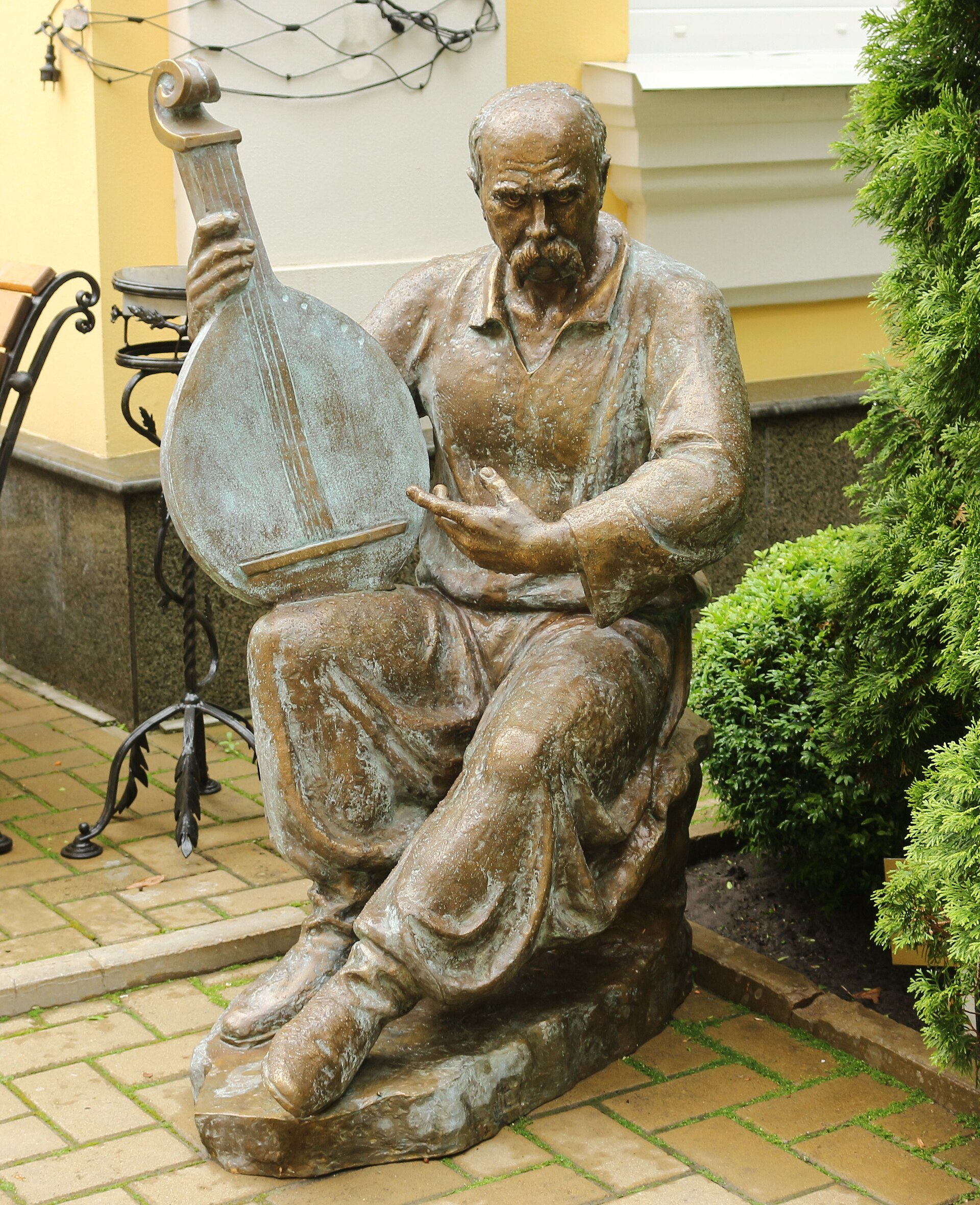
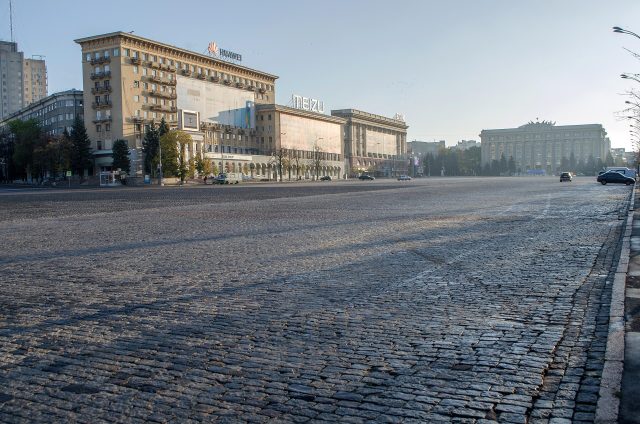
Kharkiv’s monument to Taras Shevchenko stands in the heart of the city, where the broad avenues of Svobody Square open up into a quiet, tree-lined space. It’s not the tallest or the most ornate statue in Ukraine, but its presence feels deliberate, almost understated—like a conversation between the past and the present that doesn’t need to shout. Shevchenko, the poet whose words became a foundation for modern Ukrainian identity, is depicted here in a moment of quiet reflection, one hand resting on a plinth, the other holding a book. The bronze figure doesn’t dominate the square so much as anchor it, inviting passersby to pause rather than imposing itself upon them.
The monument was unveiled in 1935, a time when Kharkiv was still the capital of Soviet Ukraine, and its creation reflects the complicated layers of history that define the city. Shevchenko, who died in 1861, was a figure of resistance—his poetry condemned serfdom and imperial oppression, and his work was banned in the Russian Empire for decades. Yet here he was, in the 1930s, being honored in a city that was then a center of Soviet power, where Ukrainian culture was both celebrated and controlled. The statue’s designer, Matvei Manizer, was a prominent Soviet sculptor, and the choice to place Shevchenko in Kharkiv, rather than Kyiv, carried its own significance. It was a way of claiming him for the broader Ukrainian narrative, even as the political winds shifted around it.
The square itself has changed over the decades, but the monument has remained a constant. In the 1950s, the area was redesigned, with fountains and flowerbeds added to soften the urban landscape. Later, during Ukraine’s independence, the statue became a gathering point for rallies and cultural events, a place where people would lay flowers on Shevchenko’s birthday or hold readings of his poetry. The surrounding buildings—many of them constructed in the Soviet era—tell their own story. The massive Derzhprom complex, with its constructivist architecture, looms nearby, a reminder of Kharkiv’s role as an industrial and administrative hub. The contrast between the monument’s human scale and the imposing structures around it is striking, as if the city is constantly negotiating between its grand ambitions and its quieter, more personal moments.
Shevchenko’s legacy in Kharkiv is more than just a statue, of course. The city has long been a center of Ukrainian intellectual and artistic life, and his influence is woven into its cultural fabric. The Kharkiv Literary Museum, not far from the square, dedicates an entire section to his work, displaying early editions of his poetry and personal artifacts. The local university, one of the oldest in Ukraine, has ties to the poet as well—many of its scholars and students have engaged with his writing over the years, interpreting and reinterpreting it for new generations. Even the language spoken in the streets around the monument reflects this duality: Russian and Ukrainian coexist here, sometimes in the same conversation, a reminder of the city’s layered identity.
What makes the monument feel alive, though, is not just its history but the way people interact with it. On any given day, you might see students sitting on the steps nearby, scrolling through their phones or chatting between classes. Older couples stroll past, sometimes stopping to read the inscription at the base. In the winter, the statue is often dusted with snow, its bronze surface taking on a muted sheen, while in the summer, the trees cast dappled shadows across the square. There’s no grand ceremony here, no tourist crowds jostling for photos—just the quiet rhythm of city life unfolding around it. That, in a way, feels like the most fitting tribute to Shevchenko: not a frozen relic, but a living part of the place.
The monument has also witnessed moments of upheaval. During the Euromaidan protests in 2013-2014, the square became a site of gatherings, with people laying flowers at Shevchenko’s feet as a symbol of solidarity. Later, after Russia’s full-scale invasion in 2022, the statue stood as a silent witness to the city’s resilience. Kharkiv, just 30 kilometers from the Russian border, became a frontline city, enduring shelling and displacement. Yet even in those difficult months, the monument remained a point of reference—a place where people could still come to reflect, to remember, or simply to feel connected to something larger than themselves.
There’s a certain irony in the fact that Shevchenko, who spent much of his life in exile and poverty, is now immortalized in bronze in one of Ukraine’s most industrialized cities. Kharkiv, with its factories and universities, its bustling markets and Soviet-era apartment blocks, is a far cry from the rural landscapes that inspired much of his poetry. But perhaps that’s the point. His words were never meant to be confined to one place or time. They were about the struggle for dignity, the fight against oppression, the search for identity—things that resonate whether you’re in a village in central Ukraine or a city of a million people.
If you visit the monument today, you won’t find a museum or a gift shop nearby. There’s no guided tour to explain its significance, no audio guide to walk you through its history. That might be why it feels so genuine. It’s not a spectacle; it’s a place where history and everyday life intersect, where the weight of the past meets the rhythm of the present. You might come here to pay your respects, or you might just pass by on your way to somewhere else. Either way, the statue will be there, as it has been for nearly a century, watching over the city with the same quiet intensity that defined the man it honors.