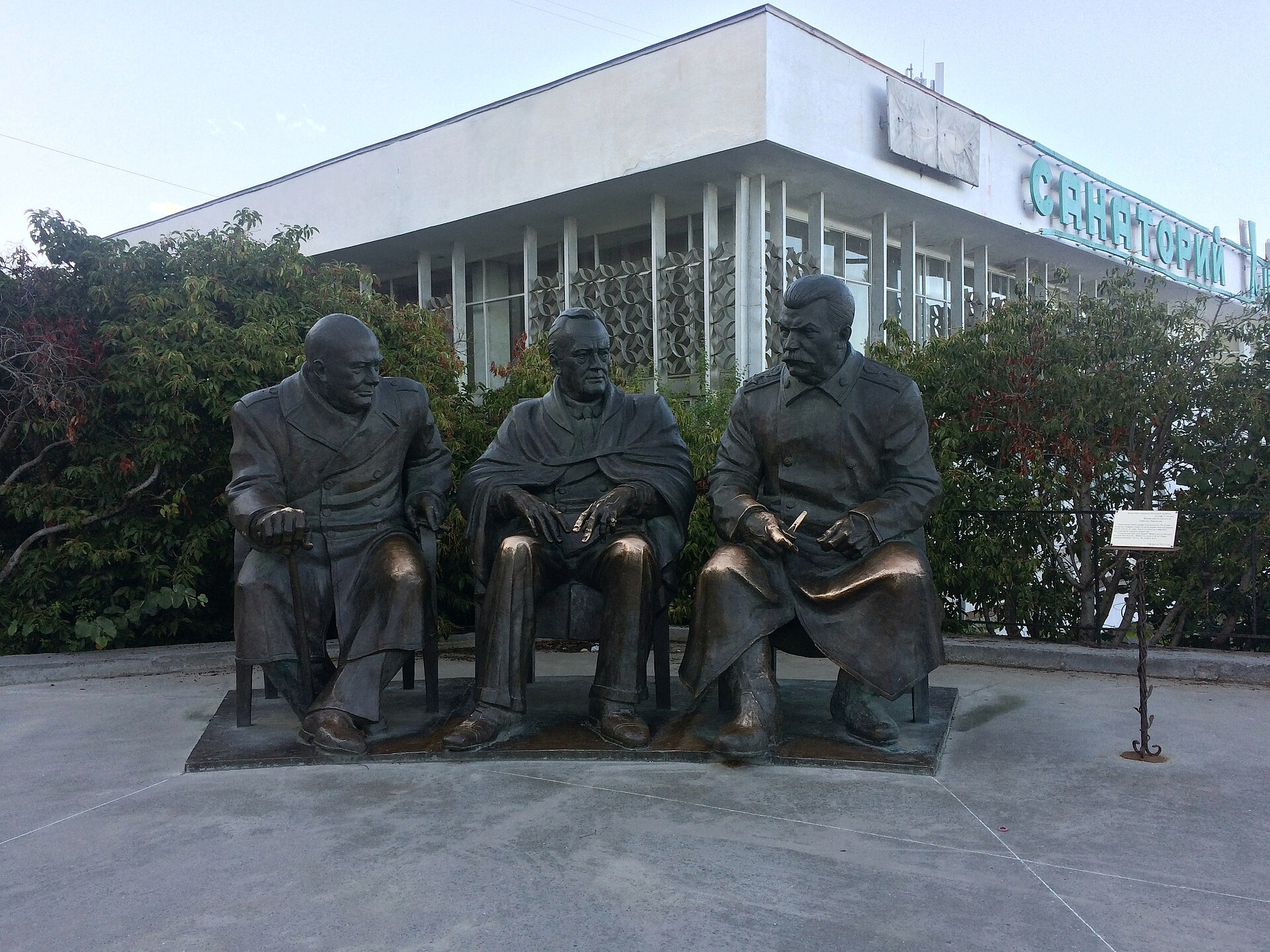
In Livadia, where the Black Sea stretches out beneath the Crimean hills, a quiet monument stands as a reminder of one of the most consequential meetings of the twentieth century. The bronze figures of Stalin, Roosevelt, and Churchill are frozen in a moment of uneasy alliance, their postures neither triumphant nor relaxed, but deliberate—three men who, despite profound differences, shaped the world’s future in a matter of days. The memorial doesn’t dominate the landscape; it blends into the grounds of the Livadia Palace, almost as if it has always been there, a natural extension of the history that unfolded within those walls.
The sculpture itself is unadorned, almost austere. There are no grand gestures or dramatic poses, just three leaders standing side by side, their expressions serious, their gazes directed toward something beyond the frame. The simplicity of the composition is deliberate—it doesn’t glorify the individuals, but rather the fragile unity they represented. The weight of their decisions is palpable in the way the figures are cast, the slight tension in their stances, the way Roosevelt’s hand rests on his cane, Stalin’s arms crossed, Churchill’s coat draped over his shoulders. It’s a snapshot of diplomacy at its most critical, when personal egos were set aside for the sake of a greater cause.
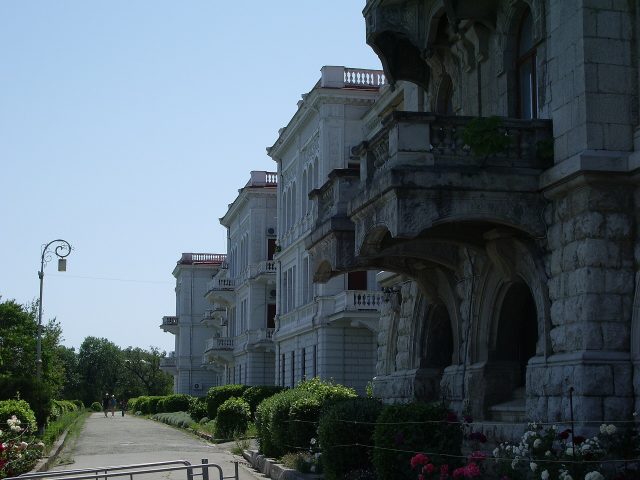
The Livadia Palace, with its white facades and arched windows, provides a fitting backdrop. Built in the early 1900s as a summer retreat for the Russian imperial family, it later became the stage for the Yalta Conference in February 1945. The choice of location wasn’t accidental—Crimea, with its mild climate and secluded setting, offered a neutral ground where the leaders could meet away from the prying eyes of the world. Behind closed doors, they debated the fate of postwar Europe, the division of Germany, the establishment of the United Nations, and the boundaries of influence in a world still smoldering from war. The decisions made here would echo for decades, shaping the Cold War and the geopolitical order that followed.
Today, the palace grounds feel suspended in time. The monument is rarely crowded; most visitors come not for spectacle, but for reflection. The sea breeze carries the scent of pine and salt, and the only sounds are the rustling of leaves and the occasional murmur of voices. You can walk the same paths where Stalin, Roosevelt, and Churchill once strolled, their conversations lost to history but their presence still lingering in the air. The palace itself, with its grand halls and ornate interiors, has been preserved much as it was during the conference, though now it serves as a museum, its exhibits detailing the events of those pivotal days.
What makes this place remarkable is its lack of pretension. There are no grand narratives of heroism or villainy, no attempts to rewrite history. The monument simply acknowledges a moment when three very different men, each with their own agendas, found a way to work together. It’s a rare example of how diplomacy, even under the most strained circumstances, can alter the course of history. The fact that the memorial exists at all—without controversy, without political overtones—speaks to its quiet power. It doesn’t demand admiration or agreement; it merely invites contemplation.
Standing before the bronze figures, it’s impossible not to wonder about the conversations that took place here. What compromises were made? What tensions simmered beneath the surface? The Yalta Conference was far from perfect—its outcomes were contentious, its legacy debated to this day. Yet the monument doesn’t dwell on those complexities. Instead, it captures something more universal: the idea that even in the darkest times, dialogue is possible. The leaders who met in Livadia were not friends, but for a brief period, they were allies, and that alliance changed the world.
The surrounding park, with its cypress trees and manicured lawns, adds to the sense of timelessness. It’s easy to imagine the three men walking these same paths, their aides trailing behind, maps and documents in hand, as they weighed the future of nations. The palace, with its mix of Italian Renaissance and Moorish Revival architecture, stands as a silent witness to it all. Its walls have seen the fall of empires, the rise of new orders, and the fragile hope of peace. The monument to Stalin, Roosevelt, and Churchill is just one small part of that history, but it’s a part that endures.
For those who visit, the experience is often understated. There are no guided tours urging you to feel a certain way, no dramatic reenactments. Instead, there’s space to think, to absorb the weight of what happened here. The monument doesn’t offer answers, but it does pose questions—about power, about compromise, about the cost of peace. In a world where diplomacy is often overshadowed by conflict, Livadia serves as a quiet reminder that even the most unlikely alliances can leave a lasting mark. The bronze figures, weathered by time and salt air, stand as testament to that truth.