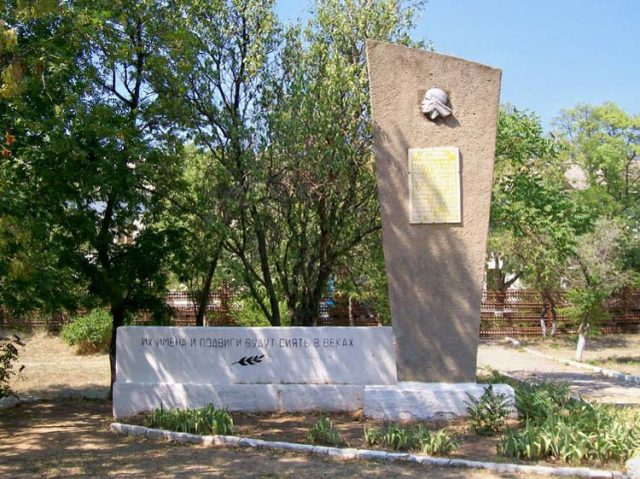
The monument to the aviators of the Kacha Flight School stands on the edge of Kacha, a quiet town near Sevastopol. This place was chosen for a reason—it was here, in what was once one of the Soviet Union’s most renowned aviation academies, that hundreds of pilots began their journey into the skies. Many of them would later become legends of military aviation. The memorial itself is unassuming but striking: a MiG-15 fighter jet mounted on a pedestal, a symbol of the era when Kacha was a forge of talent for the Soviet Air Force.
The school’s history dates back to 1910, when Russia’s first military flight school opened in Gatchina. After the revolution, it relocated to Sevastopol before settling in Kacha, where it remained until the collapse of the Soviet Union. Over the decades, thousands of cadets passed through its doors, many of whom defended the country’s skies during World War II. Among its graduates were famous aces as well as ordinary pilots whose names are still remembered in aviation history.
The monument wasn’t erected immediately after the school closed. It appeared later, as a tribute to those who had dedicated their lives to the skies. The MiG-15 chosen for the memorial wasn’t just any aircraft—it was the machine many Kacha graduates flew in the postwar years. It marked the transition from propeller-driven planes to jets, an era when Soviet military aviation was reaching new heights.
Kacha today is a peaceful town where life moves at an unhurried pace. There’s no tourist bustle here, and the monument blends into the local landscape rather than standing out as a major attraction. Yet for those interested in aviation history, this place holds special significance. It serves as a reminder that behind every flight, every combat mission, were people who had trained at the rigorous Kacha school.
A small park surrounds the monument, with benches where visitors can sit and reflect on the many lives connected to this place. In summer, the area is quiet, occasionally broken by the voices of locals or the rare visitor. In winter, the monument feels even more solitary, framed by bare trees and gray skies, but its meaning remains just as strong. It stands as a silent testament to the past, to those who once took to the skies from Kacha’s airfield.
The airfield itself, where cadets once trained, is now abandoned. Runways are overgrown with grass, and hangars slowly crumble. But the memory of what happened here lives on. Sometimes, locals share stories of how, in Soviet times, the skies above Kacha were always filled with the roar of aircraft, how cadets in blue overalls hurried to their lessons, and how the town echoed with marches and songs in the evenings.
The monument isn’t just a tribute to the past—it’s part of Kacha’s own history. The town was never large, but because of the flight school, it became known far beyond Crimea. Military families lived here, schools and shops operated, and clubs thrived. The academy wasn’t just an educational institution; it was a world that shaped the life of the entire town.
Today, Kacha remains a place where aviation history feels particularly vivid. The monument, the park, the abandoned airfield—all of it serves as a reminder that this was where the fates of individuals and the entire country were once decided. For those who visit, it’s a chance to connect with the past, to understand how those who tied their lives to the skies lived and what drove them.